

Five Canadian stories worth knowing this morning
By the North of Polite News Desk
Québec has a new government. Canada posted a surprisingly large trade surplus. Toronto’s housing market is sending another affordability warning. The Canadian Army is reorganizing. And a First Nation devastated by wildfire is confronting a remarkably basic question: what exactly are we rebuilding?
Here are five Canadian stories worth knowing today.
1. Québec elects the Parti Québécois — but this was not a referendum on Canada
The Parti Québécois is returning to government in Québec, but the numbers deserve considerably more attention than the headline.
Paul St-Pierre Plamondon’s PQ won 59 of the National Assembly’s 127 seats, leaving it five short of the 64 required for a majority government.
More strikingly, the PQ captured approximately 27.9 per cent of the popular vote.
That distinction matters.
The Parti Québécois is openly sovereigntist and St-Pierre Plamondon has pledged to eventually hold another referendum on Québec independence. But an election victory for a sovereigntist political party should not automatically be interpreted as 27.9 per cent of Quebecers voting to leave Canada.
Provincial elections are fought over health care, housing, immigration, language, taxes, leadership and dissatisfaction with the government of the day.
Polling has recently put support for Québec independence at roughly 30 per cent, well below a majority. St-Pierre Plamondon has also indicated that he does not intend to hold a referendum while Donald Trump remains president of the United States.
Still, Canada now enters an unusual period.
A sovereigntist government is returning to power in Québec while Alberta prepares for its own referendum-related political battle.
North of Polite takeaway: Québec elected a Parti Québécois government. Québec did not vote to leave Canada. Those are two very different things, and Canadians should be careful not to confuse them.
2. Canada just posted a $4.2-billion trade surplus — but look underneath the number
There was unexpectedly strong economic news this morning.
Canada recorded a $4.2-billion merchandise trade surplus in August, the largest in more than four years and far above economists’ expectations.
Exports increased while imports declined.
But there is an important wrinkle.
Canadian exports to the United States jumped 8.1 per cent, helping push Canada’s merchandise trade surplus with the U.S. to approximately $11.2 billion.
At the same time, Canadian exports to countries other than the United States fell 8.5 per cent.
That makes today’s good headline somewhat complicated.
Ottawa has spent considerable political capital talking about diversifying Canada’s trade and reducing the country’s economic dependence on a single customer.
Yet August’s strong trade performance was driven substantially by selling more to that customer.
Some exporters were also moving goods ahead of new U.S. tariffs, meaning September’s numbers may provide a clearer picture of the underlying trend.
North of Polite takeaway: A $4.2-billion surplus is good news. But if Canada’s objective is trade diversification, the more important question isn’t simply how much we exported. It’s where those exports went.
3. Toronto has homes for sale — buyers still aren’t buying them
Canada’s housing crisis produced another interesting number this morning.
Greater Toronto Area REALTORS reported 5,040 home sales in September, down nine per cent from September 2025.
There were approximately 16,500 new listings, down 14.4 per cent year-over-year.
Sales and new listings also declined from August after seasonal adjustment.
The Toronto Regional Real Estate Board says economic uncertainty, inflation and borrowing costs are keeping buyers on the sidelines.
This highlights something that can disappear from Canada’s housing debate.
Canada can simultaneously have a housing shortage and homes that people cannot afford to buy.
Building additional housing remains important. But supply alone doesn’t determine whether a family can purchase a home.
Price, mortgage costs, income, employment security and the ability to accumulate a down payment matter too.
A house can technically be available while remaining economically inaccessible to the person who needs it.
North of Polite takeaway: Counting houses isn’t enough. Canada’s housing problem ultimately has to be measured by whether ordinary Canadians can afford to live in them.
4. The Canadian Army is changing how it organizes itself
Canada’s military is undergoing a significant structural change that probably won’t receive as much public attention as a new fighter jet or ship.
The Canadian Army has reorganized around four primary formations:
1st Canadian Division — Edmonton
High-readiness forces and major operations abroad.
2nd Canadian Division — Montréal
Domestic operations, territorial defence, emergency response and sovereignty.
Canadian Army Support Division — Kingston
Infrastructure, technical expertise and operational support.
Canadian Army Doctrine and Training Centre — Kingston
Training, doctrine, professional development, experimentation and lessons learned.
The Department of National Defence says the restructuring is intended to give each formation a clearly defined mission and improve readiness.
And there’s another defence story happening today.
At CFB Suffield in Alberta, Canada is hosting innovators from six countries to demonstrate and test emerging counter-drone technology. Twenty-two participants were invited to the military’s Counter Uncrewed Aerial Systems Sandbox.
The two developments are connected by a larger question.
Canada has announced substantial new defence spending. Canadians should now watch whether that money produces measurable improvements in personnel, equipment, readiness and Canada’s ability to defend its own territory.
North of Polite takeaway: Defence spending shouldn’t be measured by the size of the cheque. It should eventually be measured by capability.
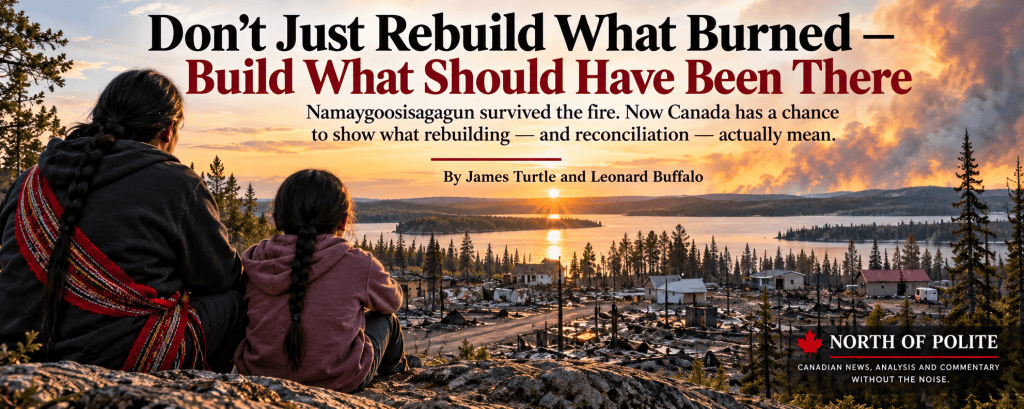
5. A First Nation survived a wildfire. Now comes the question: what exactly gets rebuilt?
This may be the smallest story in today’s Morning Five geographically.
It may also be one of the most important.
In July, members of Namaygoosisagagun First Nation in northwestern Ontario fled by boat as wildfire swept through their community.
Chief Helen Paavola met Indigenous Services Minister Mandy Gull-Masty on September 29 to discuss rebuilding.
But the community faces an unusual complication.
Namaygoosisagagun is not recognized under the Indian Act and has been negotiating its status with Ottawa since 2018. That means the normal federal mechanisms available to recognized First Nations don’t necessarily apply in the same way.
According to APTN News, Ottawa has indicated that it will help.
But Paavola raised the question that should probably guide the entire process:
What exactly are they rebuilding?
That means determining how many homes and structures are required — but it should also mean looking at infrastructure, water, power, emergency access and what the community will need years from now.
Rebuilding exactly what existed before a disaster isn’t necessarily the same thing as rebuilding properly.
North of Polite takeaway: This is a story worth following after the cameras leave. Watch what Ottawa promises, how much money is committed, who administers it — and eventually, what actually gets built.
The bigger picture
Today’s five stories don’t point in one political direction.
That’s precisely the point.
Québec’s election raises legitimate questions about national unity without proving Quebecers suddenly want independence.
Canada’s trade surplus is genuinely encouraging while simultaneously showing continued dependence on the United States.
Toronto’s housing numbers remind us that supply and affordability aren’t interchangeable.
Canada’s military is reorganizing while billions of new defence dollars begin moving through the system.
And a tiny northern Ontario community is asking Ottawa a question that governments everywhere should have to answer after disaster:
What are we actually trying to build?
Five stories. Five different parts of Canada.
No party gets a free pass. The numbers get context. And the evidence gets the last word.
North of Polite — Canadian news, analysis and commentary without the noise.
© 2026 North of Polite. Original reporting, analysis and commentary. All rights reserved. 🍁


Leave a comment