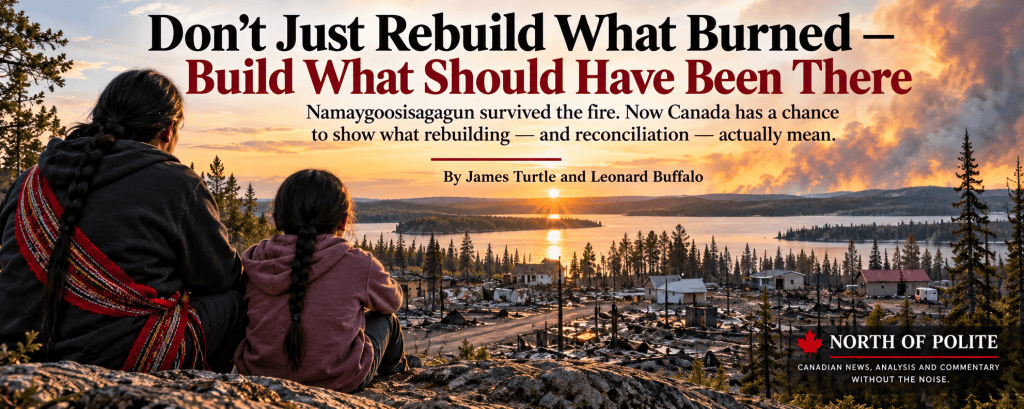
Namaygoosisagagun survived the fire. Now Canada has a chance to show what rebuilding — and reconciliation — actually mean.
By James Turtle and Leonard Buffalo | North of Polite
When wildfire swept toward Namaygoosisagagun First Nation in northwestern Ontario in July, there wasn’t time for a carefully organized evacuation.
There were minutes.
Community members grabbed what they could, ran for the water and escaped in boats as fire moved through their home on Collins Lake.
One resident told APTN News they had “literally had minutes” to get into the boats and flee. The community was devastated by the fire.
They survived.
Now comes a different challenge.
What happens when they go home?
Chief Helen Paavola met Indigenous Services Minister Mandy Gull-Masty on September 29 to discuss rebuilding the community.
And Paavola asked perhaps the most important question anyone could ask:
What are we rebuilding?
It sounds simple.
It isn’t.
Rebuilding what existed isn’t necessarily enough
Governments are very good at talking about rebuilding after disasters.
Count the destroyed structures. Calculate replacement costs. Announce funding. Build replacements.
But suppose what existed before the fire was already inadequate.
Should Canada simply reproduce it?
Rebuilding a remote Indigenous community shouldn’t mean drawing a line around what stood there before the fire and attempting to put everything back exactly as it was.
It should begin by asking the people who actually live there what their community needs.
How many homes?
What kind of homes?
What water infrastructure?
What power system?
What communications?
What emergency equipment?
What evacuation capacity?
What transportation infrastructure?
What does the community need not simply to return — but to remain safely on its land for another generation?
Those questions become even more important in Namaygoosisagagun because its relationship with Ottawa is unusually complicated.
A First Nation caught between definitions
Namaygoosisagagun is a First Nation whose members are Status Indians, but the community itself is not currently recognized by Canada as a band under the Indian Act.
The community has been pursuing federal recognition for years and filed an application in Federal Court in December 2018.
That bureaucratic distinction has very real consequences.
Namaygoosisagagun does not fit neatly into the same federal system as First Nations recognized as bands under the Indian Act.
And after the July fire, that uncertainty was anything but theoretical.
Community members fled for their lives by boat. The Anishinabek Nation subsequently said residents carried out the evacuation without the support of emergency services.
Now the unresolved recognition issue hangs over rebuilding as well.
Minister Gull-Masty has said Ottawa will help rebuild the community, although exactly what that rebuilding will look like remains to be determined.
Good.
Now Canadians should watch what “help” actually means.
Because reconciliation cannot exist only when the paperwork is convenient.
This is where accountability begins
There is another mistake Canada should avoid.
We should not measure success simply by announcing a large dollar figure.
Whether Ottawa eventually commits $10 million, $20 million, $50 million or some other amount, the size of the number alone will tell us very little.
We need to know:
What is the money intended to build?
Who receives it?
Who manages the projects?
How much reaches actual construction?
What deadlines are attached?
Who verifies that the work was completed?
And, most importantly, does the community itself have meaningful control over what gets built?
Accountability and Indigenous self-determination are not opposing ideas.
They should reinforce one another.
Public money should be traceable. Contracts should be understandable. Results should be measurable.
But the people of Namaygoosisagagun should not have Ottawa designing their future from an office hundreds of kilometres away.
The community knows what it lost.
It also knows what it never had.
Don’t rebuild yesterday
There is something bigger buried inside Chief Paavola’s question.
Canada has spent years talking about reconciliation.
Here is an opportunity to demonstrate what that word means when there is no ceremony, no commemorative plaque and no political speech.
A community was devastated.
Its residents survived.
They want to return home.
So don’t simply recreate the weaknesses that existed before the fire.
Build homes suited to northern conditions.
Build dependable infrastructure.
Build emergency capacity so people aren’t left scrambling for boats the next time disaster approaches.
Listen to Elders.
Listen to families.
Listen to the people who actually intend to live there.
And establish transparent accounting from the beginning so Canadians — and especially the people of Namaygoosisagagun — can see where every rebuilding dollar goes.
Then keep watching after the announcement.
Six months later.
A year later.
Three years later.
Because governments should not receive credit for promising to rebuild a community.
They should receive credit when the community is rebuilt.
We intend to come back
North of Polite isn’t going to declare this story finished when Ottawa announces a funding package.
We intend to follow it.
When money is committed, we’ll look at the commitment.
When contracts are awarded, we’ll look at the contracts.
When construction begins, we’ll look at what is being built.
And eventually we’ll ask the simplest question of all:
Did Canada do what it said it would do?
Namaygoosisagagun survived the fire.
Now Canada has an opportunity to help the community build something stronger than what the flames took away.
It should not waste it.
— James Turtle & Leonard Buffalo
North of Polite
Canadian news, analysis and commentary without the noise.
© 2026 North of Polite. Original reporting, analysis and commentary. All rights reserved. 🍁


Leave a comment