
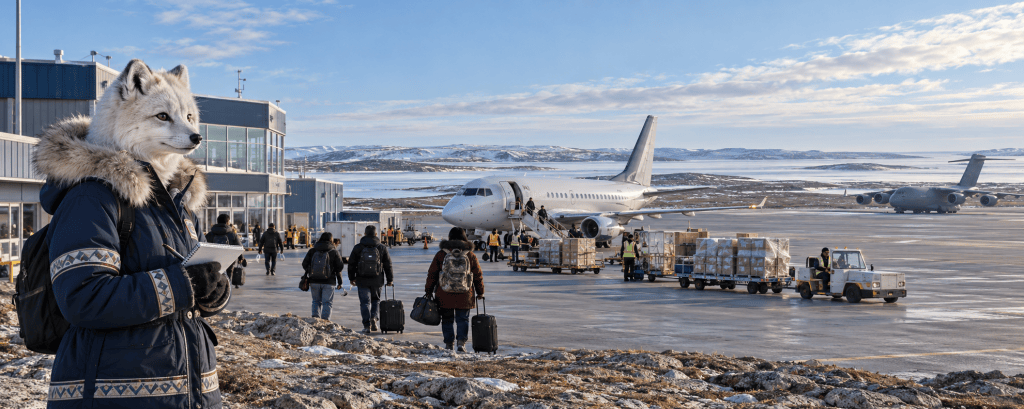
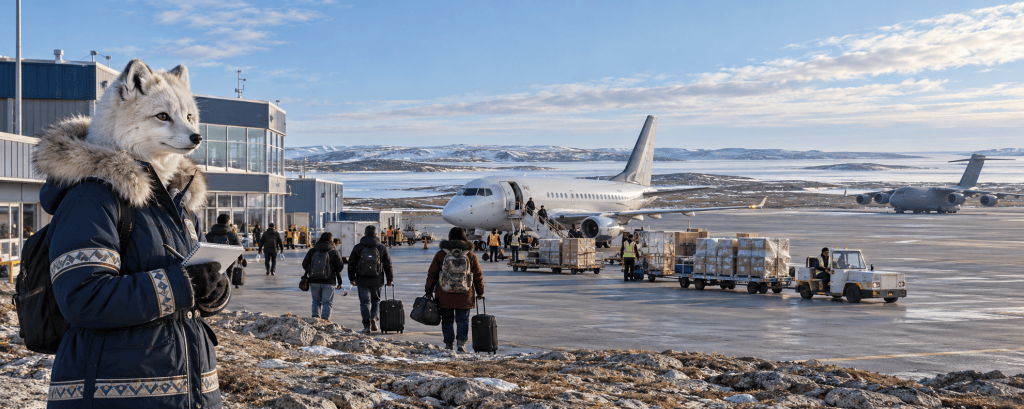
Rankin Inlet has a larger terminal and $85.5 million promised for its airfield. Now Canada must decide whether it is repairing northern infrastructure—or finally building a national transportation plan for the North.
By Nora Tiriganiaq | Arctic Correspondent
In much of southern Canada, an airport is the place between the parking lot and the vacation.
In Rankin Inlet, it is something much more basic.
It is how patients reach medical care that is not available at home. It is how food, medicine and essential supplies arrive. It is how families remain connected across communities separated by tundra, water and hundreds of kilometres without roads between them.
That is why the opening of Rankin Inlet’s new air terminal deserves to be measured by more than a ribbon, a collection of speeches and the usual supply of government adjectives.
The better question is this:
What does a better airport actually change for the people who depend on it—and what should Canada build next?
A terminal already in use
Airline operations moved into the new terminal on June 23, 2026. The formal opening took place on September 28.
The Government of Nunavut says the building is fully accessible and barrier-free, with additional seating and more space than the facility it replaced. It also showcases art and craftwork from the Kivalliq region.
Those improvements may sound modest beside the price tag and the national discussion about Arctic sovereignty.
They are not modest to an Elder waiting for a flight, a passenger with limited mobility, a parent managing children and luggage, or a medical traveller already carrying more worry than baggage.
A larger waiting area will not shorten the distance to Winnipeg. A barrier-free terminal will not create a medical specialist who does not live in the community.
But accessibility, comfort and dignity still count—particularly in a transportation system people often use because they have no practical alternative.
The federal government contributed nearly $63.5 million through the National Trade Corridors Fund toward the terminal project.
That completed terminal should not be confused with the separate $85.5-million announcement made during the September opening ceremony.
The terminal is operating.
The newly announced money is for the airfield.
The runway is the next job
The $85.5 million from the federal Arctic Infrastructure Fund is intended to rehabilitate the runway, taxiways and apron surfaces.
Transport Canada says the work will cover approximately 141,000 square metres and is expected to extend the pavement’s service life by 15 to 20 years while reducing long-term maintenance requirements.
Those are plans and projected benefits—not completed results.
Rankin Inlet Airport has one asphalt runway. It serves as a gateway and distribution point for the Kivalliq region, handling passengers, cargo, emergency services and medical transportation.
If that strip of pavement becomes unreliable, the consequences do not remain inside the airport fence.
They reach health care, store shelves, local businesses and families waiting for someone to come home.
Ottawa says the rehabilitation will improve safety, reliability and capacity. That is the promise.
The evidence will come later: in the work completed, the condition of the airfield and the years of dependable service actually delivered.
Governments announce money in one tense. Residents experience the results in another.
A civilian lifeline and a military asset
Rankin Inlet Airport also serves as a Department of National Defence forward operating location. Its 6,000-foot runway can accommodate military aircraft, and Ottawa describes the latest investment as dual-use infrastructure serving civilian and defence requirements.
That defence role is real.
So is the renewed attention being paid to Canadian sovereignty and security in the Arctic.
But a northern airport should not have to become strategically fashionable before its civilian importance is understood.
Nunavummiut—the people of Nunavut—do not need southern Canada to rediscover them whenever Arctic sovereignty returns to the headlines. They need Canada to become a dependable partner.
People in Rankin Inlet and across the Kivalliq did not begin needing reliable transportation when politicians in Ottawa started pointing north again.
They needed it yesterday. They need it today. They will continue needing it after the speeches about sovereignty move on to the next announcement.
Defence investment can help deliver infrastructure that communities also require. The test is whether the civilian half of “dual use” remains a genuine priority rather than a convenient line in a news release.
As the work proceeds, residents deserve practical answers. When will construction begin? How will airport operations be maintained? Will Inuit workers and businesses participate? How will progress be measured? Will residents be told plainly when costs or timelines change?
Those are not hostile questions.
They are what public accountability looks like when public money meets essential infrastructure.
The lesson of the qulliq
The official opening included the lighting of a qulliq, the traditional Inuit oil lamp.
It was a fitting beginning.
A qulliq is not loud or imposing, but it provides light and warmth—perhaps a better image for Canadian sovereignty than another politician standing beside a flag and pointing north.
Canada does not need to reclaim the Arctic through aggression. The Arctic is already part of Canada, and Inuit have lived there since long before Canada existed.
What Canada must reclaim is its responsibility to the Arctic.
Sovereignty is not demonstrated only by sending soldiers north, flying patrols or drawing firm lines on maps. It is strengthened when Canadians can build lasting communities, travel safely, communicate reliably, receive essential goods and obtain medical care without every ordinary necessity becoming an extraordinary logistical exercise.
An improved airport contributes to that goal.
But it also raises a larger question.
Why stop at the airport?
If reliable transportation is essential to northern life—and if infrastructure is essential to Arctic sovereignty—why is Canada not having a larger national conversation about roads, ports, energy corridors and even the long-term possibilities for rail?
Aviation will always be necessary in the Arctic. The distances are immense, the terrain is difficult and many communities are too isolated for conventional southern transportation systems.
But depending so heavily on aircraft also means depending on expensive fuel, limited cargo capacity, unpredictable weather and airfares that would make many southern Canadians reconsider leaving the house.
The Government of Nunavut is studying a possible 725-kilometre road connecting Arviat, Whale Cove, Rankin Inlet, Chesterfield Inlet and Baker Lake.
The proposed route could complement the Kivalliq Hydro-Fibre Link, a planned 1,200-kilometre transmission and fibre-optic connection between Manitoba and the Kivalliq region. The project is intended to bring hydroelectricity and high-speed internet to communities that currently depend heavily on imported diesel and satellite communications.
Neither project would be simple.
Permafrost, wetlands, rivers, immense distances and a changing climate make northern construction extraordinarily difficult. Development can also affect wildlife, harvesting areas and the land on which Inuit communities depend.
Any road, port, railway or energy corridor must therefore be planned with Inuit—not presented to them after the important decisions have been made.
In Inuktut, Piliriqatigiinniq means working together for a common cause.
That principle offers Canada a better model for Arctic nation-building than decisions made in Ottawa and delivered north in a news release.
It means combining national resources with local knowledge. It means ensuring Inuit communities help determine where projects go, how they are built, who receives the work and how the land is protected.
It also requires Qanuqtuurniq—being innovative and resourceful when solving difficult problems.
Canada once built railways across mountains, highways through rock and ports on three oceans because earlier generations understood that infrastructure does more than move people and goods.
It creates permanent connections.
Rail to Rankin Inlet is not an approved government project, and it should not be presented as an easy or immediate answer. The engineering and cost could be enormous.
But why should rail, roads and marine connections not be part of Canada’s long-term northern conversation?
If an airport runway strengthens sovereignty, would a road connecting five Kivalliq communities not strengthen it too?
Would reliable ports, clean electricity and communications infrastructure not serve residents, emergency services, businesses and national defence at the same time?
The question is not whether Canada should replace aviation.
It is whether aviation should remain the only practical answer to almost every northern transportation problem.
What the airport cannot promise
Neither the terminal nor the airfield rehabilitation guarantees cheaper airline tickets or lower grocery prices.
Neither can eliminate bad weather, aircraft shortages or the other pressures that make northern air travel difficult and expensive.
The projects may improve the conditions in which airlines, emergency services and cargo operators work. They may reduce infrastructure-related risks and improve the passenger experience.
But claims about lower fares, cheaper food or fewer cancellations would require evidence that is not yet available.
That is not a reason to dismiss the investment.
It is a reason to describe it honestly.
The terminal is a completed and visible improvement. The airfield rehabilitation is a funded promise that must still be delivered.
A broader northern transportation network remains a national question that Canada has barely begun to answer.
Showing up—and staying
From Ottawa, Rankin Inlet Airport can be described as a trade corridor, a defence asset and a piece of nation-building infrastructure.
From the departure lounge, it is where someone waits to see a doctor, receives a shipment of medicine, begins a school trip, returns to family or watches the weather and hopes the flight can leave.
Both perspectives matter.
Only one begins with the people who use the airport every day.
Canada does not need to reclaim its Arctic territory from the people who live there. It needs to reclaim its obligation to build alongside them.
Not aggressively. Not carelessly. Not by treating the North as an empty frontier waiting for someone in the South to discover it.
The new Rankin Inlet terminal is useful. The runway rehabilitation is necessary. Both deserve recognition.
Canada should still ask whether it is funding individual northern projects—or finally building a northern transportation system.
The ribbon was cut on September 28.
But the real measure of this airport will be whether travel becomes safer, more dependable and more humane for the people whose ordinary lives pass through it.
In the North, flying is not always a luxury or even a choice.
Sometimes it is simply how life works.
And it is about time the rest of Canada understood that Arctic sovereignty begins there.
© 2026 North of Polite. Original reporting, analysis and commentary. All rights reserved. 🍁



Leave a comment