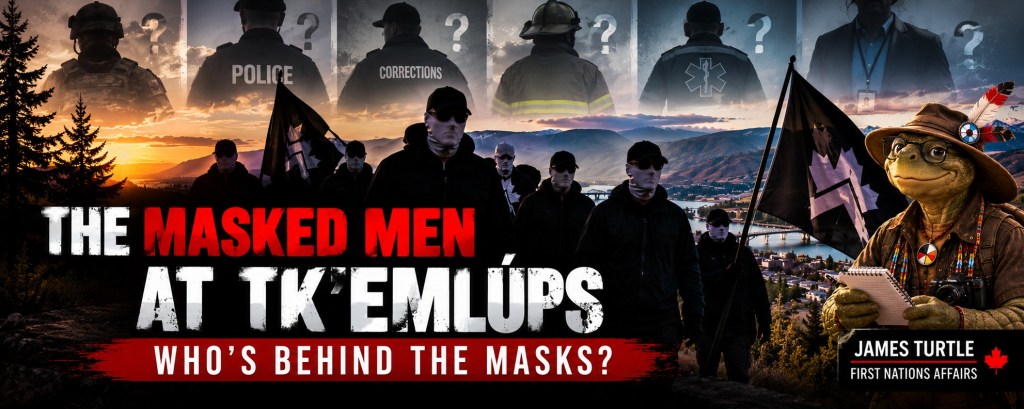
Days before National Day for Truth and Reconciliation, masked men associated with a white-nationalist movement appeared in the Tk’emlúps te Secwépemc community near Kamloops, B.C. Who are they—and what exactly is happening in Canada?
By James Turtle | First Nations Affairs | North of Polite
On Sunday morning, a group of masked men dressed largely in black appeared in the Tk’emlúps te Secwépemc community near Kamloops.
Some carried flags.
Several appeared to wear insignia associated with Second Sons Canada, a white-nationalist organization linked to the broader Active Club movement.
Later that day, photographs appeared to show members of the group on a Kamloops overpass behind a banner carrying two words:
“Got Bones?”
All of this happened two days before Canada’s National Day for Truth and Reconciliation.
That deserves more than outrage.
It deserves questions.
WHY TK’EMLÚPS?
Tk’emlúps is not just another location.
In 2021, the Nation announced that ground-penetrating radar had identified 215 potential burial sites associated with the former Kamloops Indian Residential School.
That history makes the appearance of masked white nationalists—and particularly the later “Got Bones?” banner—deeply concerning.
Kúkwpi7 Rosanne Casimir told community members that people believed to be associated with Second Sons had been observed in the community and that Tk’emlúps security and RCMP responded.
Police are investigating.
But one question remains unanswered:
Why Tk’emlúps?
The location, timing and banner invite an obvious interpretation.
But an interpretation isn’t evidence.
Until investigators establish a motive, or those involved explain it themselves, North of Polite won’t pretend to know.
There is, however, a historical problem with the ideology these groups promote.
White nationalism rests on the idea that Canada is fundamentally the inheritance of white Europeans.
Tk’emlúps itself presents a rather inconvenient problem with that story.
The Secwépemc were here before Canada.
Before British Columbia.
Before the British.
Before the French.
Before anyone thought to draw the borders these men now claim to be defending.
WHO ARE SECOND SONS CANADA?
Second Sons describes itself as a men’s organization centred around physical fitness, fraternity, activism and what it considers Canada’s traditional identity.
Researchers place it within Canada’s broader Active Club movement.
The RCMP describes Active Clubs as decentralized white-supremacist and neo-Nazi cells combining physical and combat training with extremist ideology.
Authorities have also documented connections between parts of Canada’s Active Club network and people previously associated with other white-supremacist organizations.
That does not mean every person associated with an Active Club is a terrorist.
But let’s not confuse that distinction with neutrality.
If someone knowingly joins an organization built around white-nationalist or white-supremacist ideas, they are choosing to associate themselves with a racial ideology. Whatever label an individual member prefers for himself, that ideology is racist.
Second Sons Canada itself is not currently listed by Canada as a terrorist entity.
That distinction matters.
Not every racist is a terrorist. That doesn’t make the racism disappear.
And there’s another problem with the idea of restoring some historically white Canada:
There wasn’t one.
Indigenous nations occupied these lands for thousands of years before Europeans arrived.
Even European colonial Canada wasn’t exclusively white.
Black people were present in the early history of what became Canada. Mathieu Da Costa, a free Black interpreter, worked with European explorers during the earliest period of French colonization.
Canada’s diversity isn’t something somebody invented in the 21st century.
It’s woven through the country’s history.
THEY’VE BEEN STEPPING INTO PUBLIC VIEW
Earlier this year, masked members appeared in Shawinigan, Quebec, displaying a banner declaring:
“Je me souviens d’un Québec blanc.”
In English:
“I remember a white Quebec.”
Second Sons co-founder Jeremy MacKenzie subsequently confirmed that members of his organization were responsible.
There is one small historical problem with the slogan:
Quebec has never been white.
Long before there was a Quebec—or a Canada—the territory was home to Indigenous nations.
The Quebec that followed was shaped by Indigenous peoples, French and British settlers, Black communities and generations of immigrants.
You cannot “remember” a racially homogeneous Quebec that never existed.
Other demonstrations attributed to Second Sons have appeared elsewhere in Canada.
The formula is becoming recognizable:
Black clothing.
White masks.
Flags.
Physical fitness and fraternity.
A public demonstration designed to create images that travel much farther online than the participants themselves ever could.
The masks hide the individuals.
The internet carries the message.
WHO’S BEHIND THE MASKS?
There is another irony here.
A movement presenting itself as the defender of Canadian identity apparently needs to hide the identities of the Canadians doing the defending.
And those masks raise a question that goes beyond embarrassment.
Who is behind them?
A mechanic? A construction worker? A teacher?
A firefighter or paramedic?
A police officer, corrections officer or sheriff?
A civil servant?
A serving member of the Canadian Armed Forces?
We don’t know.
And North of Polite has no evidence that any of the people photographed at Tk’emlúps hold any of those jobs.
That’s important.
But so is the broader question:
Do the institutions Canadians trust know whether people involved with white-nationalist organizations are working within their ranks?
Canada has acknowledged extremist and hateful conduct within parts of the military, while Canadian law-enforcement institutions have also confronted cases and concerns involving extremist beliefs.
None of that identifies the people photographed at Tk’emlúps.
But it does make a broader question worth asking:
What happens when someone takes the mask off Sunday night and puts on a uniform—or an employee ID—Monday morning?
There is no evidence presently establishing that this describes any of the people photographed at Tk’emlúps.
It is a question about something larger than those particular men.
HOW BIG IS THIS?
We don’t know.
And that’s important too.
Second Sons claims a presence across Canada, while researchers have identified a broader network of Active Club-style organizations operating nationally.
But North of Polite has not found reliable independent numbers establishing how many people actually belong to Second Sons.
We shouldn’t inflate a fringe movement simply because it knows how to attract attention.
Twenty masked people photographed in the right place can look considerably larger online.
But small numbers don’t automatically make a movement harmless either.
Intimidation doesn’t require a majority.
Being loud is not the same thing as being numerous.
THEN THERE’S THE MILITARY QUESTION
Second Sons says on its own website that many of its members are former military or come from related fields.
MacKenzie himself served with the Canadian Armed Forces in Afghanistan.
That doesn’t mean Canada’s military created Second Sons.
And it certainly doesn’t mean Canadian veterans generally share these beliefs.
But military experience can bring skills that an organized extremist movement could value: leadership, discipline, communications, logistics and knowledge of military organization.
That changes the question.
Who is recruiting people with those skills—and who do the recruiters represent?
Are recruiters acting for small, independent Canadian groups?
Are they connected to a larger Canadian network?
Are Canadian organizations connected operationally or ideologically to movements outside the country?
Who provides the ideology?
Who provides organizational support?
Who pays for travel, equipment, banners, websites and events?
Is money moving between organizations?
Are individuals moving between them?
And when one organization disappears, changes its name or splinters, do the same people simply reappear somewhere else?
Those are questions.
They are not conclusions.
The Active Club movement is international, and Canadian authorities have documented connections between Canadian extremists and organizations or individuals outside Canada.
But that doesn’t establish that Second Sons—or the men photographed at Tk’emlúps—are being directed or financed by some larger organization.
That requires evidence.
The military connection raises another set of questions.
Are people entering the Canadian Armed Forces already holding extremist beliefs?
Are some encountering those beliefs while serving?
Are veterans being deliberately identified and recruited after they leave?
Does informal peer culture play a role?
What about instructors?
Basic training?
Occupation-specific training?
Army, Navy or Air Force?
Regular Force or Reserves?
Particular trades or units?
North of Polite has not found evidence establishing that Canadian military instructors systematically teach or promote white nationalism.
But Canada’s military acknowledges extremist activity exists within and around its ranks.
So perhaps Canadians need to look at both ends of the pipeline:
Who is being recruited?
And more importantly:
Who is doing the recruiting?
If people with military experience are deliberately sought by extremist organizations, knowing who is doing the recruiting—and what networks those recruiters belong to—could tell Canadians considerably more than simply counting the people who eventually join.
Those are questions worth asking.
And worth remembering as more information emerges.
The Canadian Armed Forces doesn’t exist to defend a racial identity.
It serves Canada.
And Canada has never belonged to one race.
THIS IS BIGGER THAN TWENTY MASKED MEN
The people photographed at Tk’emlúps should not be mistaken for Canada.
Nor should every racist organization automatically be labelled a terrorist organization.
Precision matters.
But Canadian authorities themselves recognize violent white-supremacist and neo-Nazi extremism as a genuine security concern.
Now masked people apparently associated with that broader ideological movement have appeared in an Indigenous community just before National Day for Truth and Reconciliation.
The appropriate response isn’t panic.
It’s scrutiny.
Who are they?
How many are there?
Who is behind the masks?
Who recruits them?
Who funds the organizations?
Who connects the groups?
And why Tk’emlúps?
But perhaps there’s another question worth asking these self-appointed defenders of Canadian identity:
Which Canada are they defending?
Not the Indigenous Canada that existed before Europeans arrived.
Not the early colonial Canada where Indigenous, European and African people were already encountering one another centuries ago.
And certainly not the Canada that actually exists today.
White nationalism requires a version of Canadian history in which the country once belonged exclusively to white people and can therefore somehow be returned to them.
There is just one rather inconvenient problem.
That Canada never existed.
The problem with white nationalism isn’t merely that its racial hierarchy is ugly.
Its Canadian origin story isn’t true.
The masks may hide the faces.
They shouldn’t hide that.
As more becomes known about Second Sons Canada and the wider Active Club movement, the questions surrounding recruitment, connections and military backgrounds deserve continued public scrutiny.
© 2026 North of Polite. Original reporting, analysis and commentary. All rights reserved. 🍁
Unapologetically Canadian. We stand for a strong, sovereign and united Canada. No party owns our loyalty. If you make a claim, bring the receipts. We will too.


Leave a comment