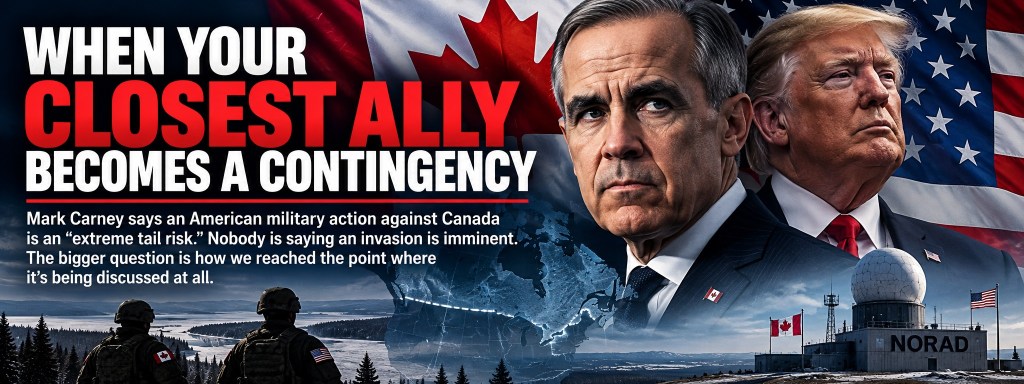
Mark Carney says an American military action against Canada is an “extreme tail risk.” Nobody is saying an invasion is imminent. The bigger question is how Canada and the United States reached the point where it is being discussed at all.
North of Polite
For generations, Canadians have looked south and seen many things.
Our largest trading partner.
Our closest military ally.
Our neighbour.
Sometimes our biggest headache.
But an invading army?
That belonged to history books.
Until recently.
Prime Minister Mark Carney was asked whether he had taken President Donald Trump’s repeated talk about Canada becoming the 51st state seriously enough to consider the possibility of American military action.
His answer was carefully chosen.
“I think you have a responsibility in these roles to look at extreme tail risk.”
Carney stressed that an American attack was “not a base case.” His point was essentially one of risk management: governments have to consider catastrophic possibilities even when they believe those possibilities are remote.
That’s an important distinction.
Carney did not say America is about to invade Canada.
The remarkable part is that a Canadian prime minister considers the possibility worth thinking about at all.
THIS DIDN’T COME FROM NOWHERE
Donald Trump has repeatedly talked about Canada becoming America’s 51st state.
He has also previously said he would not use military force to achieve that, speaking instead about “economic force.”
There is no evidence today that the United States is preparing to invade Canada.
But governments don’t prepare only for events they expect.
They also consider events whose consequences would be enormous if they ever occurred.
And Canada’s military has reportedly done exactly that.
CANADA HAS ALREADY MODELLED THE UNTHINKABLE
Earlier this year, The Globe and Mail reported that the Canadian Armed Forces had modelled a hypothetical American attack and possible Canadian responses.
A military model is not an operational war plan.
It’s a theoretical exercise used to understand what might happen under a particular scenario.
The reported exercise recognized the obvious imbalance: Canada could not conventionally match the enormous military power of the United States.
It therefore considered unconventional responses in the hypothetical event Canadian territory was occupied.
At the same time, military-to-military cooperation between the two countries continues.
And that’s where this story becomes extraordinary.
THE NORAD PARADOX
Canada and the United States don’t merely have friendly militaries.
Our continental defence systems are intertwined.
NORAD is a binational military command. Canadian and American personnel work together every day monitoring and defending North American airspace.
The two countries share intelligence.
They conduct exercises together.
They cooperate in the Arctic.
They have spent generations constructing one of the world’s closest defence relationships.
So consider the contradiction.
Canada continues working beside the United States to defend the continent while simultaneously contemplating, however remotely, what Canada would do if the country beside us became the threat.
That’s not evidence an invasion is coming.
It’s evidence of how much the strategic conversation has changed.
TRUST CHANGED
This is the real story.
Canada built enormous parts of its economy and security architecture around an assumption:
The United States would remain reliably friendly.
Not agreeable.
Not easy.
Not always fair.
But fundamentally an ally.
That assumption allowed Canada to integrate supply chains, energy markets, defence systems and infrastructure with its much larger neighbour.
Canada and the United States remain allies today.
NORAD still operates.
NATO still binds them.
Trade continues on an enormous scale.
Military and intelligence cooperation continues.
But something underneath that relationship has been damaged.
Certainty.
Canada is now diversifying trade, reconsidering strategic dependencies and asking questions about defence, communications, technology and supply chains that would have seemed considerably less urgent only a few years ago.
Carney’s invasion comment sits at the extreme end of that reassessment.
WHY SAY IT PUBLICLY?
There’s another fair question for Carney.
Governments consider unlikely contingencies all the time.
Why discuss this one publicly?
Perhaps it signals that Canadian sovereignty isn’t negotiable.
Perhaps it reinforces his government’s argument that Canada must reduce strategic dependence on the United States.
Perhaps he simply answered a direct question truthfully.
Whatever the reason, saying it publicly matters.
Once the Canadian prime minister openly acknowledges planning around even a remote possibility of American military action, something that once belonged largely to hypothetical discussion enters Canada’s mainstream strategic conversation.
That alone tells us something.
THE REAL STORY ISN’T AN INVASION
There is an easy sensational headline here:
CANADA PREPARES FOR U.S. INVASION.
It would also give readers the wrong impression.
There are no American tanks massing at the border.
There is no publicly known invasion order.
Carney himself says this isn’t the expected outcome.
The more consequential change has already happened without a soldier crossing the border.
Canada is reconsidering risk.
Trade risk.
Supply-chain risk.
Technology risk.
Defence risk.
Political risk.
And, at the absolute outer edge, sovereignty risk.
That doesn’t mean the Canada–U.S. alliance has disappeared.
It means Canada no longer appears willing to treat every old assumption about that alliance as permanent.
HOW DID WE GET HERE?
Canada and the United States have always argued.
Softwood lumber.
Dairy.
Pipelines.
Defence spending.
Trade.
That’s normal between neighbours.
What’s not normal is an American president repeatedly talking about absorbing Canada while a Canadian prime minister acknowledges considering the remote possibility of American military action.
Nobody needs to exaggerate that.
The facts are extraordinary enough.
Perhaps the question isn’t:
Will America invade Canada?
There is currently little evidence suggesting that’s about to happen.
The more important question is:
How did two countries that spent generations building one of the world’s closest economic and defence relationships reach the point where this conversation became conceivable?
And after Trump and Carney are both gone, Canada and the United States will face another question:
Can the old assumption of trust simply be put back together?
For generations, Canada planned around the United States as an ally.
Now Canada is also planning for the possibility—however remote—that the United States could become something else.
That doesn’t mean an invasion is coming.
It means an assumption Canada once considered almost unthinkable to question is now being questioned.
And that may be the bigger story.
America hasn’t invaded Canada.
But uncertainty already has.
© 2026 North of Polite. Original reporting, analysis and commentary. All rights reserved. 🍁
Unapologetically Canadian. We stand for a strong, sovereign and united Canada. No party owns our loyalty. If you make a claim, bring the receipts. We will too.



Leave a comment