
North of Polite | News analysis
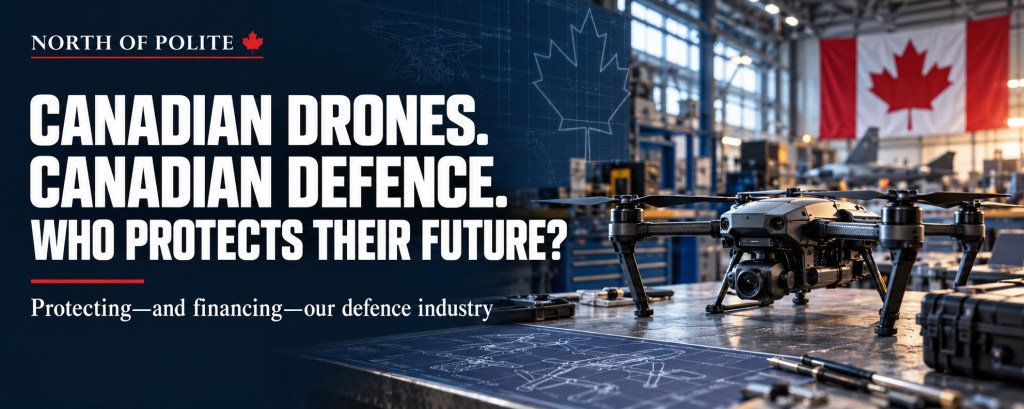
If we expect Canadian companies to help defend the country, we need a clear plan for protecting—and financing—their future.
The announced investment in Canadian drone developer Draganfly by a company connected to Donald Trump Jr. brings that question into focus. What capabilities must Canada keep under its own control? What safeguards protect them? And are our financing programs helping them grow here?
On September 28, Draganfly announced US$10 million in financing, split equally between American drone-component manufacturer Unusual Machines and an unnamed U.S. investment fund. The company expected closing around September 29, subject to conditions and approvals.
Unusual Machines identified Trump Jr. as an investor when announcing his appointment to its advisory board in November 2024. The Draganfly announcement describes a corporate investment; it does not establish a personal purchase by Trump Jr. or a takeover of the Canadian company.
Draganfly says the financing will support development and operating needs. Unusual Machines says its participation will support production growth and strengthen supplier relationships. There is a commercial rationale here—and a Canadian interest in the outcome.
Canada is already buying
CanadaBuys lists a Department of National Defence contract with Draganfly dated September 10, 2026. According to Draganfly, the five-year agreement includes an initial commitment for 100 tactical reconnaissance drone systems, with discretionary options for another 4,900. Those options are not guaranteed purchases.
The contract predates the financing announcement. These disclosures provide no basis to claim the new investment secured that award.
But buying military equipment creates an interest that lasts beyond delivery day. Canada needs spare parts, maintenance, software support and the ability to obtain more equipment when necessary.
That makes a supplier’s long-term capabilities a matter of public concern.
Will essential production and expertise remain available in Canada? What happens if an investor’s commercial priorities conflict with Canadian requirements? What protections would apply if relations between governments deteriorated?
Those questions deserve answers before dependence becomes a problem.
What does foreign ownership mean?
Canada’s system permits foreign investment while giving Ottawa powers to address national-security risks. Even minority investments can be reviewed, regardless of value. The government can impose conditions, block a transaction or require divestment. Having those powers does not mean every investment receives a full national-security review.
Share ownership also does not automatically provide access to sensitive military technology. Controlled goods and technical data face separate restrictions. Applicable contract-security requirements can include assessments of foreign ownership and influence.
These protections matter. But securing information does not, by itself, settle where a company will manufacture, develop technology or direct its future investment.
Canadian control should mean something practical: dependable access to the capabilities needed to operate, maintain and replenish our equipment.
Draganfly’s financing announcement does not identify the second fund or describe new board seats or special control rights. We have not established the resulting ownership percentages or whether this transaction underwent national-security review. These are limits in the information available—not proof of misconduct.
Protecting companies also means financing them
If Canada wants strategically important firms to retain Canadian control, it must consider how they will finance research, equipment and expansion.
Canada is already acting. The Business Development Bank of Canada has a Defence Platform of up to C$6 billion. On September 15, BDC outlined C$1 billion in investment allocations within that existing platform, including investments through other funds and its StrongNorth venture-capital fund. Those allocations should not be mistaken for money already fully disbursed.
Canada’s Defence Industrial Strategy also prioritizes Canadian ownership, protection and access concerning defence intellectual property.
The question is whether these commitments produce the intended results.
Can suitable companies obtain financing in time to meet demand? Do procurement decisions give them enough certainty to invest? When public money supports growth, what Canadian capabilities are secured in return?
We have not established whether Draganfly sought or received support through these programs. Its pursuit of American investment does not prove that Canadian alternatives were unavailable or inadequate.
It does, however, provide a timely reason to examine how our financing and ownership policies fit together.
Restricting foreign investment without providing workable alternatives could make expansion harder. Welcoming investment without protecting essential capabilities could leave Canada exposed. A credible policy must address both.
The standard should apply to everyone
The Trump connection warrants scrutiny because government purchasing and private financial interests can intersect. The relationship alone does not establish improper influence.
The same questions should apply regardless of an investor’s surname or nationality: who gains influence, what capabilities Canada retains, and how public interests are protected.
An international partnership may help a Canadian company expand. Its value to Canada should be measured by the expertise, production and dependable access it delivers.
If we expect Canadian companies to help defend the country, we need a clear plan for protecting—and financing—their future.
© 2026 North of Polite. Original reporting, analysis and commentary. All rights reserved. 🍁
Unapologetically Canadian. We stand for a strong, sovereign and united Canada. No party owns our loyalty. If you make a claim, bring the receipts. We will too.





Leave a comment