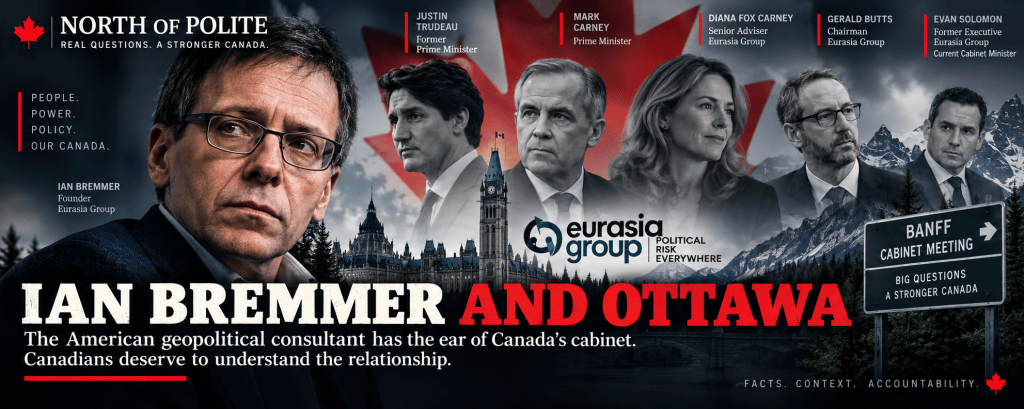
The American geopolitical consultant has the ear of Canada’s cabinet. Canadians deserve to understand the relationship.
Ian Bremmer was invited to address Canada’s federal cabinet in Banff this week.
That fact, by itself, is not a scandal.
Bremmer is one of the world’s better-known geopolitical analysts. He founded Eurasia Group, a private political-risk consulting firm headquartered in New York, and has spent decades studying the intersection of politics, economics and international affairs.
Canada is also confronting an extraordinary period in its relationship with the United States.
So there is an obvious argument for listening to him.
But Canadians should understand something else.
Ian Bremmer did not suddenly appear in Banff.
Eurasia Group has had a documented commercial relationship with Canada’s federal government stretching back almost a decade. People closely connected to both the Trudeau and Carney governments have subsequently held senior positions with the firm. Prime Minister Mark Carney’s wife is a senior adviser to it. A current cabinet minister previously sat on its management committee.
And now Bremmer himself has been invited to provide geopolitical analysis directly to Canada’s cabinet while the government confronts an escalating trade confrontation with Washington.
None of that proves wrongdoing.
But it does raise a legitimate question:
At what point does an outside consultant become part of Canada’s policy ecosystem?
What happened in Banff?
The cabinet meeting wasn’t secret.
The Prime Minister’s Office announced in advance that cabinet would meet in Banff on September 10 and 11 and would hear from outside experts on the economy, Indigenous partnerships and global affairs.
Bremmer was one of several guests invited to present.
Canadian Press reported that he spoke with journalists beforehand about the Canada-U.S. relationship and argued that Canadians need to distinguish between policies associated specifically with Donald Trump and structural changes in American politics that may survive his presidency, including tariffs and industrial policies designed to favour domestic industries.
That is exactly the sort of analysis Canada’s government might reasonably want to hear.
But Bremmer wasn’t an outside expert with no previous relationship to Ottawa.
Ottawa has been buying Eurasia Group’s expertise since 2017
Canada’s federal procurement database identifies seven Natural Resources Canada contract records involving Eurasia Group between January 2017 and February 2024.
Their currently reported total values add up to approximately $1.53 million.
That number requires an important qualification.
The federal government warns that published contract totals can include amendments, options and maximum potential values and therefore do not necessarily represent actual expenditures.
So North of Polite is not claiming taxpayers necessarily paid Eurasia Group exactly $1.53 million.
What the records establish is a continuing commercial relationship.
It began in January 2017 with a $24,999 non-competitive consultation-services contract from Natural Resources Canada. The federal record identifies the procurement justification as the low-dollar-value provision then in effect.
Four months later, Natural Resources Canada awarded Eurasia Group a $185,517.60 contract for a:
“Strategic briefing in the oil sector.”
That contract used an Advance Contract Award Notice. The federal record identifies the limited-tendering reason as consulting concerning matters of a confidential nature.
In September 2018, another contract provided Natural Resources Canada with access to Eurasia Group’s research platform and experts for political, country, regional and energy-sector analysis.
Its original value was $186,383.99. Following an amendment, its reported total reached $251,644.49.
Additional contracts followed for consulting and data services.
Then came one particularly relevant to today’s circumstances.
“Geopolitical Research – Analysis and Insights”
On February 28, 2024, Natural Resources Canada awarded Eurasia Group Ltd. a contract described as:
“Geopolitical Research – Analysis and Insights.”
Its original value was $224,495.95.
Following amendments, the government’s database currently reports a total value of $446,210.91.
The original procurement record contains some noteworthy details.
Eurasia Group Ltd. is identified as a United States vendor.
An Advance Contract Award Notice was used.
The record reports one bid.
And under the applicable government-contract exception, the database states:
“Only one person is capable of performing the contract.”
None of those things establishes wrongdoing.
Advance Contract Award Notices are an established federal procurement mechanism.
But it tells us something important:
Ottawa wasn’t merely reading Ian Bremmer’s books or watching him on television. The Canadian government was purchasing Eurasia Group’s geopolitical expertise.
And that relationship began under Justin Trudeau.
The Trudeau connection
This history predates Mark Carney’s government by years.
In September 2019, Bremmer interviewed Prime Minister Justin Trudeau during the federal election campaign for GZERO Media, a Eurasia Group subsidiary. They discussed climate, trade, immigration and the SNC-Lavalin controversy.
Bremmer also interviewed then-Alberta premier Jason Kenney, providing an opposing Canadian political perspective.
So those interviews themselves don’t demonstrate partisan alignment.
But something happened afterward that is directly relevant to transparency.
Bremmer wrote a TIME cover story about Trudeau’s re-election campaign.
On October 4, 2019, TIME added an editor’s note saying the article should have disclosed that Eurasia Group had held a consulting contract with Natural Resources Canada since 2017.
That doesn’t establish that the Trudeau government influenced Bremmer’s reporting.
TIME didn’t say that.
What it establishes is much narrower:
The financial relationship between Eurasia Group and Canada’s government was considered relevant enough that readers should have been told about it.
Transparency mattered then.
It matters now.
Then Gerald Butts joined Eurasia Group
The connections subsequently became considerably closer.
Gerald Butts served as Justin Trudeau’s principal secretary from 2015 to 2019 and was one of the most influential figures in Trudeau’s government.
Today, Butts is chairman and senior adviser of Eurasia Group.
The firm’s own biography says he works closely with CEO Maziar Minovi and Ian Bremmer on strategic initiatives and advises Eurasia Group clients on matters including trade, national security, energy transition, sustainable finance and artificial intelligence.
But Butts also provides a bridge between the Trudeau and Carney eras.
Eurasia Group’s biography says Butts has served as a senior strategic adviser to Mark Carney, participated in Carney’s 2025 Liberal leadership campaign and played a leadership role in the Liberal Party’s 2025 federal election campaign.
That’s not an allegation.
It’s Eurasia Group’s own description of its chairman.
The Prime Minister’s wife
Then there is Diana Fox Carney.
In May 2021, Eurasia Group announced that she was joining the company as a senior adviser specializing in climate and energy policy.
The firm said she would work closely with Gerald Butts, advise clients and participate in Eurasia Group events.
Current reporting continues to identify Fox Carney as doing some work for Eurasia Group.
That doesn’t establish a conflict of interest involving the prime minister.
It does establish a direct professional relationship between the prime minister’s spouse and the company whose founder has now been invited to address his cabinet.
That relationship deserves disclosure when discussing Bremmer’s access.
And one of Carney’s ministers worked there
There’s another direct connection inside the current government.
Before entering politics, Evan Solomon became publisher of GZERO Media and a member of the Eurasia Group management committee in 2022.
Solomon subsequently confirmed his previous position during parliamentary testimony.
He said he resigned before entering electoral politics and no longer receives compensation or holds an ownership interest in Eurasia Group.
That distinction matters.
We have no basis for suggesting Solomon currently works for Eurasia Group.
But his previous senior role is relevant when examining the network of relationships between the firm and Canada’s current government.
And the relationship is still active
Banff isn’t the only recent point of contact.
On June 11, 2026, Industry Minister Mélanie Joly participated in Eurasia Group’s Canada-U.S. Summit in Toronto.
The federal government’s own announcement said her discussion would concern tariff-affected industries and broader Canada-U.S. relations.
Federal travel-disclosure records also show a Natural Resources Canada chief of staff travelled to Toronto in connection with the Eurasia Group Canada-U.S. Summit.
Three months later, Bremmer was invited to address cabinet in Banff as Canada confronted an escalating trade conflict with Washington.
Again, none of those interactions is inherently improper.
But taken together, they establish that Eurasia Group occupies a recurring place in discussions between Canadian government officials and outside geopolitical expertise.
So who else does Eurasia Group work for?
This is where the public record becomes less complete.
Eurasia Group is a private company.
Its business is geopolitical-risk research and consulting.
The company says it provides information and analysis to clients operating and investing around the world. Its own material describes both Diana Fox Carney and Gerald Butts as advising Eurasia Group clients.
What we have not found is a comprehensive, authoritative public list of Eurasia Group’s current clients.
North of Polite isn’t going to manufacture one from rumours, internet net-worth sites or organizations that merely attended the same events.
Instead, that absence creates a reasonable question for Ottawa and Eurasia Group:
Does Eurasia Group currently advise companies, investors, financial institutions, governments or other organizations whose interests could be materially affected by decisions Canada makes during the Canada-U.S. trade dispute?
If the answer is yes, that does not automatically create a conflict.
But Canadians deserve to know whether potential conflicts were screened before Bremmer addressed their cabinet.
Questions for Ian Bremmer — and Canada’s government
We aren’t accusing Ian Bremmer of secretly directing Canadian policy.
We have found no evidence of that.
We aren’t accusing Mark Carney of violating Canada’s ethics laws.
We have found no evidence establishing that either.
And we aren’t claiming Eurasia Group’s federal contracts purchased political influence.
The records don’t establish that.
What we are asking is considerably simpler.
Who selected Ian Bremmer to address cabinet?
What specifically was he asked to advise Canada’s ministers about?
Was Bremmer or Eurasia Group compensated for the Banff appearance?
Does Eurasia Group currently advise organizations whose financial interests could be materially affected by Canada’s response to the U.S. trade dispute?
If so, were potential conflicts disclosed or screened before Bremmer addressed cabinet?
What information was provided to Bremmer before his presentation?
Was any cabinet-confidential or otherwise protected government information provided to him?
Was Diana Fox Carney’s professional relationship with Eurasia Group considered before Bremmer’s appearance?
Did Eurasia Group’s existing federal contracting relationship have any bearing on his selection?
And perhaps the largest question:
What rules govern the access private geopolitical consultants receive to Canada’s highest decision-makers?
Those aren’t accusations.
They’re questions with factual answers.
This isn’t about Bremmer being American
Ian Bremmer’s nationality shouldn’t disqualify him from advising Canadians.
Canada needs outside expertise.
During a confrontation with Washington, hearing from someone who understands American politics could be extremely useful.
The issue isn’t Bremmer’s passport.
It’s the relationship.
The documented record now looks like this:
Federal contracts with Eurasia Group began during the Trudeau government in 2017.
Bremmer interviewed Trudeau in 2019, and TIME subsequently said his related article should have disclosed Eurasia Group’s government consulting relationship.
Trudeau’s former principal secretary Gerald Butts became a senior Eurasia Group figure and is now its chairman.
Butts subsequently became a strategic adviser to Carney and participated in his leadership and election campaigns.
Carney’s wife is a Eurasia Group senior adviser.
A current cabinet minister previously sat on Eurasia Group’s management committee.
Another cabinet minister participated in Eurasia Group’s Canada-U.S. summit this June to discuss tariffs and bilateral relations.
And now Eurasia Group’s founder has addressed Canada’s cabinet while the government is making extraordinarily consequential decisions about its economic relationship with the United States.
Every one of those facts may have a perfectly legitimate explanation.
That’s exactly why asking for the explanation shouldn’t be controversial.
So who is Ian Bremmer to Canada?
An outside expert?
A government contractor?
A geopolitical consultant whose firm has developed longstanding relationships with Canadian decision-makers?
Perhaps all three.
There is nothing inherently wrong with any of those roles.
But private expertise and public power are different things.
When the two meet — particularly during a crisis capable of reshaping Canada’s economy — Canadians should be able to understand the relationship.
We don’t need conspiracy theories.
We don’t need accusations unsupported by evidence.
We need transparency.
Ian Bremmer had the ear of Canada’s cabinet this week.
Canadians deserve to know exactly what role he and Eurasia Group play in the conversations shaping Canada’s response to the United States.
Mr. Bremmer, the invitation is open.
If we’ve missed relevant context, North of Polite would welcome it.
If there are safeguards governing Eurasia Group’s private-client relationships when Bremmer advises governments, tell Canadians what they are.
If there are straightforward answers to the questions above, we’d like to hear them.
And if the answer is simply that Canada’s cabinet wanted the independent assessment of an experienced geopolitical analyst during an unprecedented dispute with Washington, Canadians deserve to hear that too.
The purpose of scrutiny isn’t to manufacture wrongdoing.
It’s to understand who has access to power — and why.
© 2026 North of Polite. Original reporting, analysis and commentary. All rights reserved. 🍁
Unapologetically Canadian. We stand for a strong, sovereign and united Canada. No party owns our loyalty. If you make a claim, bring the receipts. We will too.



Leave a comment