
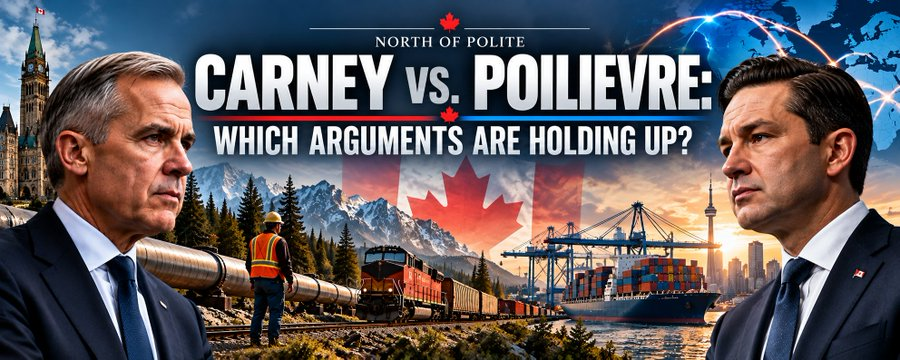
Months into the trade war, we finally have enough evidence to test some of the promises.
North of Polite | September 27, 2026
When we first compared Mark Carney’s and Pierre Poilievre’s economic plans, much of the debate was theoretical.
Carney argued Canada could attract investment, build infrastructure and diversify away from excessive dependence on the United States.
Poilievre argued that Canada’s taxes, regulations and slow approval system were preventing the country from doing exactly that.
Months later, something interesting has happened:
They increasingly agree about the problem.
CAN CARNEY ATTRACT INVESTMENT?
There is more evidence today than when we first asked.
Canadian banks, pension funds, insurers and investment managers have announced enormous financing and investment initiatives aimed at Canadian infrastructure and strategic industries.
But our original warning remains:
Financing isn’t construction.
Available capital doesn’t automatically create factories, mines, ports or productivity.
Carney has stronger evidence that capital can be attracted.
Whether Canada can turn it into completed projects remains unproven.
CAN CANADA DIVERSIFY?
Here, too, we’re seeing movement.
Canada says free-trade negotiations with the Philippines and ASEAN are now more than 90% complete, with completion targeted for November.
The Bank of Canada also says Canadian businesses are changing suppliers, seeking customers outside the United States and investing in technology.
Non-energy exports rose 14.5% in the second quarter, reaching their highest level since early 2025.
That’s real adaptation.
But there’s a catch.
Energy, minerals and agricultural products can often find alternative buyers more easily than manufactured goods.
An automotive supply chain built across the Canada–U.S. border cannot simply be recreated in Europe or Asia.
Diversification is happening.
Whether it can happen fast enough remains unanswered.
WHAT ABOUT POILIEVRE’S BIGGEST ARGUMENT?
Poilievre has argued for years that Canada doesn’t lack resources or investors.
It lacks the ability to get projects built quickly.
Now Carney’s government has introduced Bill C-39, the Building Canada Strong Act.
Its objective:
One project. One review. One year.
Federal reviews and decisions would generally be completed within one year after a proponent submits the required information, with permitting and assessment processes increasingly happening together rather than sequentially.
Poilievre’s plan also proposes a one-stop approval system and a single environmental review within one year, alongside broader regulatory reductions.
So the argument has changed.
The question is no longer whether Canada should speed up approvals.
Both sides say yes.
The question is whether either can actually deliver.
THE TAX ARGUMENT HAS CHANGED TOO
Poilievre wants lower taxes on investment and fewer regulatory barriers.
Carney is using investment tax incentives, accelerated write-offs and government efforts to mobilize private capital.
Both are trying to make Canada more attractive to investment.
But their methods remain different.
Poilievre generally wants government to tax and regulate investment less.
Carney is more willing to use government policy to encourage and direct investment toward strategic sectors.
That’s a real policy choice.
THEN THERE’S THE COST
This may become the hardest question for both sides.
Trade uncertainty continues to weigh on Canadian growth.
The Bank of Canada says businesses have adapted and investment has recently improved—but renewed tariffs could again delay investment and hiring.
Carney’s strategy requires significant tax incentives, infrastructure spending and government support.
Poilievre’s tax reductions would also reduce federal revenue unless stronger growth or spending reductions compensate.
So Canadians should demand the same thing from both:
Show the arithmetic.
WHAT HAS THE TRADE WAR TAUGHT US?
Canada’s economic vulnerability wasn’t created by Donald Trump.
The trade war exposed it.
Canada became enormously successful selling into the world’s largest economy.
It also became enormously dependent on it.
Now both approaches increasingly revolve around the same words:
Investment.
Resources.
Infrastructure.
New markets.
Speed.
Where they differ is how government should achieve those things.
NORTH OF POLITE
Some of our original questions can now be answered.
Carney has more evidence that Canada can attract capital and begin diversifying trade.
He does not yet have proof that those efforts will produce enough completed projects, productivity and new exports to offset trade-war damage.
Poilievre’s argument that Canada must get projects built faster has been reinforced by the fact that Ottawa itself is now undertaking major approval reform.
He does not yet have proof that his combination of tax and regulatory reductions would produce stronger growth while keeping federal finances sustainable.
So the next test is remarkably simple.
Do projects actually get approved within a year?
Does announced investment become construction?
Do new trade agreements produce exports?
And does economic growth ultimately pay for the strategy?
Those answers won’t come from speeches.
They’ll come from permits, construction sites, export numbers, investment data and federal accounts.
That’s where we’ll keep looking.
© 2026 North of Polite. Original reporting, analysis and commentary. All rights reserved. 🍁
Unapologetically Canadian. We stand for a strong, sovereign and united Canada. No party owns our loyalty. If you make a claim, bring the receipts. We will too.






Leave a comment