
Editorial | North of Polite
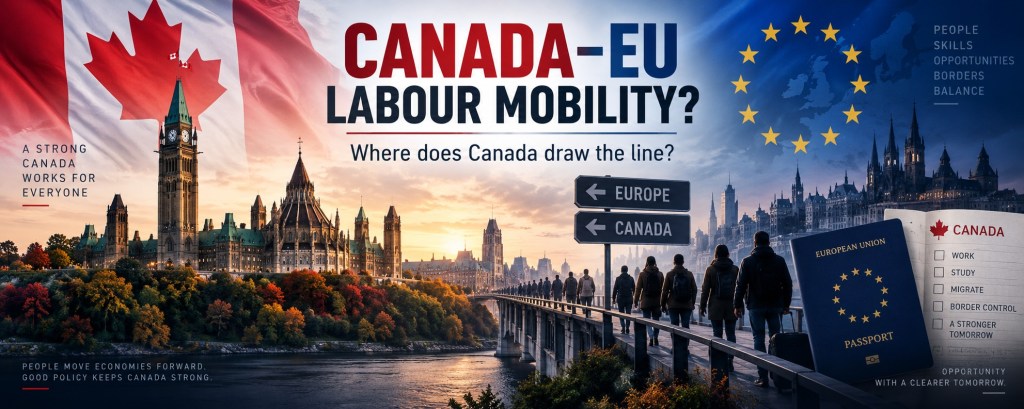
A troubling claim is spreading across Canada: that Prime Minister Mark Carney’s proposed new relationship with the European Union could open the door to importing Europe’s migration crisis.
Right now, that claim goes further than the evidence.
But the questions behind it deserve answers.
Carney has confirmed that Canada and the European Union are discussing what he calls a “unique alliance.” He has also said those discussions could include enhanced labour mobility.
That is significant.
It is not, however, the same thing as agreeing to accept Europe’s asylum seekers, refugees or migrant population.
That distinction matters.
Parts of Europe continue to face significant asylum and migration pressures. EU+ countries received approximately 822,000 asylum applications in 2025. By June 2026, an estimated 1.18 million asylum cases remained pending at various stages.
European governments have spent years wrestling with overloaded asylum systems, border pressures, integration challenges and growing political backlash.
Canada should learn from that experience — not recreate it.
And Canada is hardly entering this discussion from a position of unlimited capacity.
Our immigration system has already been forced into a major correction. Ottawa is reducing temporary-resident arrivals after population growth outran housing construction and placed additional pressure on infrastructure and public services.
CMHC now estimates Canada needs between roughly 417,000 and 469,000 new homes every year to restore pre-pandemic affordability by 2036.
We are nowhere near that level.
So if “enhanced labour mobility” eventually means something relatively narrow — Canadian and EU citizens with needed skills being able to work more easily on either side of the Atlantic — that deserves a rational discussion.
Engineers, physicians, tradespeople, researchers, scientists and other skilled workers moving between two advanced economies could benefit both sides.
That is very different from an agreement allowing anyone legally residing in an EU country to obtain easy access to Canada.
And that is precisely where Ottawa needs to stop speaking in broad diplomatic language and start providing specifics.
Who would qualify?
EU citizens only?
Permanent residents of EU countries?
People holding temporary European residency?
Recognized refugees?
People whose asylum cases are still being processed?
Would there be annual limits?
Would workers have to demonstrate skills Canada actually needs?
Would they receive a pathway to permanent residency?
Would provinces have any control over numbers when they are responsible for providing health care, schools and much of the housing infrastructure newcomers depend upon?
And most importantly:
Could someone who entered Europe through its asylum system eventually use European residency as a route into Canada under this agreement?
Those are not anti-immigrant questions.
They are the questions a responsible country asks before weakening Canadian control over any part of its immigration system.
Canada benefits from immigration. It always has.
But immigration works when Canadians believe the system is controlled, newcomers have a reasonable opportunity to succeed, housing and services can accommodate population growth, employers need the workers being admitted, and the rules apply fairly.
When governments allow numbers to outrun capacity, something else happens.
Housing becomes harder to find. Infrastructure struggles to keep up. Public services come under greater pressure. And confidence in the immigration system itself begins to erode.
That hurts Canadians.
It also hurts immigrants who arrive expecting opportunities Canada may no longer be able to provide.
Carney is right about one thing: Canada needs alternatives to its overwhelming economic dependence on the United States.
A stronger relationship with Europe could be an important part of that strategy.
More Canadian energy sold to Europe? Explore it.
More defence cooperation? Absolutely worth discussing.
More access for Canadian businesses? Long overdue.
Scientific and university cooperation? There are obvious possibilities.
But economic diversification does not require Canada to surrender control of its borders.
Until Ottawa produces the details, Canadians should neither accept the worst rumours as established fact nor dismiss legitimate concerns as fearmongering.
The government should simply answer the question.
When Mark Carney says “enhanced labour mobility,” exactly who will have the right to come to Canada — and who will not?
Before Canada signs anything, Canadians deserve to know.
Sources: Government of Canada/IRCC; Canada Mortgage and Housing Corporation; European Union Agency for Asylum.
© 2026 North of Polite. Original reporting, analysis and commentary. All rights reserved. 🍁
Unapologetically Canadian. We stand for a strong, sovereign and united Canada. No party owns our loyalty. If you make a claim, bring the receipts. We will too.






Leave a comment