
By Simon Niinjii | North of Polite
October 8, 2026 · 2-minute read
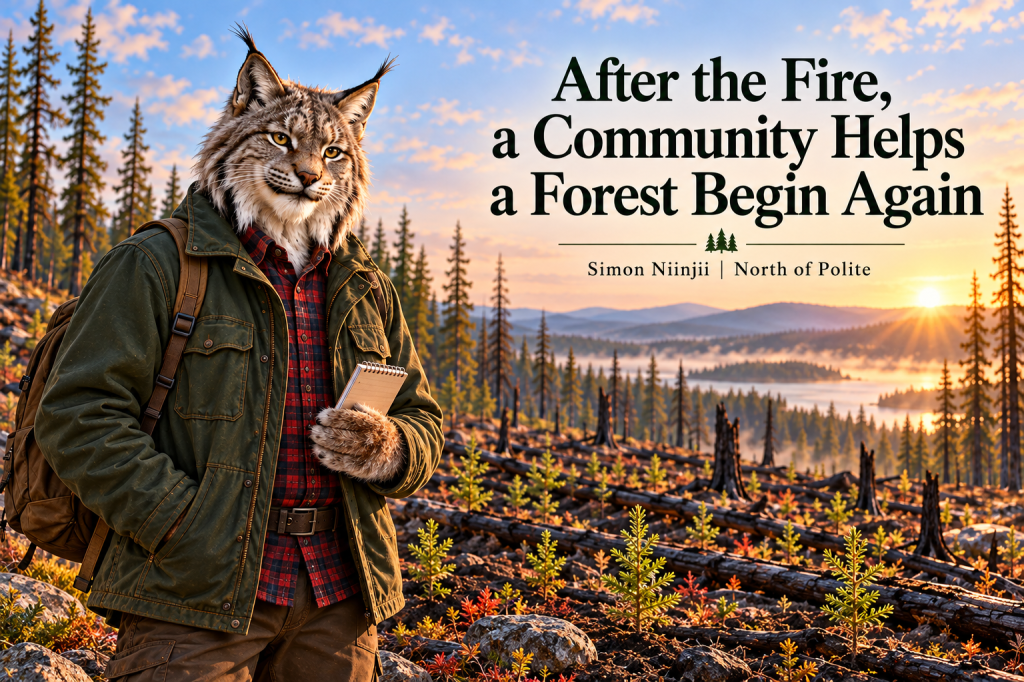
A forest does not grow back overnight. But helping it along can bring people together—and create something worth celebrating today.
Near Sambaa Deh Falls in the Northwest Territories, Jean Marie River First Nation helped deliver a major planting project on wildfire-affected land.
In its October 5 announcement, the territorial government reported approximately 3.37 million native trees and shrubs planted across 403 hectares through the Morrissey Creek restoration project. That is the project’s reported total, rather than the number planted this summer alone.
The government values the project at about $3.9 million. It says Jean Marie River First Nation provided project management, equipment and camp support, creating 18 direct jobs for members, with nearly 100 tree planters employed overall.
Those contributions put the community at the heart of the operation: organizing services, supporting crews and helping carry the work through to completion.
Even an evacuation did not stop it. When support services had to relocate from Fort Simpson to Hay River on short notice, the operation adapted. According to the government, planting still finished on schedule.
That is an achievement in its own right.
More than a planting count
In a statement accompanying the announcement, Chief Melanie Norwegian-Menacho described the planting area as hunting grounds used by community members.
She also described shared meals, drum dancing and friendships formed between residents and planting crews. Her account connects the project with both the community’s relationship to the land and the people who came to work there.
The positive story is already broader than seedlings: local employment, community involvement and people working together through difficult circumstances.
For a community affected by floods, fires and other natural disasters, helping restore familiar land offers a hopeful step forward.
A beginning worth celebrating
Only time—and monitoring over the coming years—will show how the planted area develops. The announcement does not yet provide long-term survival results, and planting totals alone cannot tell us what the future forest will look like.
That does not take away from what has been accomplished.
The government reports that the planting is complete, community members gained work and the project stayed on schedule despite an evacuation. Chief Norwegian-Menacho’s account adds another dimension: relationships built along the way.
There is good reason to recognize that effort now, while allowing the land time to respond.
The crews have done their part in this stage. The next chapter will grow at the forest’s pace.
Source: Government of the Northwest Territories, October 5, 2026. Project figures and community statements are attributed to that release.
© 2026 North of Polite. Original reporting, analysis and commentary. All rights reserved. 🍁





What do you think? Have something to add, a question to ask, or a different perspective? We want to hear it. Leave a comment and join the conversation. You don’t have to agree with us—just bring your point of view.