Parliament Has a Plan. Does the Math Work?
By Gord Moose | North of Polite
A few days ago, North of Polite asked a fairly simple question:
Could Canada improve its ability to guarantee Canadians reliable access to Canadian-refined gasoline, diesel and aviation fuel — while still allowing our energy industry to export to the world?
We followed the barrels, looked at Canada’s refineries, examined imports and exports and asked what a genuine Canadian fuel-security system might require.
Now the federal Conservatives have put forward their own Emergency Fuel Relief Plan.
It proposes cutting federal taxes on diesel, encouraging investment in refineries and fuel infrastructure, accelerating permitting and establishing a strategic reserve of refined petroleum products.
That last part should sound familiar to readers of this series.
So rather than cheer the proposal or dismiss it because of the party proposing it, let’s do what North of Polite does.
Let’s check the math.
What are the Conservatives proposing?
The Conservative Emergency Fuel Relief Plan has two broad objectives: reduce diesel costs immediately and increase Canada’s domestic fuel security over the longer term.
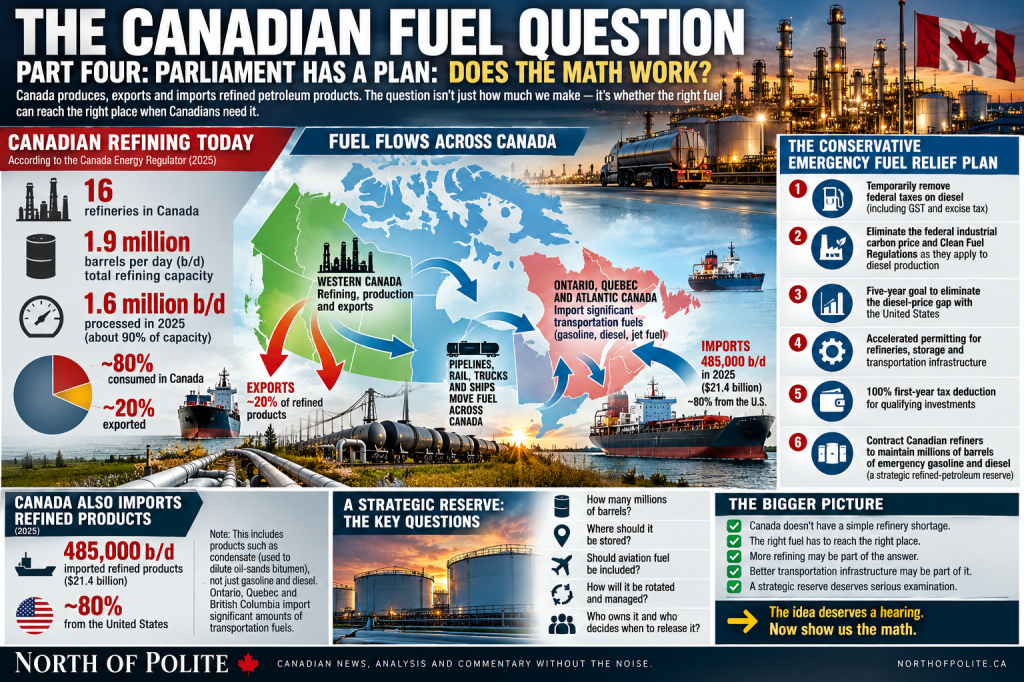
Among its proposals are:
- temporarily removing federal taxes from diesel sales;
- eliminating the federal industrial carbon price and Clean Fuel Regulations as they apply to diesel production;
- establishing a five-year goal of eliminating the diesel-price gap with the United States;
- creating accelerated permitting for refineries, storage and transportation infrastructure;
- allowing a 100-per-cent first-year deduction for qualifying investments in fuel production and distribution infrastructure; and
- contracting Canadian refiners to maintain millions of barrels of emergency gasoline and diesel as a strategic refined-petroleum reserve.
There is an important parliamentary distinction.
The Conservatives subsequently brought a fuel-relief motion before the House of Commons on October 6. The broader party plan includes the strategic reserve, but Canadian Press reported that the reserve itself was not included in that day’s House motion.
For this article, we are examining the broader Emergency Fuel Relief Plan.
Canada does not have a simple refinery shortage
Here’s where the numbers become important.
According to the Canada Energy Regulator, Canada’s 16 refineries can process approximately 1.9 million barrels of crude oil per day.
In 2025 they actually processed approximately 1.6 million barrels per day — about 90 per cent of total capacity.
That means Canada’s refinery system isn’t sitting half-empty waiting for someone to switch it on.
It is already working fairly hard.
The CER also reports that the majority of the products produced by Canadian refineries are consumed domestically, while approximately 20 per cent are exported.
That doesn’t mean Canada should stop exporting them.
Exports support refinery economics, Canadian employment and trade.
But it demonstrates why fuel security is more complicated than simply saying:
“Refine more Canadian oil.”
Canada also imports substantial amounts of refined petroleum products
Canada imported approximately 485,000 barrels per day of refined petroleum products in 2025, worth about $21.4 billion.
Nearly 80 per cent came from the United States.
But that number requires context.
It does not mean Canada imported 485,000 barrels per day of gasoline and diesel.
Alberta alone imported about 200,000 barrels per day of refined petroleum products in 2025, much of it condensate used to dilute oil-sands bitumen so it can move through pipelines.
Quebec, Ontario and British Columbia were the next-largest importing provinces. The CER says most refined-product imports into those provinces are transportation fuels such as gasoline, diesel and jet fuel.
So Canada can simultaneously:
produce large quantities of refined petroleum,
export refined products,
and import refined products elsewhere in the country.
That may sound contradictory.
It isn’t.
The map matters
A refinery in Edmonton producing diesel does not automatically solve a supply problem in Atlantic Canada.
A refinery in Saint John cannot instantly supply Vancouver.
Canada is enormous.
Pipelines, terminals, railways, ships, trucks and storage facilities connect the country’s fuel system.
Commercial decisions also matter. Companies source fuel according to price, availability, transportation costs, product specifications and other logistical considerations.
That’s why increasing refinery capacity alone doesn’t necessarily create national fuel security.
The right fuel has to reach the right place.
And that is one area where the Conservative proposal and North of Polite’s earlier analysis arrive at a similar conclusion.
Fuel security isn’t only about production.
It is also about transportation and storage.
Now we get to the strategic reserve
The Conservative plan proposes contracting Canadian refiners to maintain millions of barrels of emergency gasoline and diesel for major supply disruptions.
Conceptually, this deserves serious examination.
A strategic stockpile of finished fuels could provide additional resilience during a major interruption in normal supply.
But “millions of barrels” isn’t yet enough information to evaluate the system.
It’s a starting point.
How many millions?
That is the first question.
What exactly is the reserve supposed to accomplish?
Seven days of essential national demand?
Fourteen?
Thirty?
Would it protect normal Canadian consumption or only essential services and transportation?
Those choices dramatically change the required size — and therefore the cost — of the reserve.
Then comes another question:
Where do you put it?
One enormous tank farm in Alberta would not provide national fuel security.
Neither would one in Ontario.
If the objective is resilience across Canada, storage location and transportation access would be fundamental to the design.
A strategic reserve that exists on paper but cannot reach a region during an emergency isn’t much of a reserve.
What about aviation fuel?
This is one place where North of Polite believes another question needs answering.
The Conservative announcement specifically identifies emergency gasoline and diesel.
But Canada also depends heavily on aviation.
Passenger travel is only part of that equation.
Northern communities, medical transportation, military operations, cargo movement and emergency response can all depend on aviation fuel.
If Canada is seriously considering a national reserve of finished petroleum products, aviation fuel deserves to be included in the analysis.
That doesn’t necessarily mean it belongs in the final reserve.
It means Canadians should know why it is included or excluded.
Fuel inventory has to be managed
A refined-fuel reserve would also require active inventory management.
Gasoline and diesel are not commodities that government should simply place in storage indefinitely and forget about.
Fuel quality, storage conditions and inventory turnover would all have to be addressed.
That makes the Conservative proposal to contract Canadian refiners particularly interesting.
Rather than government trying to operate the fuel business itself, contracts could potentially require industry to maintain specified emergency inventories while rotating product through normal commercial channels.
But the details would matter enormously:
Who owns the fuel?
Who audits the inventory?
Where must it be stored?
How frequently must it be rotated?
What triggers its release?
And who gets priority during a genuine emergency?
Those questions need answers before anyone can calculate the real cost.
The million-barrel target needs clarification
The Conservatives have established another ambitious objective:
Increase Canadian production of diesel and other refined fuels to one million barrels per day within five years.
That figure needs to be explained carefully.
Canada’s refineries already process approximately 1.6 million barrels of crude per day — but crude throughput and finished-fuel production are not the same measurement.
A refinery produces a mixture of products that can include gasoline, diesel, jet fuel, asphalt, lubricants and other petroleum products.
You cannot simply turn every additional barrel of crude into another barrel of diesel.
Output depends on refinery configuration, crude type, equipment and economics.
Increasing production of particular fuels may therefore require refinery modifications, additional conversion equipment or additional capacity.
Those investments may prove worthwhile.
But before adopting a million-barrel target, Canadians should see the engineering and economic assumptions behind it.
Then there is the price promise
The Conservatives also want to eliminate the diesel-price gap between Canada and the United States within five years.
Government policy can influence fuel prices.
Taxes matter.
Refining capacity matters.
Transportation costs matter.
Infrastructure matters.
But crude prices, refinery margins, exchange rates, competition and international markets matter too.
A government can influence some of those factors.
It cannot control all of them.
So eliminating the price gap is best understood as a policy target, not a guaranteed outcome.
Where the proposal deserves attention
Perhaps the most interesting part of the Conservative plan is its recognition that refined-fuel security can be treated as national infrastructure.
Canada is one of the world’s major petroleum-producing countries.
It also has substantial refining capacity.
Yet geography, infrastructure and commercial realities mean some regions still import transportation fuels.
That does not automatically mean Canada’s existing system is broken.
International and interprovincial trade can be economically efficient.
But efficiency and resilience are not always identical.
A supply system designed for ordinary market conditions may face very different challenges during a major disruption.
That’s where the strategic-reserve proposal becomes worth examining seriously.
But show us the complete plan
Before taxpayers commit potentially substantial amounts of money, several questions need answers:
How large would the strategic reserve actually be?
How many days of essential consumption would it cover?
Where would the fuel be stored?
Would aviation fuel be included?
How much additional refinery capacity is actually required?
Could existing refineries be expanded or reconfigured more economically than constructing entirely new facilities?
Which transportation bottlenecks prevent Canadian fuel from reaching Canadian markets?
What would the proposed tax incentives cost?
Who would own the stored fuel?
Who would manage it?
And what conditions would trigger its release?
Most importantly:
What would the entire system cost?
Those aren’t arguments against the proposal.
They’re the questions that turn a political announcement into an actual national energy-security plan.
The North of Polite conclusion
The Conservative Emergency Fuel Relief Plan addresses a legitimate Canadian fuel-security question.
Canada produces enormous quantities of crude oil and operates a substantial refining industry.
Its refineries processed approximately 1.6 million barrels per day in 2025.
Canada exports refined products.
Canada also imports refined products.
And some of Canada’s most populated provinces continue to import transportation fuels because geography, infrastructure, economics and refinery configuration matter.
Additional refining capacity may be part of improving Canada’s resilience.
Better transportation infrastructure may be part of it.
Strategically located fuel storage may be part of it.
And a national reserve of finished fuels deserves serious examination.
But the objective shouldn’t simply be:
Produce more fuel.
It should be:
Make sure the right fuel can reach the right Canadian place when Canadians actually need it.
That’s a much more complicated engineering and economic problem.
And before Ottawa spends potentially billions of dollars solving it, Canadians deserve to see the numbers.
Because energy security is too important to be reduced to a slogan.
The idea deserves a hearing.
Now show us the math.
— Gord Moose
Editor & Lead Writer
North of Polite
Canadian news, analysis and commentary without the noise.
© 2026 North of Polite. Original reporting, analysis and commentary. All rights reserved. 🍁




What do you think? Have something to add, a question to ask, or a different perspective? We want to hear it. Leave a comment and join the conversation. You don’t have to agree with us—just bring your point of view.