
By Lucien Lièvre | Québec Correspondent | North of Polite
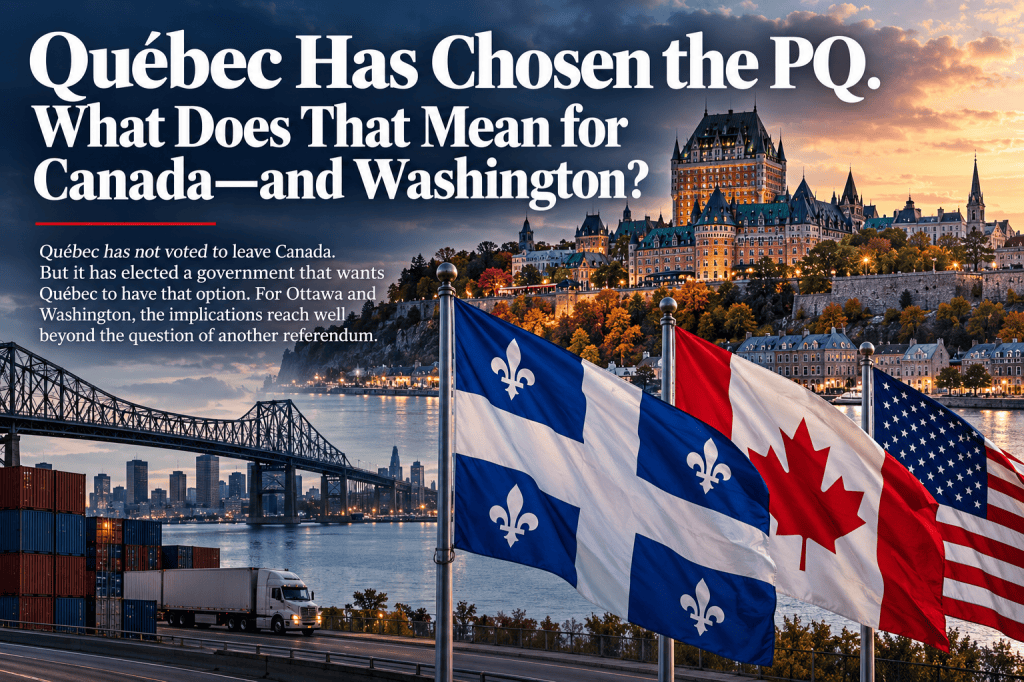
Québec has not voted to leave Canada. But it has elected a government that wants Québec to have that option. For Ottawa and Washington, the implications reach well beyond the question of another referendum.
Québec has a new government.
After the October 5 election, the Parti Québécois won the most seats in the National Assembly, taking 59 of Québec’s 127 seats. That leaves the PQ five seats short of the 64 required for a majority.
The PQ received about 28% of the popular vote.
That is significant.
But there is an important distinction that should not get lost in the headlines:
Québec has not voted to leave Canada.
There was no independence question on the ballot.
Québec voters elected a provincial government.
What they elected is a sovereigntist government whose leader, Paul St-Pierre Plamondon, has promised to eventually give Québec voters another opportunity to decide the question of independence.
That changes the political conversation in Canada.
It also creates questions beyond Canada’s borders.
Québec has a government to run
Before anyone starts talking about the breakup of Canada, there is a more immediate reality.
The PQ has to govern Québec.
And it has to do it as a minority government.
Housing, health care, immigration, infrastructure, jobs and the economy aren’t going away while the sovereignty debate continues.
Prime Minister Mark Carney has already said Ottawa intends to work with the new Québec government, with an immediate focus on economic growth, housing, infrastructure and helping workers affected by U.S. tariffs.
That creates an important distinction.
The PQ may want an independent Québec eventually. For now, it is governing a province of Canada.
Ottawa still has to work with Québec.
And Québec still has to work with Ottawa.
The referendum isn’t happening tomorrow
The independence question isn’t going away.
St-Pierre Plamondon has reaffirmed his intention to hold another referendum.
But the PQ has also committed not to hold one before January 20, 2029, the end of Donald Trump’s current presidential term.
That puts the referendum question down the road rather than on the immediate political calendar.
It also creates an unusual connection between Québec’s sovereignty debate and American politics.
The PQ wants the option of independence—but its own timetable places that question beyond the current U.S. administration.
And that brings Washington into the picture
The United States already has a substantial economic relationship with Québec.
Québec’s economy is closely connected to American markets through manufacturing, energy, aluminum and other exports.
Those businesses are already dealing with U.S. trade measures.
That makes the timing of the PQ victory particularly interesting.
Québec now has a government openly committed to eventual sovereignty while Canada is dealing with a difficult relationship with its largest trading partner.
For Washington, those aren’t necessarily two completely separate issues.
But there is an important limit.
Washington still deals with Canada.
Ottawa remains the negotiating partner
Québec has considerable provincial authority, but it is still part of Canada.
International trade remains a federal responsibility.
So when Washington discusses tariffs, trade arrangements and the broader economic relationship with Canada, Ottawa remains the government across the negotiating table.
Québec can—and does—advocate for its industries and economic interests.
But Québec isn’t currently negotiating with Washington as a separate country.
That could change only if Québec actually became independent.
And that is a very different question from what happened on October 5.
What would change if Québec eventually chose independence?
This is where the potential consequences become much larger.
If Québec eventually held a referendum and voters chose independence, Canada and Québec would face an entirely different set of questions.
So would Washington.
Trade.
Customs.
Border arrangements.
Energy.
Transportation.
Supply chains.
Currency.
Citizenship.
Defence and security.
None of those questions need to be answered because of this election.
They would become relevant if Québec actually moved through the constitutional process toward independence.
We should also be careful about assuming what Washington would do.
There is no basis for saying the United States would support Québec independence, oppose it, or take any particular position.
What we can say is that Québec’s economic importance to the United States would give Washington a legitimate interest in understanding the consequences of any major change to Canada’s political geography.
There is another complication for Ottawa
Québec isn’t the only province where independence has become an active political issue.
Albertans are scheduled to vote on October 19 on whether the Alberta government should begin the legal process required to hold a later, binding referendum on separation from Canada.
That October 19 vote is not itself a vote on separation.
The two movements are not the same.
They have different histories, different political arguments and different relationships with the federal government.
But Ottawa now has to deal with independence being an active political issue in both Québec and Alberta.
That doesn’t mean Canada is breaking apart.
It does mean the federal government is managing national-unity questions in two provinces while also dealing with a difficult trade relationship with Washington.
What did Québec actually vote for?
This may be the most important question of all.
The PQ won the most seats in the election.
It has a mandate to govern Québec.
It does not have a mandate to say that Québec has voted for independence.
The party received roughly 28% of the popular vote, while several parties competed for voters.
The result was shaped by a fragmented political landscape.
So the election tells us something significant:
A sovereigntist government has been elected.
It does not tell us that a majority of Québec voters have decided they want to leave Canada.
That question remains unanswered.
Québec, Ottawa and Washington
For Québec, the immediate challenge is to govern.
For Ottawa, it is to work with a minority government whose long-term objective is sovereignty.
For Washington, the immediate relationship remains with Canada—but Québec’s political direction is worth watching because Québec is an important part of the North American economy.
And there is a larger question sitting underneath all three relationships.
Can Québec pursue its sovereignty ambitions while continuing to operate economically and politically within Canada—and how would that relationship change if voters eventually chose independence?
We don’t know the answer.
What we do know is that the referendum is not here yet.
Québec remains Canadian.
Ottawa remains Washington’s negotiating partner.
And the PQ has a province to govern.
The independence question may be down the road.
The Canada–Québec–U.S. relationship is happening today.
And that may be the more important story to watch.
© 2026 North of Polite. Original reporting, analysis and commentary. All rights reserved. 🍁



What do you think? Have something to add, a question to ask, or a different perspective? We want to hear it. Leave a comment and join the conversation. You don’t have to agree with us—just bring your point of view.