
WHY COULDN’T CANADA DO BOTH?
By Gord Moose, with Leonard Buffalo
Research and fact-checking: Frank Facts and Walter Beaver
For two days, North of Polite has been asking what sounds like a very Canadian question:
If we have so much oil, why is making sure Canadians have the fuel they need so complicated?
Part One found that Canada already has a substantial refining industry.
The problem isn’t simply that we don’t refine enough oil.
It is that the fuel isn’t always produced in the right form, in the right place, with the infrastructure required to move it where Canadians need it.
Part Two went looking for the price tag.
And we stopped.
Not because improving Canadian fuel security is impossible.
Because nobody has done enough engineering work to responsibly tell Canadians what a national program would cost.
So we refused to invent a number.
Now we arrive at the final question.
And the timing could hardly be better.
On October 1, the federal government formally listed Pacific Link, the proposed new West Coast oil pipeline, as a project of national interest.
Canada is preparing to spend enormous amounts of money, engineering talent, political capital and construction capacity figuring out how to get substantially more Canadian crude to customers overseas.
Which leaves us with a question that has followed this investigation from the beginning:
Why couldn’t Canada do both?
Get Canadian oil to the world.
And strengthen the system that gets Canadian fuel to Canadians.
First, understand what Pacific Link actually does
Pacific Link is not a refinery project.
It is not a gasoline-security project.
And it is not a strategic fuel reserve.
It is an export pipeline.
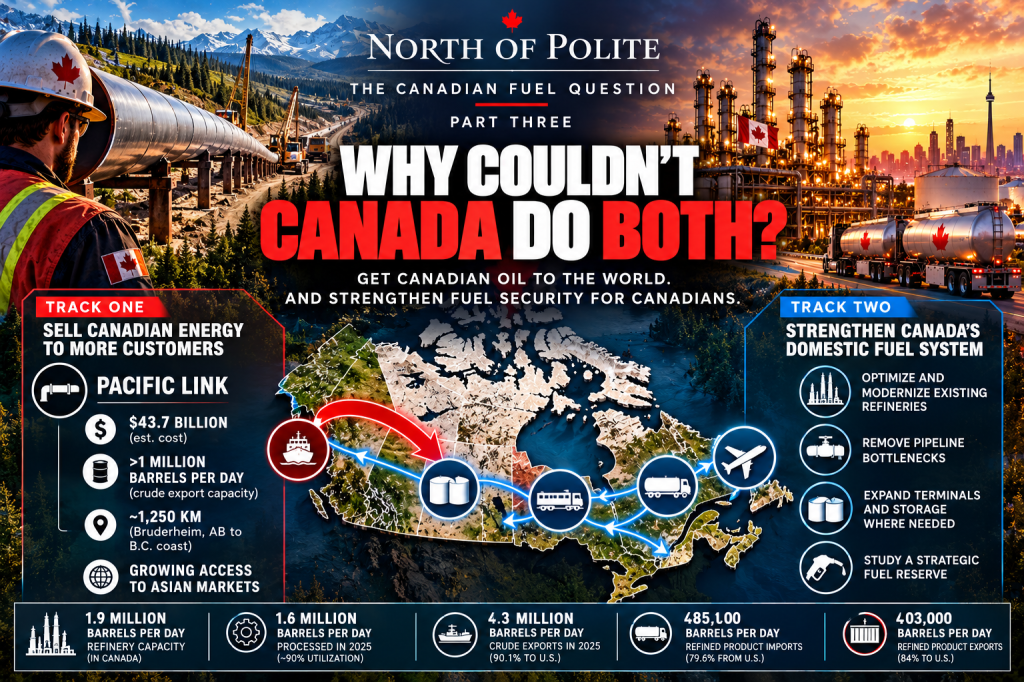
The proposed line would run roughly 1,250 kilometres from Bruderheim, Alberta, to a deepwater port on British Columbia’s southwest coast.
Its planned capacity is more than one million barrels of crude oil per day, primarily intended to improve access to growing Asian markets.
That addresses a genuine Canadian vulnerability.
In 2025, Canada exported approximately 4.3 million barrels of crude oil per day.
About 90.1 per cent went to the United States.
That is an extraordinary concentration in one customer.
The Trans Mountain Expansion has already begun expanding Canada’s access to non-U.S. markets.
Pacific Link would attempt to take that diversification much further.
That is the export-security argument.
More customers.
More access to tidewater.
Less dependence on a single foreign market.
And potentially more competition for Canadian crude.
This isn’t a small project
Alberta’s Major Projects inventory currently places Pacific Link’s estimated cost at approximately $43.7 billion, with completion targeted for 2032.
Governments and industry have projected major economic benefits, including as many as 140,000 jobs, tens of billions of dollars in additional annual economic activity and substantial government revenues over the project’s life.
Those are projections.
They are not guaranteed outcomes.
And that distinction matters.
The final project concept is still being developed.
Route mapping, ecological surveys, cost estimates, procurement and workforce planning remain underway.
The Major Projects Office, supported by the Canada Energy Regulator, is expected to spend the next year developing the project’s federal conditions, with a target of September 1, 2027.
So Pacific Link has received a powerful national-interest designation and a streamlined federal review path.
It has not magically become a finished pipeline.
There is a lot of engineering, consultation, financing, regulatory work and construction between those two things.
Who owns it?
The proposed ownership structure is unusual.
Trans Mountain Corporation, the Alberta Petroleum Marketing Commission and Pembina Pipeline Corporation form the project’s ownership group.
The Major Projects Office says Pembina’s economic interest through construction is expected to be 10 per cent, with an opportunity for up to another 10 per cent once the project enters commercial operation.
Trans Mountain and Alberta’s petroleum marketing corporation would own equal shares of the remaining interest.
Indigenous communities are to be offered at least a 10 per cent ownership interest, supported through federal and Alberta Indigenous loan-guarantee programs.
That could create substantial long-term economic participation for communities that choose to invest.
But an ownership offer is not the same thing as consent.
Some First Nations along or potentially affected by the proposed route have already raised serious concerns about consultation, environmental effects and their rights.
Coldwater Indian Band has publicly said it is considering court or other action, and other First Nations leaders have also challenged the consultation process.
Those concerns cannot be erased by putting an equity percentage on a PowerPoint slide.
Neither should opposition from some communities be represented as the position of every Indigenous nation affected by the project.
The consultation and regulatory processes still matter.
Now look at the other end of the barrel
While Canada is trying to diversify where its crude goes, Canada continues importing substantial quantities of refined petroleum products.
In 2025, Canada imported approximately 485,000 barrels per day of refined petroleum products.
About 79.6 per cent came from the United States.
Canada also exported approximately 403,000 barrels per day of refined products that year, with roughly 84 per cent going to the United States.
Yes. Read those numbers again.
Canada is a major producer of crude oil.
Canada is a major refiner.
Canada exports refined petroleum products.
Canada imports refined petroleum products.
And Canada still depends heavily on the United States on both sides of the energy relationship.
That isn’t necessarily evidence that something is broken.
Energy systems follow geography, refinery configuration, transportation infrastructure, contracts and economics.
Sometimes importing a product from a nearby American refinery makes considerably more sense than moving the same product thousands of kilometres across Canada.
And the national import number itself needs context: Alberta is Canada’s largest importer of refined petroleum products, much of it condensate used to blend bitumen.
Trade can strengthen energy security.
But concentration can also create vulnerability.
That is why this series has never argued that Canada should stop importing fuel.
The question is whether Canada has enough alternatives when the normal system fails.
Pacific Link doesn’t solve that problem
This is the distinction at the centre of Part Three.
A million additional barrels of Canadian crude reaching overseas customers could improve Canada’s export diversification.
But those barrels do not automatically become gasoline in Toronto.
They don’t automatically become diesel in Atlantic Canada.
They don’t automatically become aviation fuel at Montréal-Trudeau or Pearson.
And they don’t create an emergency reserve.
Those are different pieces of the energy system.
Pacific Link addresses one question:
How does Canada get more crude to more customers?
The Canadian fuel-security question asks another:
How does Canada make sure essential refined fuel reaches Canadians when and where they need it?
Both can reasonably be called energy security.
They simply secure different things.
Now let’s show the math
This is where the comparison becomes interesting.
Pacific Link is currently estimated at approximately:
$43.7 BILLION
For that estimated investment, the project is intended to create infrastructure capable of moving more than:
1 MILLION BARRELS OF CRUDE PER DAY
toward Canada’s West Coast and overseas markets.
Now look at the system Canada already has at home.
Canada’s existing crude-oil refineries have approximately:
1.9 MILLION BARRELS PER DAY OF CAPACITY
In 2025 they actually processed roughly:
1.6 MILLION BARRELS PER DAY
Canada therefore does not need to construct an entirely new 1.9-million-barrel-per-day refining system in order to begin examining stronger domestic fuel security.
The refining system already exists.
That changes the financial question.
The domestic strategy examined in this series begins with existing refineries, pipelines, terminals and storage.
Then it asks:
Where can those assets be optimized?
Where does the product mix need changing?
Where are the transportation bottlenecks?
Where is additional storage actually necessary?
And what would an appropriately sized strategic reserve cost?
There is evidence that optimization can matter.
Suncor recently increased the rated capacity of its four-refinery network from 466,000 to 511,000 barrels per day—a roughly 10 per cent increase—following sustained operational improvements and targeted lower-cost changes.
That does not mean every Canadian refinery can increase capacity by 10 per cent.
And because one of Suncor’s four refineries is in Colorado, it certainly doesn’t mean Canada just gained 45,000 barrels per day of domestic refining capacity.
But it demonstrates something important:
Existing infrastructure can sometimes produce more without being replaced.
Now consider the money.
Pacific Link’s current estimate gives us a $43.7-billion benchmark.
Could Canada build Pacific Link and strengthen its domestic fuel system without spending the equivalent of another giant megaproject?
We don’t know.
And we’re not going to manufacture the missing number just to make the argument work.
But here is what the arithmetic does tell us:
For the domestic side, Canada would not be starting by constructing another 1.9 million barrels per day of refining capacity.
Much of the expensive industrial base already exists.
That means the relevant costs would be incremental costs such as:
Refinery modifications.
Reliability improvements.
Pipeline bottleneck removal.
Terminal upgrades.
Additional storage.
And whatever strategic reserve an engineering study determines Canada actually requires.
So the proposition worth testing is not:
Can Canada build two $40-billion megaprojects for $40 billion?
Obviously not.
The real proposition is:
Could Canada build the $43.7-billion export pipeline while using optimization and targeted additional investment to strengthen the enormous domestic system Canada already has—without doubling the total bill?
We cannot answer yes yet.
And without the engineering and cost studies, we cannot responsibly put a price on the domestic side.
Considering the scale of infrastructure Canada already possesses, however, that calculation is worth doing before assuming export security and domestic fuel security have to compete with each other.
So why not examine both?
Canada has the oil.
Canada already has the refineries.
Canada has substantial engineering and skilled-trades capability.
If we’re willing to build infrastructure to move Canadian energy outward, why wouldn’t we also examine the infrastructure needed to strengthen supply inward?
But doing both doesn’t make the costs disappear.
Canada only has so many workers
Pacific Link would require engineers, welders, pipefitters, heavy-equipment operators, electricians, environmental specialists and project managers.
So would refinery modernization.
So would pipeline upgrades.
So would new terminals and strategic storage.
Canada cannot simply announce twenty giant projects and assume twenty giant workforces will appear on Monday morning.
Labour availability matters.
Training capacity matters.
Project sequencing matters.
And if governments and industry try to build numerous large projects simultaneously, competition for workers, equipment and materials can push costs higher.
Doing both may therefore require staging, not simply spending.
Canada only has so much capital
The same applies to money.
Pacific Link is currently estimated in the tens of billions of dollars.
Pathways carbon capture, upstream production growth, port infrastructure and related projects add billions more.
A domestic fuel-security program would require additional private and potentially public capital.
Nobody should pretend Canada can spend without limits.
But that doesn’t automatically mean the projects compete dollar-for-dollar.
A refinery upgrade could be privately financed.
A strategic reserve could involve government.
A pipeline bottleneck might be solved by an existing operator.
Storage could involve partnerships with industry.
Pacific Link itself involves federal, provincial and private-sector participation, with Indigenous equity participation proposed as well.
Before anyone says Canada cannot afford both objectives, we should first determine what both actually cost taxpayers and private investors.
That number does not yet exist.
And then there is the environmental question
Moving another million barrels of crude per day is not environmentally neutral.
Neither is processing more petroleum through Canadian refineries.
Pacific Link would mean additional infrastructure and marine transportation.
Refinery expansion could increase industrial emissions unless offset by efficiency improvements or emissions-reduction technology.
The broader federal-Alberta energy strategy also links increased oil production and export capacity with the Pathways carbon-capture project and other emissions-reduction measures.
Supporters argue that Canada can expand production while reducing emissions intensity.
Critics question the costs, effectiveness and climate implications of expanding fossil-fuel infrastructure at all.
Those arguments won’t disappear because we would also like better domestic fuel security.
They have to be tested alongside the economics.
There is another risk: building too much
Part Two identified this problem.
Gasoline demand is not guaranteed to grow forever.
The Canada Energy Regulator’s Current Measures scenario projects gasoline demand in Ontario and Quebec declining steadily toward 2050.
Diesel demand remains relatively stable initially before gradually increasing, while jet-fuel demand grows.
CER stresses that its scenarios are not predictions.
That makes building enormous new gasoline refineries particularly risky.
But it doesn’t necessarily make flexibility risky.
A refinery that can better adjust its product mix may still be valuable.
A pipeline bottleneck that can be removed may still matter.
Strategic storage may still provide insurance.
Infrastructure designed around resilience can have a different economic case from infrastructure designed around permanently increasing gasoline production.
That distinction matters.
So what would “both” actually look like?
Not two giant government megaprojects.
That is probably the wrong mental picture.
A more realistic Canadian strategy might have two tracks.
TRACK ONE — SELL CANADIAN ENERGY TO MORE CUSTOMERS
Continue examining Pacific Link and other export infrastructure on their economic, environmental, legal and Indigenous-partnership merits.
The objective:
Reduce Canada’s dependence on a single export customer and improve access to global markets.
TRACK TWO — STRENGTHEN CANADA’S DOMESTIC FUEL SYSTEM
Conduct the refinery-by-refinery, pipeline-by-pipeline and region-by-region engineering work identified in Part Two.
Determine:
Where can existing refineries economically produce more?
Where can their product mix be improved?
Where are the actual transportation bottlenecks?
What storage already exists?
Does Canada need a strategic reserve?
Should it contain crude, finished fuels or both?
Where should it be located?
And what would the entire system actually cost?
The objective:
Make Canada’s domestic fuel network more resilient without building unnecessary infrastructure.
Those two tracks are not inherently contradictory.
One is about selling Canadian crude more effectively.
The other is about making Canada’s domestic refined-fuel system more resilient.
There may even be a third benefit
Canada is already trying to expand the skilled-trades workforce needed for major infrastructure.
Federal programs announced in 2026 include additional support for paid trades placements, apprenticeships, training capacity and Red Seal certification.
That matters beyond one pipeline.
A welder trained during a major construction cycle does not cease being a welder when that project is finished.
A pipefitter trained during the same period becomes part of Canada’s industrial capacity.
Leonard Buffalo might put it this way:
Infrastructure isn’t only what gets built.
It’s also the people who learn how to build it.
If Canada genuinely intends to enter another period of major infrastructure construction, training Canadians may be one of the most durable investments involved.
But there is one condition
“Do both” cannot mean:
Approve everything.
Spend anything.
Build anywhere.
And ask questions later.
That isn’t nation-building.
That’s a shopping spree.
Every project still needs to answer basic questions.
What problem does it solve?
What does it cost?
Who pays?
Who benefits?
What can go wrong?
What environmental effects result?
What Indigenous rights are affected?
What happens if the economic assumptions change?
And is there a cheaper way to achieve the same objective?
Pacific Link should have to answer those questions.
So should a Canadian Strategic Fuel Reserve.
So should refinery upgrades.
So should pipelines, terminals and storage.
North of Polite doesn’t get to lower the standard because we happen to like our own question.
After three days, here’s what we actually know
Canada does not have a simple “we don’t refine our own oil” problem.
We have a much more interesting problem.
Canada already produces enormous quantities of crude oil.
Canada already operates a major refining industry.
Canada already exports crude and refined petroleum products.
Canada also imports crude and refined products.
And much of that trade still involves one country:
the United States.
Pacific Link attempts to diversify one side of that relationship.
A serious domestic fuel-security strategy could examine the other.
Maybe the engineering studies would show that major refinery changes aren’t economical.
Maybe commercial inventories already provide enough protection in some regions.
Maybe strategic storage makes sense only for certain fuels.
Maybe some pipeline bottlenecks can be solved cheaply.
Maybe others would cost far more than they’re worth.
We don’t know.
And after three days of looking at this, that may be the most important conclusion of all.
Canada should find out
Before committing tens of billions to new infrastructure, Canadians deserve more than slogans.
Not:
Build pipelines.
Not:
Stop pipelines.
Not:
Build refineries.
Not:
Oil is finished.
Those fit nicely on signs.
Energy systems don’t.
The better question is harder:
What combination of production, refining, transportation, storage, trade and emergency capacity gives Canada the strongest energy system for the money Canadians are being asked to invest?
That requires engineering.
Economics.
Environmental analysis.
Indigenous consultation and participation.
And some willingness to admit when the evidence doesn’t support the answer we expected.
Maybe the choice isn’t home or abroad
Canada is an energy exporter.
There is no obvious reason it should stop being one.
But Canada is also a country of more than 40 million people spread across nearly 10 million square kilometres.
Those people need trucks moving groceries.
Aircraft moving passengers and freight.
Farm equipment working fields.
Emergency vehicles running when something goes wrong.
And industries that cannot simply shut down because a supply route failed.
So perhaps Canada’s energy strategy should not begin by choosing between Canadians and customers overseas.
Perhaps it should begin with a more practical question:
What does Canada need at home—and what can Canada profitably sell to the world after we’ve built a system resilient enough to handle both?
That isn’t an argument for Pacific Link.
It isn’t an argument against Pacific Link.
And it isn’t proof that a Canadian Strategic Fuel Reserve would be worth its cost.
It is an argument for finding out.
Because after three days, one fact is difficult to ignore:
Canada has the resources.
Canada has much of the infrastructure.
Canada has skilled workers.
What Canada still needs is a clear answer to what it wants the entire system to accomplish.
And maybe that is the real Canadian fuel question.
© 2026 North of Polite. Original reporting, analysis and commentary. All rights reserved. 🍁





Leave a comment