

By Gary Goose | North of Polite
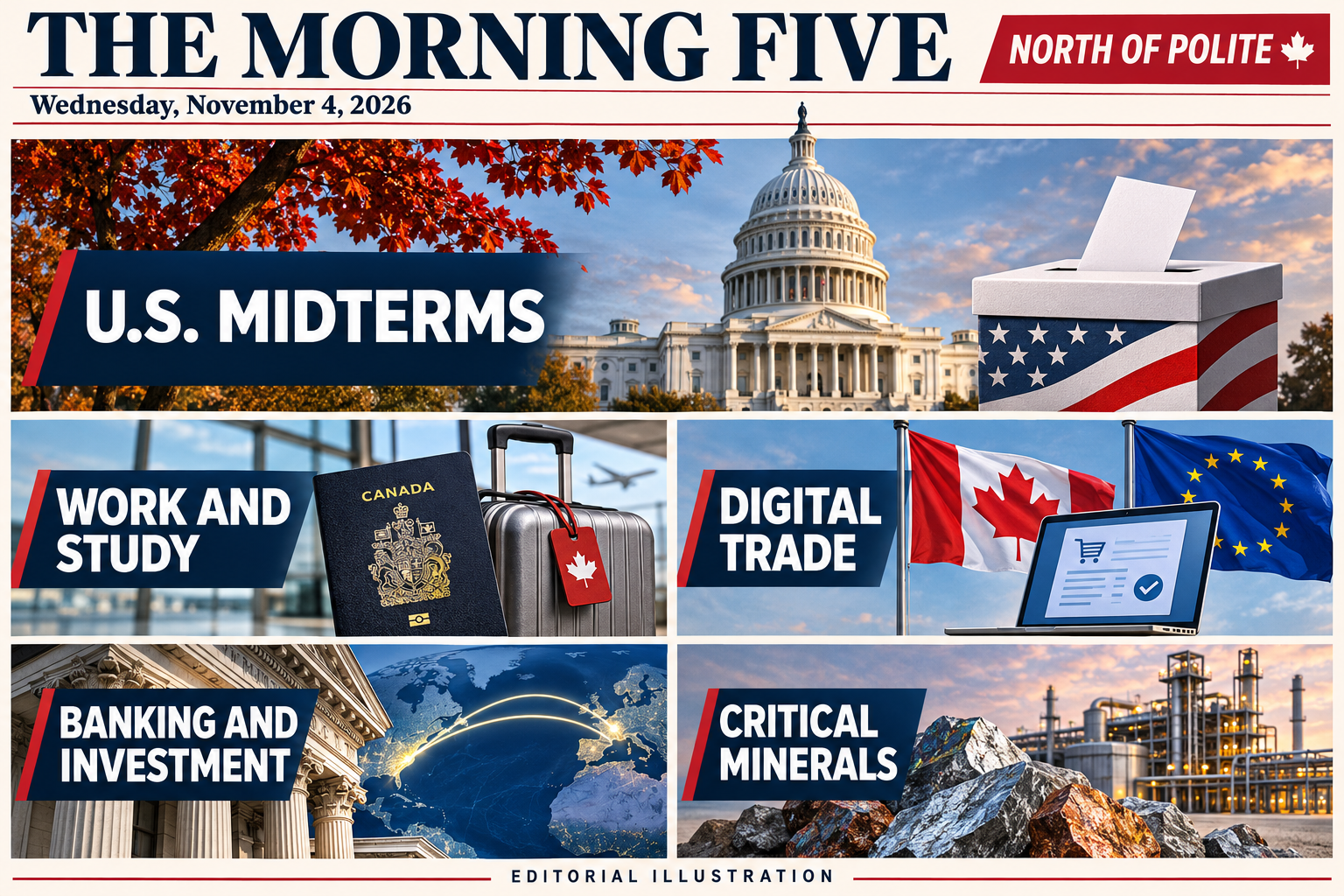
For Canadians watching the U.S. midterms, there are two contests worth following separately. One is for the House of Representatives. The other is for the Senate. Before election day, polls favoured Democrats to take the House, while the contest for Senate control was closer. A House majority takes 218 seats. In the Senate, Democrats need 51 for control, while Republicans can retain control with 50 because the vice-president can break a tie. Close races can take days to call.
A change in the House majority would change who runs its committees and which bills get floor time. That matters when Congress takes up trade legislation or decides what to spend on customs and border operations. A committee can also call officials to explain what a policy is doing to businesses on either side of the border. A hearing can put those costs on the public record. Changing the policy is another step.
The White House will still make decisions under the trade powers Congress has delegated to the executive branch. And when changing the law requires a bill, the House and Senate both have a say. So if you run a shop that ships to Michigan or a trucking company that crosses at Windsor, the question after the election is concrete. Has a tariff changed? Has a customs rule changed? Has money actually been approved for the crossing you use? The seat count tells you who can move those decisions forward. The decisions themselves tell you what to do Monday morning.
© 2026 North of Polite. Original reporting, analysis and commentary. All rights reserved. 🍁

Could it get easier for Canadians to work or study in Europe?
By Gord Moose | North of Polite
A Canadian offered a job in Europe can have the right experience and still face two separate questions. Can they get permission to work there? And will the country recognize the qualifications they bring? The Canada–EU summit in Montréal put both issues on the table. Ottawa and Brussels agreed to discuss ways to make it easier for skilled workers and researchers to move across the Atlantic, and to improve recognition of professional qualifications. They also agreed to explore a new youth mobility partnership.
Those are different tracks. A youth mobility arrangement could make it easier for eligible young people to spend time abroad. Recognition of professional qualifications could matter to someone who already has years of training and wants to know whether it counts in another country. A work permit and permission to practise a regulated profession answer different questions. The joint statement leaves the terms of any new arrangement to future talks.
Here’s what would make the announcement useful to someone making plans. Which countries would take part? What would the age limits be? How long could someone stay? If you’ve got a trade certificate or a professional licence, who decides whether it’s accepted, and what extra training could they ask for? When governments can answer those questions, people can start deciding whether the opportunity works for them.
© 2026 North of Polite. Original reporting, analysis and commentary. All rights reserved. 🍁

Canada and the EU finished digital trade talks. What changes for a small business?
By Gord Moose | North of Polite
Say you run a small Canadian design shop and land a client in France. The work can cross the Atlantic in seconds. Doing business still means agreeing to a contract, getting paid and knowing what you’re allowed to do with customer information. Those are the kinds of everyday transactions that give a digital trade agreement its importance.
Canada and the European Union announced on October 30 that they had concluded negotiations on a Digital Trade Agreement. It’s intended to build on CETA, the existing Canada–EU trade agreement. Global Affairs Canada still lists its status as concluded negotiations. For a business owner deciding what to do with a contract today, the date the agreement takes effect matters more than the date negotiators finished their work.
Ottawa says the agreement is designed to preserve Canada’s ability to regulate in areas including privacy, culture, cybersecurity and financial regulation. That matters because making an online sale easier and protecting the information that comes with it are both part of the job. Once the terms and start date are clear, the test will be whether a small firm can point to a step that has actually become simpler. Can it complete a transaction electronically with fewer duplicate steps? Can it tell which rules apply without paying someone to sort through them every time? That’s what an online seller will be able to measure.
© 2026 North of Polite. Original reporting, analysis and commentary. All rights reserved. 🍁

What would closer Canada–EU financial ties mean on Main Street?
By Gord Moose | North of Polite
A small manufacturer can win an order from Europe and still have a problem at home. Materials and wages have to be paid before the customer settles the invoice. A lender willing to finance that gap can make the difference between filling the order and turning it down. That’s one way to judge the promise of closer financial ties between Canada and the European Union.
In their October 30 joint statement, Ottawa and Brussels said they would pursue closer cooperation to make it easier for capital to move across the Atlantic and expand access to financial services. The statement sets a direction for governments and regulators. It leaves the terms of any future financing offer or service to be worked out.
The phrase cross-border capital flows can cover a lot of ground. A European institution investing in a large Canadian project is one thing. A Canadian business gaining a financing option it can actually apply for is another. For that business, the questions are who’s eligible, how much the financing costs and whether it arrives in time to fill an order. For consumers, the same test is even simpler. What service can you get, what does it cost, and who handles the complaint if something goes wrong? Those are the details that will show how far the cooperation reaches.
© 2026 North of Polite. Original reporting, analysis and commentary. All rights reserved. 🍁

Critical minerals and the Canadian jobs beyond the mine
By Gord Moose | North of Polite
When a mine is proposed, the first question in town is often how many people it will hire. There’s a second question worth asking while the plans are still on the table. Where does the ore go after it leaves the mine? The answer can tell you where the next round of work will be done and which communities will be in line for it.
Canada and the European Investment Bank concluded negotiations on an agreement intended to facilitate European investment in Canadian resources, particularly critical minerals. In their wider summit statement, Canada and the EU also committed to supporting investment across the supply chain, including extraction, processing, refining, manufacturing and recycling. That list matters. It covers several kinds of work and several investment decisions.
A mine can create work for equipment operators, mechanics and contractors. A processing plant can bring its own construction, maintenance and operating jobs. The two facilities can be built in different places. When a project is announced, ask where the processing will happen, what work will remain after construction and what agreements are in place with affected First Nations and other local communities. The financing agreement gives Canada and Europe a way to pursue projects. The plans for each project will show where the jobs are expected to land and who will have a say in how the work proceeds.
© 2026 North of Polite. Original reporting, analysis and commentary. All rights reserved. 🍁
Leave a Reply