
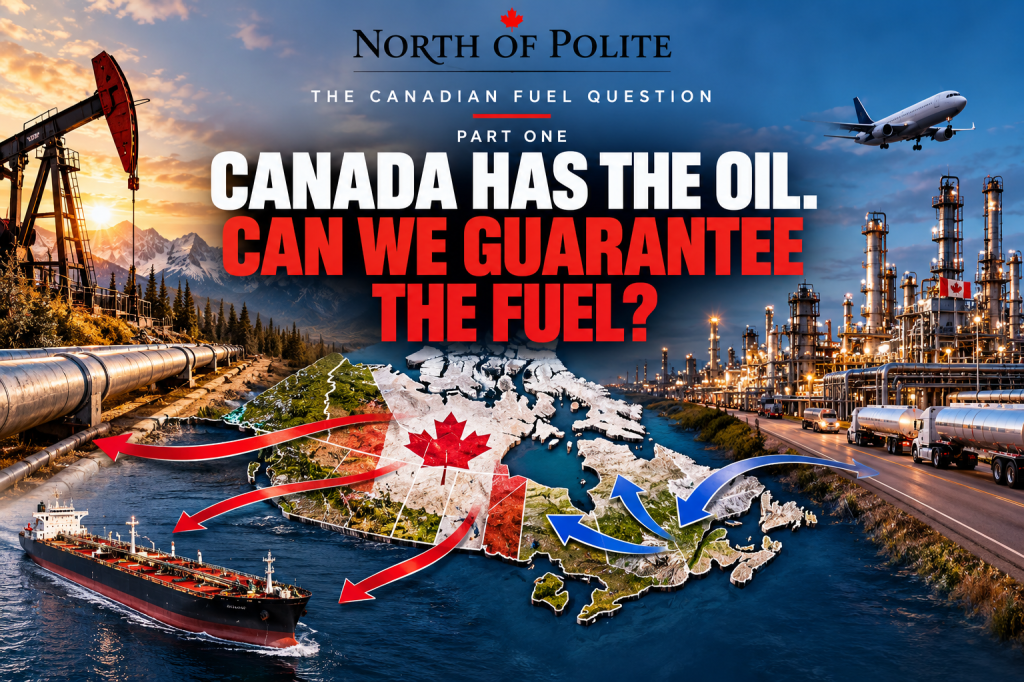
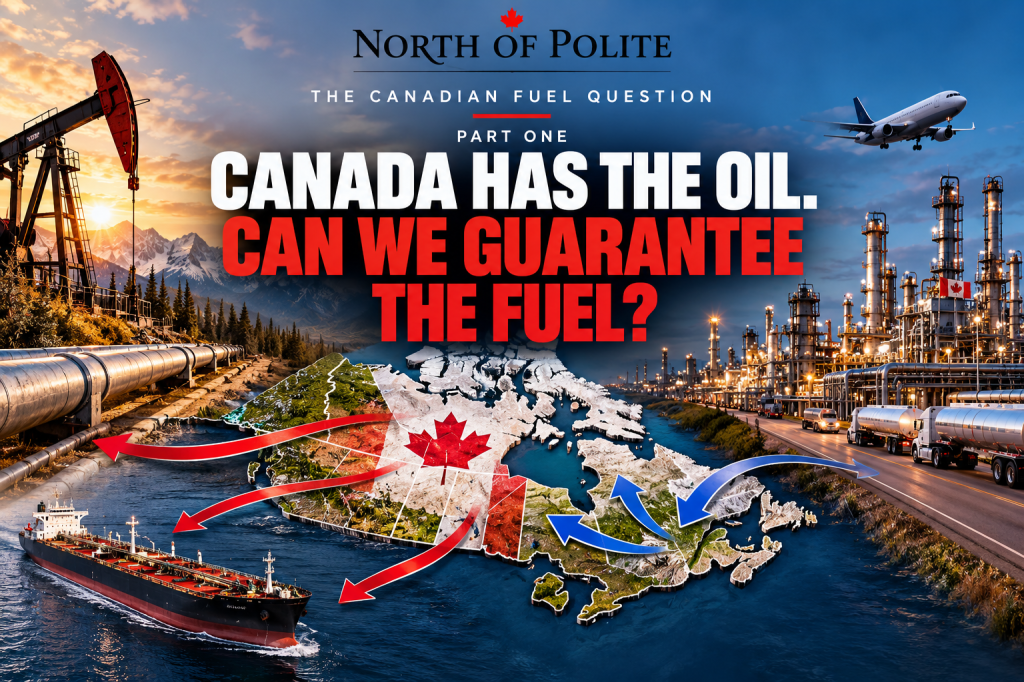
CANADA HAS THE OIL. CAN WE GUARANTEE THE FUEL?
By Gord Moose
Research and fact-checking: Frank Facts and Walter Beaver
Canada has a lot of oil.
That is hardly breaking news.
We are one of the world’s major crude-producing countries. Pipelines carry enormous quantities of Canadian oil across the continent. Tankers carry it overseas. Governments are now discussing billions of dollars in additional infrastructure intended to get even more Canadian crude to customers beyond the United States.
So North of Polite started with what seemed like a fairly simple question:
Can Canada produce enough gasoline, diesel and aviation fuel to secure its own needs first?
Then we looked at the numbers.
And the question became considerably more interesting.
Canada already makes an enormous amount of fuel
In 2025, Canadian refineries produced a record 117.1 billion litres of finished petroleum products.
Canadian consumption was approximately 105.0 billion litres.
Canada also recorded a 10.9-billion-litre trade surplus in finished petroleum products that year.
Those numbers are related, but they are not interchangeable: production, consumption, imports, exports and inventories all move independently through the system. What they do establish is that Canada is already a major net producer of finished petroleum products.
That production includes gasoline, diesel and other distillates, aviation fuel and numerous other petroleum products.
Canada also isn’t operating some tiny collection of antiquated neighbourhood stills behind Gord’s garage.
The country has 16 operating crude-oil refineries with approximately 1.9 million barrels per day of operating capacity.
In 2025, they processed about 1.6 million barrels per day, operating at approximately 90 per cent of capacity over the year.
And roughly 20 per cent of the refined petroleum products produced in Canada were exported.
At first glance, that seems to produce an obvious conclusion:
Canada has oil.
Canada has refineries.
Canada produces enormous quantities of finished petroleum products.
Canada exports refined petroleum products.
Therefore Canada shouldn’t need to import fuel.
Except we do.
And this is where the story stops being simple.
Canada exports fuel — and imports fuel
In 2025, Canada exported approximately 400,000 barrels per day of refined petroleum products.
About 84 per cent of those exports went to the United States.
At the same time, Canada imported refined petroleum products.
Quite a lot of them.
Total imports reached approximately 485,000 barrels per day in 2025, with almost 80 per cent coming from the United States.
Before anybody starts throwing furniture, there is an important catch.
Those imports are not all gasoline, diesel and jet fuel.
Alberta alone accounted for approximately 200,000 barrels per day of refined-petroleum-product imports in 2025. Much of that was condensate—a light petroleum product mixed with heavy oil-sands bitumen so it can flow through pipelines.
So saying, “Canada imported 485,000 barrels of foreign gasoline every day while exporting Canadian gasoline,” would be wrong.
We didn’t.
But the regional transportation-fuel numbers are still worth examining.
Look at Ontario and Quebec
Ontario and Quebec account for nearly half of Canada’s refined-petroleum-product demand.
Together they have six refineries capable of processing almost 800,000 barrels of crude per day.
Yet in 2024, Ontario and Quebec imported approximately 62,000 barrels per day of gasoline.
At the same time, they exported approximately 22,000 barrels per day of gasoline.
They imported only about 2,000 barrels per day of diesel while exporting approximately 50,000 barrels per day of diesel.
And nearly one-third of the aviation fuel used in Ontario and Quebec was imported.
YES, read that again.
Central Canada can be importing gasoline, exporting gasoline, exporting large quantities of diesel and importing substantial aviation fuel at the same time.
That isn’t evidence of a conspiracy.
It’s evidence that an oil refinery isn’t a magic box where Canada pours crude into one end and selects “gasoline,” “diesel” or “jet fuel” from a menu at the other.
A barrel of oil becomes many things
Refineries are designed differently.
Their equipment determines which crude oils they can efficiently process and what mixture of products they can economically produce.
Demand changes too.
We need gasoline for cars, diesel for trucks and heavy equipment, aviation fuel for aircraft, heating products, petrochemical feedstocks and numerous other petroleum products.
And the refinery producing those products may be hundreds or thousands of kilometres from the Canadian who needs them.
That brings us to the second problem.
Canada is enormous
This may also not qualify as breaking news.
Producing a litre of gasoline somewhere in Canada does not mean it can economically appear at a gas station anywhere else in Canada.
Western Canadian refineries sit close to enormous domestic crude supplies and have direct pipeline connections.
The situation changes as you move east.
Ontario has four refineries with combined capacity of approximately 402,000 barrels per day. Ontario and Quebec together have six refineries capable of processing almost 800,000 barrels per day.
Crude moves into Central Canada primarily through infrastructure including the Enbridge Mainline and Line 9, supplemented by marine shipments.
Finished gasoline, diesel and other products move through a different network involving pipelines, railways, ships and trucks.
The Trans-Northern Pipeline, for example, distributes refined petroleum products from refineries in Montreal and southern Ontario to delivery points across both provinces.
So sometimes the economically sensible way to supply a Canadian market is to import the particular product it needs while another Canadian refinery exports a different product somewhere else.
Commercial decisions matter too.
According to the Canada Energy Regulator, distributors consider product specifications, price, availability of local supply, transportation costs and other logistical or commercial factors when deciding where to purchase refined petroleum products.
In other words, there isn’t one giant Canadian fuel tank.
There are regional markets connected—imperfectly—by pipelines, railways, highways, ports, refineries and international trade.
And some Canadian refineries still import crude
There is another apparent contradiction.
Canada produces more crude oil than its refineries process.
Yet some Canadian refineries import crude oil.
Again, geography explains much of it.
Western Canadian refineries have close proximity and direct pipeline connections to western Canadian production.
Eastern refineries don’t always have that luxury.
In 2025, Quebec imported approximately 126,000 barrels of crude per day, essentially all from the United States.
Ontario imported approximately 87,000 barrels per day, with virtually all of those imports also coming from the United States.
And New Brunswick imported approximately 270,000 barrels per day.
The Saint John refinery in New Brunswick—the largest refinery in Canada—is not connected to a crude-oil pipeline at all. It therefore relies on marine shipments for its feedstock.
Canada can therefore simultaneously:
produce enormous quantities of crude,
export crude,
import crude,
produce enormous quantities of refined fuel,
export refined fuel,
and import refined fuel.
That sounds absurd until you look at the map.
Then it starts making considerably more sense.
But understanding it doesn’t mean we shouldn’t question it
This is where North of Polite’s investigation really begins.
The existing system developed around geography, economics, refinery design, continental trade and infrastructure built over many decades.
There are legitimate economic and logistical reasons for much of what we’re seeing.
But “there is a reason for it” is not the same thing as saying it is the best system Canada could have.
The Canada Energy Regulator says significantly increasing domestic aviation-fuel production in Ontario and Quebec would likely require significant changes to existing refinery infrastructure.
It also identifies a larger vulnerability: the major pipeline systems delivering crude oil and natural gas into Central Canada are likely operating near their capability to deliver additional volumes into the region. The CER concludes that Central Canada’s energy security would not significantly change without major energy-transportation infrastructure changes.
There is another wrinkle worth remembering.
Much of the western Canadian crude reaching Ontario and Quebec travels on the Enbridge Mainline through the United States before re-entering Canada at Sarnia. The CER notes that there is currently no crude-oil pipeline running entirely within Canada that connects western Canadian production with eastern Canadian refineries.
So Canada’s fuel-security question isn’t simply about how much oil we produce.
It is also about where our refineries are, what they are designed to make and how crude and finished fuels move between them.
And that gives us a much more useful question.
Not:
Why doesn’t Canada make its own gasoline?
We already make an enormous amount of it.
Not:
Why are companies exporting Canadian fuel instead of selling it to Canadians?
International trade and regional economics are considerably more complicated than that.
The real question is:
Could Canada redesign what it already has?
Could we upgrade existing refineries so their output better matches Canadian demand?
Could we improve the pipelines, terminals and storage moving finished fuels between Canadian regions?
Could we produce enough gasoline, diesel and aviation fuel domestically to cover normal Canadian requirements?
Could we maintain an emergency reserve for refinery outages, wars, natural disasters or international supply disruptions?
Could Canadian refiners still export their surplus and remain profitable?
And could we accomplish all of that without spending tens of billions building entirely new refineries that Canada may eventually not need?
Those are very different questions.
And they’re the ones we’re going to try to answer.
Because if Canada is prepared to invest enormous sums getting Canadian crude to customers around the world, it is reasonable to ask what it would cost to make Canada’s own fuel system more secure at home.
Not because imports are inherently bad.
Not because exports are inherently bad.
And certainly not because Canada can somehow disconnect itself from world oil prices.
But because energy security isn’t simply about how much oil lies beneath Canadian soil.
It is about whether we can turn that oil into the products Canadians actually need—and get those products to the places Canadians need them when they need them.
Canada has the oil.
Canada has the refineries.
Now we need to find out what it would take to guarantee the fuel.
NEXT: PART TWO — WHAT WOULD CANADIAN FUEL SECURITY ACTUALLY COST?
North of Polite will examine Canada’s existing refineries, the upgrades that could be required, pipelines and storage, a possible strategic fuel reserve, construction and permanent jobs, environmental costs, taxpayer exposure—and whether the numbers actually make economic sense.
© 2026 North of Polite. Original reporting, analysis and commentary. All rights reserved. 🍁





Leave a comment