
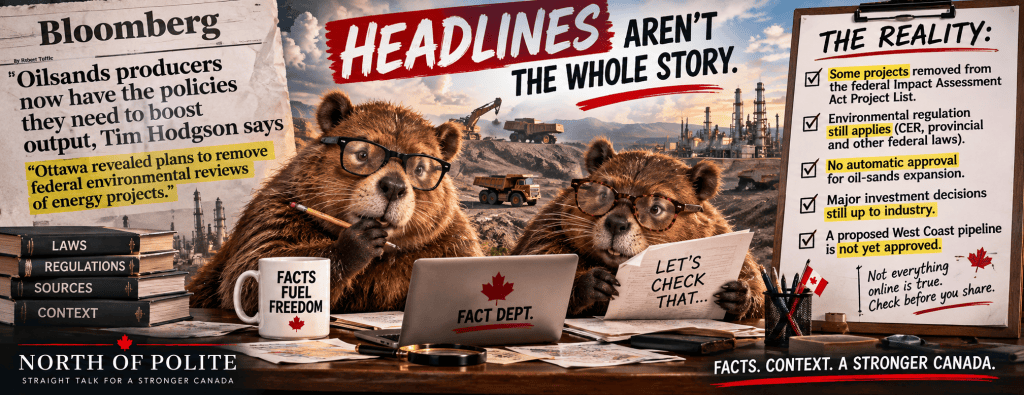
Canada’s energy rules really did change. But “Ottawa removes federal environmental reviews” doesn’t tell Canadians what actually happened — or what still stands between regulatory reform and another million barrels of production.
A headline about Canada’s oil sands is making an extraordinary claim.
Federal Energy Minister Tim Hodgson says Canada’s oil-sands producers now have the federal policy conditions they need to increase production.
Reporting surrounding those comments has described Ottawa as removing federal environmental reviews of energy projects.
Read quickly, and the impression seems obvious:
Ottawa has removed environmental assessment from pipelines and oil-sands development, clearing the way for producers to dramatically increase output.
That isn’t the whole story.
Something significant has changed.
But environmental oversight has not simply disappeared.
And oil producers have not yet demonstrated that changing these regulations will trigger the enormous investments required to produce enough additional oil to fill Canada’s proposed new export infrastructure.
Let’s separate what actually happened from what the shorthand can make it sound like happened.
Ottawa did change the rules
On September 3, 2026, the federal government registered amendments to the Physical Activities Regulations, commonly called the Project List, under Canada’s Impact Assessment Act.
The government publicly announced the changes on September 9.
The amendments remove several categories of projects from automatic designation under the federal Impact Assessment Act.
They include:
- international and interprovincial pipelines;
- international and designated interprovincial electrical transmission lines;
- certain offshore renewable-energy projects regulated by the Canada Energy Regulator;
- certain CER-regulated oil and gas facilities;
- qualifying in-situ oil-sands extraction facilities; and
- fossil-fuel-fired power generating facilities.
That is a substantial regulatory change.
But here is the distinction Canadians need to understand:
Being removed from the Impact Assessment Act Project List is not the same thing as being removed from environmental regulation.
Those are very different statements.
Pipelines don’t suddenly become unregulated
International and interprovincial pipelines remain federally regulated through the Canada Energy Regulator.
And the Canada Energy Regulator Act specifically requires the regulator to consider matters including:
- environmental effects, including cumulative environmental effects;
- protection of people, property and the environment;
- health, social and economic effects;
- Indigenous interests and concerns;
- effects on constitutionally protected Indigenous rights;
- climate commitments;
- economic feasibility; and
- the existence of actual or potential markets.
In other words, federally regulated pipelines aren’t going from environmental review to no environmental review.
They are being moved away from the additional Impact Assessment Act pathway and handled through the specialized federal regulator that already governs them.
For the in-situ oil-sands and fossil-fuel power categories being removed from the Project List, provincial assessment and regulation continue, along with other applicable federal laws and constitutional obligations.
So describing the entire change simply as the elimination of “federal environmental reviews” risks leaving readers with the impression that Ottawa has abandoned environmental scrutiny altogether.
It hasn’t.
What Ottawa is attempting to eliminate is an additional federal assessment process where it believes another regulator or provincial system already addresses the relevant effects.
Whether those remaining systems ultimately provide environmental protection Canadians consider adequate is a legitimate question.
We don’t know the practical outcome yet.
But that’s very different from saying environmental oversight disappeared.
Ottawa itself says relatively few projects are affected
This is another part of the story worth understanding.
According to Ottawa’s own regulatory analysis, approximately 10 projects per year were expected to enter the Impact Assessment Act system without the amendments.
Under the new regulations, Ottawa estimates approximately seven or eight will.
That’s a reduction of roughly two or three designated projects annually.
And there is another revealing fact.
The integrated Impact Assessment Act/Canada Energy Regulator review-panel system created for certain pipelines and transmission projects in 2019 has never actually been used for a pipeline or electrical transmission-line project.
Not once.
Ottawa also says no in-situ oil-sands project that would have fallen under the provision being removed is anticipated to be proposed during the next decade.
That puts the immediate effect of the amendment into perspective.
This isn’t Ottawa throwing Canada’s environmental-assessment system into the garbage.
It’s Ottawa changing which regulatory door certain projects have to walk through.
So why does Tim Hodgson think this matters?
Because the government’s economic argument isn’t primarily about the cost of paperwork.
It’s about certainty.
Oil-sands projects require enormous amounts of capital.
Companies considering investments expected to operate for decades need to know who regulates them, what approvals are required, how governments and regulators interact and approximately how long the process might take.
The Carney government has increasingly focused its regulatory strategy on that problem.
Its approach now emphasizes:
One project. One review.
Faster decisions.
Greater reliance on specialized regulators.
Less duplication.
And more infrastructure capable of getting Canadian resources to markets beyond the United States.
That’s the context in which Hodgson’s argument matters.
From Ottawa’s perspective, the federal government has now provided much of the regulatory framework needed for producers to consider significant new expansion.
Notice the qualifier:
From Ottawa’s perspective.
The federal government cannot order private companies to spend tens of billions of dollars expanding production.
Now industry has to decide
This may be the most important part of the story.
Canada can change regulations.
Governments can support pipelines.
They can create tax incentives.
They can negotiate regulatory frameworks.
But companies still have to decide whether investing enormous amounts of private capital in additional oil-sands production makes economic sense.
And that decision doesn’t depend on C-69 alone.
Companies have to consider:
Oil prices.
Construction costs.
Operating costs.
Financing.
Pipeline tolls.
Labour availability.
Fiscal policy.
Carbon policy.
Carbon-capture economics.
Long-term global demand.
Political risk.
And the return available from investing that capital somewhere else.
That’s why Hodgson’s statement should be understood for what it is:
The federal government’s assessment of the investment environment.
It isn’t proof that producers have already reached the same conclusion.
The West Coast Oil Pipeline makes this a real-world test
Canada and Alberta are now advancing an Alberta proposal for a new interprovincial pipeline from the Edmonton region toward a deepwater port in southern British Columbia.
The proposal is designed to carry approximately one million barrels of crude oil per day.
The economic objective is straightforward.
Canada remains heavily dependent on the United States as a market for its crude exports.
Additional Pacific export capacity could provide greater access to overseas markets.
But precision matters here too.
The pipeline has not been approved for construction.
It remains in the early stages of development.
The precise route has not been finalized.
The federal Major Projects Office is consulting Indigenous communities, governments and other affected parties as part of determining whether the project should be listed as a project of national interest under the Building Canada Act.
The federal government also says advancement of the pipeline is connected to advancement of the Pathways carbon-capture project.
So there are still major steps ahead.
Regulation.
Consultation.
Indigenous rights.
Commercial agreements.
Financing.
Construction economics.
And ultimately enough oil production to support the additional transportation capacity.
A million-barrel-per-day pipeline only makes economic sense if sufficient supply and customers exist to use it.
That’s why Hodgson’s comments are significant.
Ottawa is effectively saying:
We’ve changed our part of the equation. Now what does industry do?
And this changes the political argument too
For years, federal regulation — particularly Bill C-69 and the Impact Assessment Act — has been blamed for making major Canadian energy projects extraordinarily difficult to build.
Alberta challenged the original Impact Assessment Act all the way to the Supreme Court of Canada.
And Alberta had a legitimate constitutional argument.
In 2023, the Supreme Court concluded that the designated-project portion of the original federal scheme was outside Parliament’s constitutional authority as it was then structured.
The Court did not say Parliament had no authority to conduct environmental assessment.
It said Ottawa had designed important parts of this particular scheme too broadly.
The federal government subsequently amended the legislation.
Now Ottawa has gone further.
It has removed additional energy-project categories from the federal Project List.
It is relying more heavily on specialized regulators.
It is pursuing a one-project, one-review approach.
It is participating with Alberta in advancing a proposed new west-coast oil pipeline.
And the federal energy minister is publicly telling oil-sands producers that Ottawa believes the federal policy conditions required for significant growth are now largely in place.
That doesn’t mean every Alberta grievance has disappeared.
It doesn’t mean Ottawa suddenly agrees with Alberta on everything.
And it certainly doesn’t guarantee another pipeline will be built.
But it does mean the argument has changed.
This is where everyone has to show their cards
For Ottawa:
You say you’ve improved the regulatory system. Prove it.
Show Canadians that projects can actually move more efficiently.
Show that investment responds.
Show that environmental protection remains meaningful.
Show that Indigenous consultation remains substantive.
And show that Canadian resources can reach additional markets.
For industry:
You have repeatedly identified regulatory uncertainty as an investment problem. Ottawa is changing the system. What happens now?
If companies begin committing major capital, expanding production and supporting additional export capacity, that will provide evidence that regulatory reform mattered.
If they don’t, Canadians deserve to understand why.
Perhaps other regulatory barriers remain.
Perhaps more fiscal support is required.
Perhaps some projects simply aren’t economic.
Perhaps long-term oil-market uncertainty matters more than regulation.
Whatever the answer is, let’s identify it.
For Alberta separatists:
If federal policies cited as evidence that Canada prevents Alberta from developing its resources are changed, how does that affect the argument for leaving Canada?
Perhaps the answer is that it doesn’t.
That’s a position separatists are entitled to make.
But then the argument needs to explain why.
And for environmental advocates:
If Canada can eliminate duplicated processes while maintaining meaningful environmental protection, is duplication itself worth defending?
Conversely, if environmental protection or meaningful Indigenous participation weakens under the new system, Ottawa should be held accountable.
Same standard.
Every side.
The real story isn’t that environmental oversight disappeared
The real story is considerably more interesting.
Canada is attempting something it has struggled with for years:
Building faster without simply abandoning oversight.
Whether it succeeds is still unknown.
The Carney government believes it has removed enough federal regulatory uncertainty for oil-sands producers to seriously consider additional investment.
Industry now has an opportunity to demonstrate whether regulation really was one of the major obstacles holding expansion back.
Environmental organizations, Indigenous communities and Canadians generally now have an opportunity to see whether Ottawa’s promise of faster but responsible development survives contact with actual projects.
And Alberta now has an opportunity to test whether changing federal policy can meaningfully change its relationship with Ottawa.
That’s the story Canadians deserve.
Not:
Environmental reviews are gone.
And not:
The oil boom has begun.
Neither has been established.
What has happened is more precise:
Ottawa changed the regulatory pathway.
Now comes the important part.
Does anything actually get built?
© 2026 North of Polite. Original reporting, analysis and commentary. All rights reserved. 🍁
Unapologetically Canadian. We stand for a strong, sovereign and united Canada. No party owns our loyalty. If you make a claim, bring the receipts. We will too.


Leave a comment