
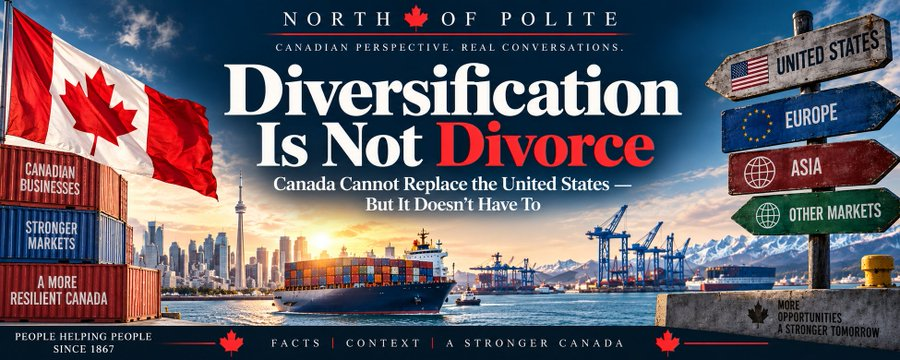
Canada Cannot Replace the United States But It Doesn’t Have To —
There is an argument making the rounds in Canada right now: the United States is overwhelmingly our largest customer, so trying to redirect Canadian trade toward Europe, Asia or other markets is unrealistic — perhaps even economically dangerous.
There is some truth buried inside that argument.
The United States cannot simply be replaced.
It is our neighbor, our largest trading partner and part of supply chains that have been built across the border for generations. In 2024, more than $1 trillion in merchandise trade crossed between Canada and the United States. Canadian energy, automobiles, manufacturing, agriculture and countless smaller businesses have been built around access to the American market.
Pretending we could simply redirect all of that business across the Atlantic or Pacific would be foolish.
But that is not what diversification means.
First, Let’s Get the Numbers Straight One of the most common misconceptions in the current debate is that because roughly 70% of Canadian goods exports go to the United States, something approaching 70% of Canada’s entire economy therefore depends on America.
Those are not the same thing.
Exports are an important component of Canada’s economy, but export percentages are not percentages of GDP. Nor does one additional dollar of gross exports automatically create one additional dollar of Canadian GDP.
Canada’s dependence on the American market is substantial enough without exaggerating it.
In 2024, 75.9% of Canada’s merchandise exports went to the United States. In 2025, that figure fell to 71.7%. Canadian merchandise exports to the U.S. declined 5.8% that year, while exports to countries other than the United States increased 17.2%.
That deserves attention.
It does not mean Canada has replaced the American market. It does not mean diversification has already succeeded. And it certainly does not mean losing access to American customers would be painless.
It means something much simpler:
Canadian businesses can sell more to the rest of the world.
Statistics Canada found that non-U.S. domestic exports increased by $27.6 billion in 2025. Precious metals accounted for a significant part of that growth, which is an important qualification. But even after excluding gold, silver and platinum-group metals, exports to non-U.S. markets still increased by about $14 billion.
And the movement has continued.
In July 2026, Canadian merchandise exports to countries other than the United States rose another 7.4% to a record $25.6 billion. For that month, 33.7% of Canadian merchandise exports went somewhere other than the United States.
That is not proof that the problem has been solved.
But it is strong evidence that diversification is not some economic fantasy.
Why Not Just Sell Even More to America? This is where the argument becomes interesting.
If America is already our largest and richest nearby customer, why not simply double down?
If a Canadian company can profitably increase its American sales, it absolutely should.
But what makes sense for an individual company today is not necessarily a sound national risk-management strategy for the next 30 years.
Imagine a business with one customer responsible for nearly three-quarters of its exports. Now imagine that customer suddenly begins changing the conditions under which it will buy from you.
Would the sensible response be, make that customer responsible for an even greater share of your business?
Or
Would you keep that valuable customer while beginning the difficult work of finding others?
That is the distinction being lost in much of this debate.
A great customer is an asset. Having no alternative to that customer is a vulnerability.
The United States should remain one of Canada’s most important markets. Geography alone makes that obvious.
But the current trade confrontation has demonstrated why Canada also needs options.
Diversification isn’t about punishing America.
It’s about protecting Canada.
You Can’t Diversify Without Building Something
This is where political rhetoric eventually runs into physical reality.
You cannot announce diversification from a podium and expect cargo to magically arrive in Rotterdam, Tokyo or Seoul.
Trade requires ports.
It requires railways, highways, pipelines, energy terminals, electricity, warehouses and efficient border and regulatory systems.
It requires companies willing to invest billions of dollars based on the belief that Canada can actually complete major projects.
Prime Minister Mark Carney recently reached into Canadian history to make essentially this infrastructure argument. In discussing nation-building, he invoked the Canadian Pacific Railway as an “iron spine” that helped connect a young country, expand trade and unlock Canadian resources.
The historical analogy is useful.
But an analogy isn’t an economic plan.
If today’s government wants to invoke Canada’s great nation-building projects,
Canadians should reasonably ask what today’s projects actually are, what they will cost, who will build them, how long they will take and whether customers exist at the other end.
That same standard should apply regardless of which party is governing.
Show us the railway. Show us the port. Show us the customer. And show us the numbers.
That is how diversification becomes an economic strategy instead of a political slogan.
Europe Isn’t Another America — And That’s Fine Europe cannot simply absorb everything Canada currently sells to the United States.
Neither can Asia.
Neither can any single country.
But why would one country have to?
That is the entire point of diversification.
Canada doesn’t need to find another customer capable of replacing the United States.
It needs many additional customers capable of reducing the consequences if American access becomes less reliable.
Europe can take some.
Asia can take some.
The United Kingdom can take some.
Other emerging markets can take some.
And America can remain an enormous customer throughout the process.
The objective should not be to turn 70% into zero.
It should be to build enough alternatives that Washington — or any other foreign capital — cannot exercise disproportionate leverage over the Canadian economy.
There Are Real Costs
We should also be careful not to turn diversification into another comforting slogan.
It will cost money.
Some infrastructure projects will fail.
Some markets won’t develop as quickly as governments predict.
Canadian businesses will encounter regulatory barriers, transportation costs and fierce competition.
And certain industries are extraordinarily difficult to redirect. In 2024, for example, 94.1% of Canada’s motor vehicles and parts exports went to the United States, while 88% of energy-product exports did.
Those aren’t supply chains Canada casually replaces.
There is another uncomfortable number worth remembering.
In 2024, nearly two-thirds of Canadian goods-exporting businesses that exported at all sold exclusively to the United States.
Many were small and medium-sized businesses.
That illustrates both sides of the argument.
America’s importance to Canada is enormous.
So is the risk created by excessive concentration.
This Isn’t America or the World Perhaps that is the biggest misconception of all.
Canada does not face a choice between trading with the United States and trading with everybody else.
We should do both.
We should want the strongest possible mutually beneficial economic relationship with the United States.
It is a market of hundreds of millions of people sitting directly beside us, and abandoning it voluntarily would make little economic sense.
But Canada should simultaneously be building the infrastructure, relationships and industries necessary to sell substantially more to the rest of the world.
Those positions aren’t contradictory.
They’re complementary.
Canada cannot replace America.
We don’t need to.
We need enough alternatives that disagreement with one government — American or otherwise — cannot put entire Canadian industries in jeopardy.
That isn’t anti-American.
It isn’t pro-Carney.
It isn’t anti-Poilievre.
It’s basic economic risk management.
And that gives Canadians a much better standard by which to judge every economic plan being presented during this trade war.
Don’t ask which politician sounds toughest.
Don’t ask which politician promises the quickest solution.
Ask something much more useful:
Does their plan make Canada more competitive, give Canadian businesses more customers and leave this country less vulnerable to decisions made somewhere else?
If the answer is yes, let’s examine it.
If the answer is no, no amount of patriotic rhetoric will make it a good economic strategy.
Canada’s choice isn’t America or the world.
It’s whether Canada has the ambition to trade successfully with America and the world.
That is what real economic independence looks like.
© 2026 North of Polite. Original reporting, analysis and commentary.
All rights reserved. 🍁
Unapologetically Canadian. We stand for a strong, sovereign and united Canada. No party owns our loyalty. If you make a claim, bring the receipts. We will too.


Leave a comment