
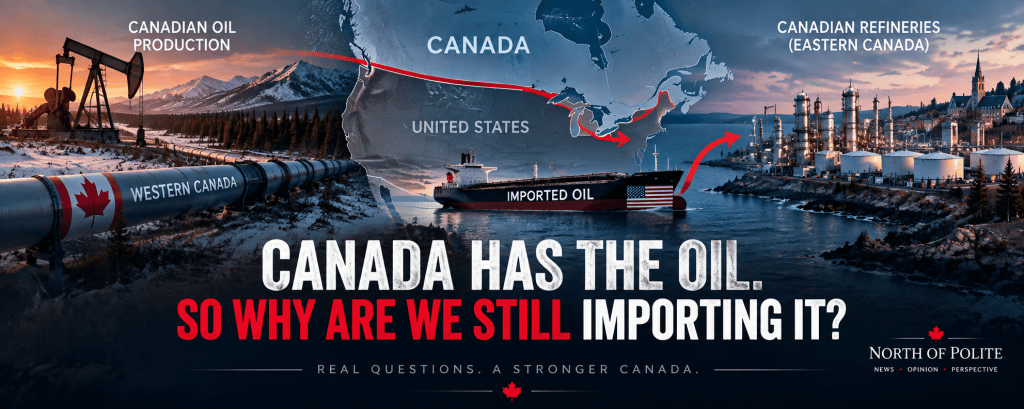
North of Polite Explainer: Canada is one of the world’s major oil-producing countries. We produce more crude oil than our own refineries need.
So here’s a question that sounds almost ridiculous: Why does Canada still import oil?
And an even stranger one: Why do we import large quantities of petroleum products when we have enormous oil reserves of our own?
The easy answer would be to blame government, environmental regulations or oil companies.
The real answer is considerably more complicated.
And with Canada’s relationship with the United States becoming less predictable, it’s worth asking whether an arrangement that once made economic sense still makes sense today.
First, Canada DOES refine oil
Let’s clear up the biggest misconception.
Canada isn’t simply pumping crude out of the ground and shipping all of it somewhere else to be refined.
Canada has 16 operating crude-oil refineries capable of processing approximately 1.9 million barrels per day.
In 2025, those refineries processed about 1.6 million barrels per day, operating at roughly 90% of capacity.
Most of what they produce—gasoline, diesel, jet fuel, asphalt, lubricants and other petroleum products—is consumed in Canada.
About 20% is exported.
So the question isn’t: Why doesn’t Canada refine its own oil?
We already do.
The better question is: Why don’t we refine more of it—and why do parts of Canada remain so dependent on foreign supply?
Here’s where things get strange In 2025, Canada imported approximately 506,000 barrels of crude oil every day, costing about $17.8 billion.
And 75.6% came from the United States.
Canada also imported approximately 485,000 barrels per day of refined petroleum products, worth another $21.4 billion.
Almost 80% came from the United States.
There is an important qualification .“Refined petroleum products” doesn’t just mean gasoline and diesel.
It also includes products such as condensate, which Alberta imports in large quantities to dilute oil-sands bitumen so it can move through pipelines.
So it would be misleading to say Canada spent $21.4 billion simply importing fuel we could have made ourselves.
Still, the contradiction remains: Canada is an enormous oil producer, yet significant parts of the country depend heavily on imported crude and petroleum products.
Why?
Problem #1: Our oil isn’t necessarily where our refineries are
Most Canadian crude production is in Western Canada.
But millions of Canadians—and some major refineries—are thousands of kilometers away.
Canada’s largest refinery is in Saint John, New Brunswick.
It isn’t connected to a crude-oil pipeline.
Its crude arrives by ship.
New Brunswick imported about 270,000 barrels per day in 2025.
Quebec imported approximately 126,000 barrels per day, entirely from the United States.
Ontario also imported crude, overwhelmingly from the United States.
And here’s one of the strangest parts of Canada’s energy system: Western Canadian crude reaching Ontario through the Enbridge Mainline travels across the border, through the American Midwest, and then back into Canada at Sarnia.
That wasn’t necessarily irrational when Canada and the United States had one of the world’s most dependable trading relationships.
Today, it’s worth another look.
Problem #2: Oil isn’t just oil
Crude oil comes in different forms.
Light.
Heavy.
Sweet.
Sour.
Bitumen.
Synthetic crude.
And refineries aren’t interchangeable.
A refinery designed around lighter crude cannot necessarily process unlimited quantities of heavy oil-sands crude without different or additional equipment.
But here’s an important finding from the Canada Energy Regulator:
Crude type probably isn’t Canada’s biggest obstacle.
Western Canada continues to produce significant quantities of lighter crude suitable for Central Canadian refineries.
So crude quality matters. But it doesn’t fully explain Canada’s dependence on imports.
Problem #3: Refineries cost billions
A modern refinery isn’t a gas station with a bigger tank.
It’s an enormous industrial complex requiring pipelines or marine terminals, storage, processing equipment, environmental controls, electricity, water and transportation connections.
And it can cost billions.
Then the owner needs to recover that investment over decades.
Canada’s existing refineries were already operating at about 90% capacity in 2025.
So imagine you’re considering spending billions on another one.
Your first question isn’t:
Does Canada have enough oil? Obviously we do.
Your question is: Will there be enough profitable demand for this refinery for the next 30 or 40 years?
That’s much harder to answer.
Would another refinery lower gasoline prices? Not automatically.
It’s tempting to think: Canadian oil + Canadian refinery = cheap Canadian gasoline.
Unfortunately, energy markets aren’t that simple.
Canadian crude has a market value.
Gasoline and diesel do too.
A refinery has to obtain crude, process it, maintain enormously expensive equipment, transport its products and earn enough money to justify the investment.
More Canadian refining capacity might improve resilience, keep more value-added activity inside Canada and support industrial employment.
But anyone promising that another refinery would automatically produce dramatically cheaper gasoline should have to show Canadians the math.
Newfoundland makes this even more interesting Canada doesn’t only produce crude in Alberta and Saskatchewan.
Newfoundland and Labrador produced approximately 210,000 barrels per day in 2024. Most of it was exported internationally.
Nearly 60% went to the United States, with much of the remainder going to Europe.
Meanwhile, Central Canada continued importing foreign crude.
The Canada Energy Regulator specifically identifies Newfoundland and Labrador crude as one possible way of replacing some foreign oil currently delivered by ship.
Think about that. Canada produces crude off its Atlantic coast and exports much of it while other Canadian refineries import crude from abroad.
Again, that isn’t necessarily stupidity.
Transportation, contracts, crude quality, refinery configuration and price all matter.
But in a world where energy security is becoming more important, the old calculation deserves another look.
Maybe the biggest problem isn’t refining.
This may be the most important part of the story.
Canada may not primarily have a refinery problem.
We may have an infrastructure problem.
The Canada Energy Regulator examined Canada’s energy security in 2026 and found that major pipeline systems delivering crude into Central Canada are already operating around their practical delivery capability.
Meaningfully changing that situation would require major changes to Canada’s energy-transportation infrastructure.
In plain English: Building another refinery doesn’t solve much if you can’t economically get Canadian crude to it.
So the conversation becomes bigger than building another refinery.
Canada has to consider pipelines.
Marine transportation.
Ports.
Storage.
Existing refinery upgrades.
Rail.
East-west infrastructure.
And potentially alternative energy sources that reduce petroleum demand.
Then the trade war changes the calculation
For decades, Canada and the United States built an extraordinarily integrated energy market.
It generated enormous benefits for both countries.
But consider what that integration looks like today.
Canada exports enormous quantities of crude to the United States.
Parts of Canada import crude from the United States.
Canada imports petroleum products from the United States.
Western Canadian crude supplying Central Canada travels through American territory.
And Canada also exports hundreds of thousands of barrels of refined petroleum products—mostly to the United States.
There’s nothing inherently wrong with that.
Sometimes an American customer is geographically closer to a Canadian refinery than another Canadian customer.
That’s trade.
But trade and dependency aren’t quite the same thing.
When the political relationship is stable, an integrated continental system can be extraordinarily efficient.
When the relationship becomes unpredictable, the same integration can become a vulnerability.
So should Canada build another refinery? Maybe.
But that’s the wrong question to start with.
The better question is: What problem are we trying to solve?
If the goal is simply cheaper gasoline, another multibillion-dollar refinery may not be the answer.
If the goal is energy security, there are several possibilities: Increase or modify capacity at existing refineries.
Improve east-west energy transportation.
Move more Newfoundland and Labrador crude to Canadian refineries. Expand domestic petroleum-product transportation and storage.
Improve marine access.
Build strategic reserves.
Diversify foreign suppliers. Or, if the economics justify it, construct additional refining capacity.
Every option carries costs, environmental consequences and trade-offs.
Energy independence isn’t really the goal Canada doesn’t need to isolate itself from the world.
And we shouldn’t tear apart the Canada–U.S. energy relationship simply to say everything is Canadian.
In 2025, Canadian exports of crude oil, refined products, natural gas and natural-gas liquids to the United States were worth $157.5 billion.
That relationship is enormously valuable. So complete energy independence isn’t necessarily the objective.
Energy security is. That means having reliable access to enough affordable energy—and infrastructure capable of continuing to deliver it when something goes wrong.
The question isn’t:
Can Canada stop buying energy from everybody else?
It’s: Could Canada keep itself supplied during a serious disruption?
The question Canada should be asking For decades, our energy system operated on a reasonable assumption:
The United States would remain a dependable customer, supplier and transit partner.
That helped create an extraordinarily efficient North American energy system.
But assumptions can change.
Maybe Canada’s biggest oil problem isn’t that we don’t have enough refineries.
Maybe it’s that we built an extraordinarily efficient
North American energy system without building a sufficiently robust Canadian backup plan.
That doesn’t automatically mean another pipeline.
It doesn’t automatically mean another refinery.
And it certainly doesn’t mean ending energy trade with the United States.
It means determining what Canada would actually need to keep homes heated, trucks moving, aircraft flying, farms operating and businesses functioning during a serious disruption.
Then Canadians can decide what level of security is worth paying for.
Because security isn’t free.
Dependence carries a price too.
Canada has the oil.
Canada has refineries.
Canada has workers.
Canada has engineering expertise.
What Canada needs to decide is how much resilience we want built into the system connecting them.
Perhaps we’ll never need that backup.
Hopefully we won’t.
But after everything Canadians have learned about economic dependency, there’s a simple question worth asking:
Shouldn’t Canada at least know what it would take?
© 2026 North of Polite. Original reporting, analysis and commentary. All rights reserved.
Unapologetically Canadian. We stand for a strong, sovereign and united Canada. No party owns our loyalty. If you make a claim, bring the receipts. We will too.


Leave a comment