
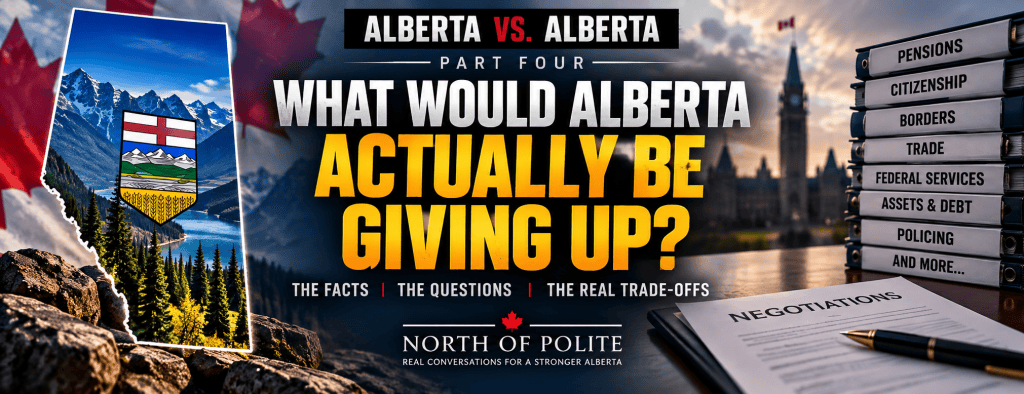

WHAT WOULD ALBERTA ACTUALLY BE GIVING UP?
Independence can sound remarkably simple when reduced to a slogan.
Hold a referendum. Win the vote. Leave Canada.
But countries don’t separate with the stroke of a pen.
If Albertans ever voted clearly to leave Canada, the vote itself would not make Alberta an independent country the next morning.
The Supreme Court of Canada established that principle in the 1998 Reference re Secession of Quebec. A clear expression of a clear majority on a clear question would give democratic legitimacy to pursuing secession and create an obligation for the other participants in Confederation to engage with that initiative.
But the referendum itself would have no legal effect on its own.
Alberta could not simply declare itself independent or dictate the terms of its departure.
And the Supreme Court made another point that matters enormously:
“There would be no conclusions predetermined by law on any issue.”
In plain language, a referendum could begin the process.
It could not tell Albertans in advance exactly what the final agreement would look like.
WHAT IS THE CLARITY ACT?
The Clarity Act is a federal law passed in 2000 following the Supreme Court’s 1998 Quebec Secession Reference.
Despite its name, it does not simply give Ottawa the power to say yes or no to independence.
It establishes conditions governing whether the Government of Canada could enter negotiations following a provincial referendum on secession.
The House of Commons would first determine whether the referendum question clearly asked voters whether their province should cease to be part of Canada and become an independent state.
After the vote, the House would also have to determine whether there had been a clear expression of support from a clear majority.
Importantly, the Act does not define “clear majority” as a particular percentage. It requires consideration of factors including the size of the majority, voter turnout and other relevant circumstances.
If those requirements were satisfied, lawful secession would still require negotiations and an amendment to Canada’s Constitution.
Those negotiations would involve at least the federal government and the governments of every province.
The Act specifically identifies matters including the division of assets and liabilities, possible changes to provincial borders, Indigenous rights, interests and territorial claims, and minority rights.
In other words, the Clarity Act doesn’t tell us what an Alberta separation agreement would look like. It establishes some of the rules for getting to one.
WHAT ABOUT KEITH WILSON’S TRANSITION PLAN?
That legal reality remains true regardless of how detailed a proposed transition plan may be.
Keith Wilson and the Alberta Transition Council have produced a 29-chapter plan describing how they believe Alberta could make an orderly transition from province to independent country.
That matters.
Serious proposals deserve serious examination.
The plan addresses courts, policing, taxation, banking, currency, pensions, citizenship, immigration, Indigenous and treaty relations, borders, defence, international relations, trade and many of the other responsibilities Alberta would face as an independent country.
Importantly, the Transition Council itself acknowledges that not every negotiating outcome can be known in advance.
Its plan distinguishes between things Alberta could control directly, agreements it would pursue with Canada, First Nations, the United States and others, and matters requiring negotiation.
But a transition plan is still a proposal.
It cannot determine what Canada, the United States, the other provinces, First Nations or other parties would ultimately agree to where their agreement or participation would be required.
And those parties would not all play the same role. Canada and the provinces would be participants in the constitutional process of secession. The United States would not. But separate agreements with the United States could become important for matters such as trade, border relations and other international arrangements.
Wilson’s plan can tell Albertans how its authors believe independence could work.
It cannot guarantee that those would be the terms under which independence actually occurred.
That distinction does not dismiss the plan.
It defines what the plan can — and cannot — promise.
WHAT HAPPENS TO YOUR PENSION?
Albertans currently participate in the Canada Pension Plan.
Canadian law already provides a mechanism through which a province can establish a comprehensive provincial pension plan in place of the CPP. The legislation also provides for coordination between the CPP and a provincial plan.
But independence would raise questions beyond simply establishing an Alberta pension plan.
What assets and liabilities would follow Alberta?
How would benefits be administered for someone who spent part of a career in Alberta and part elsewhere in Canada?
What arrangements would apply to people retiring on opposite sides of a newly international border?
There may ultimately be workable answers.
What does not exist today is a negotiated independence agreement guaranteeing what those answers would be.
WHAT MONEY WOULD ALBERTA USE?
An independent Alberta would have to decide what currency it would use and what monetary system would support it.
It could seek to continue using the Canadian dollar. It could establish its own currency. It could seek some form of monetary arrangement with Canada.
Those choices would have different consequences.
Canada’s monetary policy is conducted by the Bank of Canada. Simply using Canadian dollars would not, by itself, give an independent Alberta control over Canadian monetary policy.
Creating a new currency would require institutions and policy decisions Alberta does not currently need to make as a province.
Again, the point isn’t that these problems couldn’t be solved.
The point is that the solution has not been negotiated.
WOULD ALBERTANS REMAIN CANADIAN CITIZENS?
This is one of the most personal questions independence would raise.
Today, Albertans are Canadian citizens, afforded the same rights and protections of Canadian citizenship as Canadians living anywhere else in the country.
After separation, citizenship arrangements would have to be settled.
Would Albertans retain Canadian citizenship?
Could dual citizenship be permitted?
Who would qualify?
What would happen to an Albertan living elsewhere in Canada, or a Canadian from another province living in Alberta?
The Clarity Act itself recognizes that secession could entail the termination of citizenship and other rights that Canadian citizens living in the separating province currently enjoy as full participants in Canada.
It does not say every Albertan would automatically lose Canadian citizenship.
A transition plan can propose what Alberta would like those arrangements to be.
It cannot unilaterally determine Canada’s future citizenship laws.
WHAT HAPPENS AT THE BORDER?
Today, someone can drive from Alberta into British Columbia or Saskatchewan without crossing an international border.
Independence would change the legal nature of those boundaries.
That doesn’t necessarily mean fences, checkpoints everywhere or endless lineups.
Canada and an independent Alberta could negotiate arrangements intended to make movement relatively easy.
But customs, immigration, border enforcement and the movement of goods and people would become matters between separate countries rather than provinces of the same country.
Today’s provincial boundary could not simply be assumed to operate exactly the same way after independence.
WHAT HAPPENS TO TRADE?
Alberta’s economy doesn’t stop at its borders.
Energy, agricultural products, workers, investment, equipment and supply chains cross provincial boundaries every day.
An independent Alberta would therefore have powerful reasons to seek continued access to Canadian markets.
Canada would have economic reasons to negotiate as well.
An independent Alberta would also have to determine its relationship with the United States and other international markets, including trade arrangements presently entered into by Canada.
That doesn’t mean Alberta couldn’t negotiate trade agreements with Canada, the United States or other countries.
It means those agreements would have to exist rather than simply be assumed.
WHAT HAPPENS TO FEDERAL SERVICES?
Then come the things people rarely think about precisely because they already exist:
Passports.
Employment Insurance.
Border services.
Immigration.
Postal services.
National defence.
Banking regulation.
Criminal law.
Federal courts and agencies.
Currency.
Some functions might continue temporarily through agreements.
Some could be replaced by Alberta institutions.
Others could require new sovereign institutions.
The Alberta Transition Council argues that Alberta already possesses much of the institutional capacity and professional workforce necessary for a transition and proposes preparations intended to keep essential systems operating.
That’s an important part of its case.
But today’s workforce cannot simply be assumed to remain unchanged after independence.
Individual Canadians living and working in Alberta would have their own decisions to make about whether to stay, leave or continue working within whatever new arrangements emerged.
An independent Alberta could recruit and retain workers, just as countries do today. But the size, composition and availability of that future workforce cannot be known in advance.
Becoming a country would still mean assuming responsibilities a provincial government does not presently perform itself.
WHAT ABOUT POLICING?
Alberta would not be starting from zero.
The province already has municipal and Indigenous police services, RCMP policing and the Alberta Sheriffs. Alberta has also established the Alberta Sheriffs Police Service, and legislation passed in 2026 enables Alberta Sheriffs personnel to transition into the new police organization as it develops its capacity.
That existing infrastructure matters.
But it does not automatically answer what policing would look like in an independent country.
Alberta would have to determine which organizations continued, which expanded or changed, what happened to existing arrangements with the RCMP and whether additional institutions were required.
And, as with the broader workforce, it cannot simply be assumed that every RCMP officer, sheriff, municipal police officer or other employee working in Alberta today would necessarily choose to work for an independent Alberta.
Nor should we assume they would leave.
Their individual decisions simply cannot be known today.
Again, this isn’t an impossible problem.
It is another major public service whose future structure, staffing, jurisdiction, funding and transition would have to be worked out.
WHO GETS THE ASSETS — AND THE DEBT?
This may be one of the most complicated questions.
The federal government owns property and infrastructure in Alberta.
Albertans, as Canadians, also participate in the ownership and financing of federal assets and liabilities extending far beyond Alberta.
Canada has federal debt.
Alberta has provincial debt.
There is no constitutional calculator that simply produces Alberta’s final bill.
The Clarity Act specifically identifies the division of assets and liabilities as something that would have to be addressed in negotiations.
It also identifies possible changes to Alberta’s borders, Indigenous rights, interests and territorial claims, and minority rights.
Those Indigenous and treaty questions are significant enough to deserve their own article in this series rather than being reduced to a paragraph here.
HOW LONG WOULD ALL OF THIS TAKE?
There is no legal countdown clock for independence.
Neither the Supreme Court’s Secession Reference nor the Clarity Act establishes a deadline requiring negotiations to finish within six months, one year, two years or any other fixed period.
So giving Albertans a precise timeline would be purely speculative.
Consider what might have to be resolved:
A constitutional amendment.
Assets and liabilities.
Pensions.
Citizenship.
Borders.
Trade.
Federal property.
Government institutions.
Indigenous and treaty rights.
Minority rights.
And agreements involving parties whose decisions Alberta cannot control.
Given the number and complexity of those issues, it is reasonable to say that such a process could take years rather than weeks or months.
But that needs to be very clear:
“Years” is only an approximation. It is not a legal timetable, a prediction or a guarantee. There is currently no way to know how long negotiations would take, whether they would encounter an impasse, or when — or even whether — all of the necessary agreements could ultimately be reached.
A transition plan may propose a timetable, but it cannot establish a date certain for independence.
In plain language, no transition plan can guarantee exactly when — or even whether — Alberta would ultimately become independent.
The constitutional outcome would depend not only on Alberta, but on negotiations involving Canada and the other provinces, as well as unresolved matters involving First Nations and other Indigenous rights and interests.
Separate arrangements involving the United States could also be necessary for matters such as trade and cross-border relations.
Alberta could propose its preferred terms and timetable.
It could not unilaterally control what those other parties would agree to.
DOES ALL OF THIS MEAN ALBERTA COULDN’T BECOME INDEPENDENT?
No.
And that’s an important distinction.
Listing the complications of independence is not the same thing as arguing that independence is impossible.
Keith Wilson and the Alberta Transition Council have attempted to answer many of these practical questions.
Their proposals deserve to be examined on their merits, just as arguments against separation deserve scrutiny.
Some problems could prove easier to solve than critics predict.
Others could prove more difficult than supporters expect.
We don’t know.
And that is really the central point.
A referendum could answer one enormously important question:
Do Albertans want to leave Canada?
It could not answer all the questions that would follow.
What currency?
What citizenship?
What pensions?
What borders?
What trade arrangements?
What share of Canada’s assets and liabilities?
What happens to federal services?
What happens to Indigenous and treaty rights?
How long would negotiations take?
And what would Canada, the other provinces, First Nations and other affected parties demand or offer in return?
Those aren’t reasons Albertans shouldn’t discuss independence.
They’re reasons to discuss it seriously.
Because independence sounds simple in a slogan.
It gets considerably more complicated when you start dividing a country.
That’s where slogans collide with paperwork. And there is an awful lot of paperwork.
Unapologetically Canadian. We stand for a strong, sovereign and united Canada. No party owns our loyalty. If you make a claim, bring the receipts. We will too.


Leave a comment