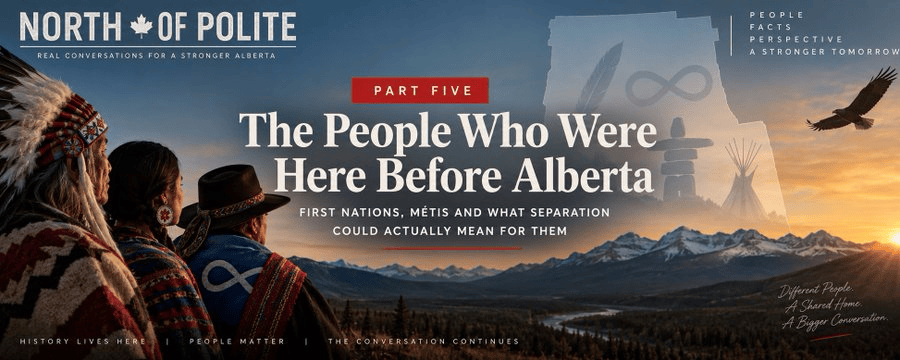
First Nations, Métis and what separation could actually mean for them
There is something easy to forget when discussing whether Alberta should leave Canada:
Alberta didn’t exist before Indigenous peoples did.
The Province of Alberta was created in 1905. Long before that, First Nations and Métis peoples lived, governed, traded, hunted, raised families and built communities across the lands that now make up the province.
That history matters because these relationships didn’t disappear when Alberta was created.
Treaties still exist. Aboriginal and treaty rights are recognized and affirmed by Canada’s Constitution. First Nations governments exist. Métis governments and communities have their own legal relationships with Alberta and Canada.
So if Albertans are going to seriously consider creating an independent country, there is a question that deserves a clear answer:
What could independence actually mean for the First Nations and Métis peoples who live here?
And just as importantly:
What would staying in Canada mean?
What exists today?
Start with what we know.
Section 35 of Canada’s Constitution recognizes and affirms existing Aboriginal and treaty rights and specifically includes First Nations, Inuit and Métis peoples.
But that doesn’t mean every Indigenous community has the same rights or the same relationship with government.
They don’t.
Alberta includes First Nations connected to Treaties 6, 7 and 8. Those are distinct treaties covering different territories and communities.
There is also the Otipemisiwak Métis Government, the government of the Métis Nation within Alberta, which has been developing its self-government relationship with Canada.
And Alberta has eight Métis Settlements, with their own governments and a unique land system covering approximately 1.25 million acres.
There are other Métis communities in Alberta as well.
That distinction is important.
There is no single “Indigenous deal” that could settle all of these relationships at once.
What happens if Alberta votes to leave?
A referendum would answer an important political question.
It would tell us whether Albertans wanted independence.
But it would not make Alberta an independent country the next morning.
Under Canada’s existing constitutional framework, a province cannot simply declare itself independent and leave. A lawful separation would require constitutional negotiations involving Alberta, Canada and the other provinces.
And Indigenous rights are specifically part of that process.
The federal Clarity Act says negotiations over a province leaving Canada must address issues including possible changes to provincial borders and the rights, interests and territorial claims of Aboriginal peoples.
That gives us an important fact:
Indigenous peoples would not simply be spectators while Alberta and Canada decided their future.
But there is another fact that is just as important.
The law does not already tell us what the final outcome would be.
It doesn’t tell us that every First Nation reserve would automatically remain in Canada.
It doesn’t tell us that every reserve would automatically become part of an independent Alberta.
It doesn’t tell us that Métis Settlement lands would automatically change countries.
And it doesn’t give us a finished map showing exactly what the borders of an independent Alberta would look like.
Those questions would have to be dealt with during the constitutional and political negotiations surrounding separation.
What about Treaties 6, 7 and 8?
These treaties existed before Alberta became a province.
And they aren’t simply historical documents sitting in an archive.
Treaty rights are constitutionally protected within Canada today.
Canadian courts have also made clear that treaties aren’t interpreted like ordinary modern contracts. Their written words matter, but so do their historical circumstances, oral promises and the understandings of the First Nations that entered them.
That becomes extremely important when discussing independence.
A referendum could not, by itself, rewrite Treaties 6, 7 and 8.
But we shouldn’t go further than the evidence allows.
There has never been a negotiated separation of an Alberta—or any other Canadian province—from Canada.
We therefore don’t have a court decision or previous Canadian separation agreement telling us exactly what every treaty relationship would look like afterward.
That would have to be worked out.
What are independence supporters proposing?
This deserves a fair hearing.
The Alberta Transition Council’s independence plan does not simply say Alberta takes everything within its current borders and deals with Indigenous peoples afterward.
Its plan recognizes First Nations as treaty partners and rights-holders and proposes negotiations with individual First Nations over their future relationships.
It considers different possibilities, including continued relationships with Canada, new arrangements with Alberta, or combinations of the two.
The plan also treats the Métis Settlements and other Métis governments and communities separately rather than assuming that one organization speaks for every Métis person in Alberta.
Those are important acknowledgements.
But there is a critical difference between a proposal and an agreement.
The Transition Council can propose what it believes an independent Alberta should offer.
It cannot guarantee what Canada, individual First Nations, Métis governments or other parties would ultimately agree to.
That isn’t an argument against the proposal. It is simply the difference between a negotiating position and a negotiated result.
What about the Métis Nation within Alberta?
The Métis situation is different from the First Nations treaty situation.
The Otipemisiwak Métis Government is the government of the Métis Nation within Alberta and has been working with Canada toward greater recognition of Métis self-government.
That process is still developing.
Canada and the Otipemisiwak Métis Government have continued working on an updated self-government agreement, while work toward a modern-day treaty has also continued.
But the Otipemisiwak Métis Government does not represent every Métis community or every Métis rights-holder in Alberta.
That matters.
There are also the Métis Settlements and other Métis communities with their own histories, interests and legal relationships.
So independence couldn’t realistically be handled through one agreement called “the Métis deal.”
Different Métis rights-holders and governments would have different questions to resolve.
What about the eight Métis Settlements?
This is a particularly Alberta story.
The province has eight Métis Settlements covering approximately 1.25 million acres.
They have their own governments and a land system established through Alberta legislation and agreements.
They are not First Nations reserves, and treating them as though they were would be legally incorrect.
Today, those Settlements operate within Alberta and Canada’s existing constitutional and legal system.
Independence would create a different question:
How would those lands, governments and protections operate in a new sovereign Alberta?
There are possible answers.
But there is no completed separation agreement telling us what that answer would be.
That makes the Métis Settlements another part of Alberta’s future that couldn’t simply be assumed during a separation process.
This isn’t only theoretical
Some of these questions are already before Alberta’s courts.
In May 2026, the Alberta Court of King’s Bench ruled that the Crown had failed in its duty to consult First Nations in connection with a citizen-initiative separation petition.
That decision has been appealed.
So we need to be precise about what it means.
It does not establish a simple First Nations veto over Alberta independence.
And because the case is still moving through the courts, it would be wrong to claim that every legal question about consultation and separation has been finally settled.
What it does show is something much simpler:
Indigenous and treaty rights are already a real constitutional issue in Alberta’s separation debate.
They are not something that could simply be dealt with after everything else was decided.
What happens if Alberta stays in Canada?
This side of the choice matters just as much.
Remaining in Canada doesn’t mean disagreements between Indigenous peoples, Alberta and Ottawa disappear.
They don’t.
There are disputes today involving land, resources, consultation, treaty interpretation, Métis rights and self-government.
Staying in Canada does not guarantee Indigenous peoples will win those disputes.
What it does mean is that we already know the constitutional system under which those disputes occur.
Section 35 exists.
The treaties exist.
Canadian courts exist to interpret constitutional obligations.
Existing relationships between Indigenous governments, Alberta and Canada continue within that framework.
That is the key difference.
Remaining in Canada means continuing within an established constitutional system.
Independence means negotiating how existing Indigenous rights and relationships would be dealt with as Alberta left that system and created a new one.
So what do we actually know?
Quite a lot.
We know First Nations and Métis peoples were here before Alberta existed.
We know Aboriginal and treaty rights are constitutionally protected within Canada.
We know Treaties 6, 7 and 8 cannot simply be treated as ordinary provincial programs.
We know Alberta’s Métis population does not fall under one single legal or political structure.
We know the eight Métis Settlements have their own distinctive land and governance system.
And we know Canadian law specifically requires Indigenous rights, interests and territorial claims to be addressed as part of the process surrounding a lawful provincial separation.
What we don’t know is just as important.
Nobody can honestly tell Albertans today exactly what every treaty relationship, reserve, Métis Settlement, self-government arrangement, border or Indigenous-Crown relationship would look like after a successfully negotiated Alberta separation.
Independence advocates can propose solutions.
Canada can take negotiating positions.
Alberta can take negotiating positions.
First Nations and Métis governments can take their own positions.
But a proposal is not the same thing as a final agreement.
And that brings us back to the choice Albertans are actually being asked to consider.
A referendum could decide what a majority of Albertans wanted. It could not, by itself, decide the future of every treaty, reserve, Métis Settlement or existing Indigenous right within Alberta’s present borders.
For First Nations and Métis Albertans, the difference between staying in Canada and creating a new country is therefore about much more than changing the flag over the legislature.
Staying means remaining within a constitutional system where these rights and relationships already have legal protection.
Independence means entering a process to determine how those rights and relationships would operate as Alberta left that constitutional system and created a new one.
Neither answer tells Albertans how they should vote.
But before they make that choice, they deserve to understand what the choice could mean for the people who were here before Alberta.
Unapologetically Canadian. We stand for a strong, sovereign and united Canada. No party owns our loyalty. If you make a claim, bring the receipts. We will too.


Leave a comment