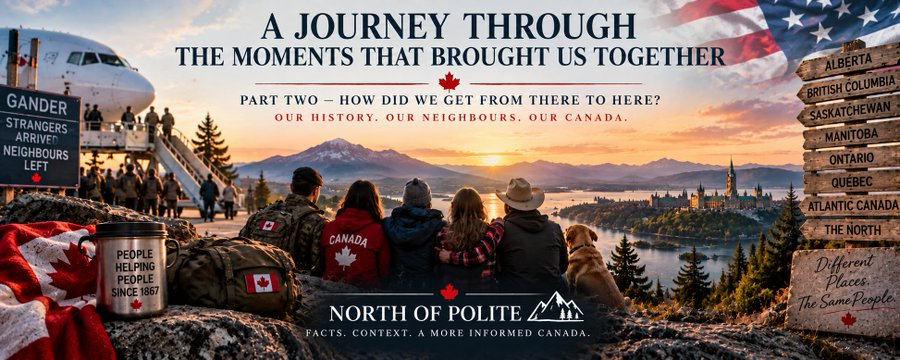
At the end of Part One, we asked a question:If we have spent generations crossing provincial and international borders to help one another when things were at their worst, how did we reach a point where those borders can feel more important than the people on the other side?There is no single answer.There was no morning when Canadians woke up and suddenly stopped trusting one another. Alberta’s frustrations with Ottawa did not appear overnight. Neither did the disagreements that have always existed between provinces, regions and governments.Canada has never been a country where everyone agreed.Perhaps we sometimes forget
and Alberta have not always wanted the same things. Neither have Ontario and the Atlantic provinces. Western alienation has a long history. So do arguments over resources, taxes, language, representation and which level of government should control what.And yet, somehow, we remained neighbours.Perhaps one of the clearest examples of what that once looked like came after September 11,
we discussed in Part One, when the United States was attacked, aircraft were diverted into Canadian communities. Gander alone received 38 transatlantic flights. People opened schools, community centres and homes to thousands of strangers.But Canada’s response did not end at the airport.Canada went to Afghanistan.More than 40,000 members of the Canadian Armed Forces would serve there between 2001 and 2014, Canada’s largest military deployment since the Second World War.They came from communities across the country.They were Albertans. Quebecers. Ontarians. British Columbians. Newfoundlanders and Labradorians. People from the Prairies, the North and the Maritimes.But when they deployed, the flag on their uniform was
hundred and fifty-eight members of the Canadian Armed Forces lost their lives during Canada’s mission. Many more returned carrying physical or psychological injuries from their
is worth stopping there for a moment.Not to use their deaths to settle a political argument. They deserve better than that.But to ask what their service tells us about the country they represented.When Canadians stood beside one another in Afghanistan, did it matter which province they came from?The Albertan who served beside someone from Quebec was no less Albertan.The Quebecer was no less Québécois.Neither had to surrender where they came from in order to stand together as Canadians.Some of them never came home.And when they died, Canada mourned them as Canadians.There is something else about Afghanistan worth remembering.Canada went after an ally had been attacked. Two years later, when the United States invaded Iraq, Canada chose not to join the U.S.-led coalition invading Iraq.That difference matters.We could stand beside our closest neighbour when we believed the cause was just and still say no when our government believed it was not.Friendship did not require obedience.And disagreement did not automatically make someone an
what changed? Some things changed slowly.Economic pressures grew. Industries changed. Communities that had once felt secure became less certain about their futures.Regional grievances
Alberta, arguments over energy, federal policy, equalization and political representation accumulated over years. Whether every complaint was justified is a separate question. The frustration itself was real.Other parts of Canada developed grievances of their own.Then something else changed.The way we talked to one another.For most of our history, a rumour told in a coffee shop remained in the coffee
it can cross the country before lunch.A misleading headline, an edited video or an angry post can reach thousands or millions of people before anyone asks whether it is true.And anger travels particularly well.Political disagreement increasingly became something more personal.Liberal. Conservative.East. West.Urban. Rural.Albertan. Canadian.Left. Right.Labels made it easier to decide who someone was before listening to what they had to say.And while those divisions were growing inside Canada, something changed in our relationship with the country next door.The Neighbour We Thought We Knew Canada and the United States have argued before.We have fought over trade. We have disagreed over foreign policy. We have protected different industries and pursued different national interests.But the current dispute has crossed into territory many Canadians have never experienced before.President Donald Trump has repeatedly spoken about Canada becoming America’s 51st state. His administration has used increasingly aggressive trade measures against Canadian goods, and the confrontation has continued to escalate.On September 8, the United States announced that certain Canadian imports would be prohibited beginning September 29. Trump also recently posted a map depicting Canada, Mexico, Greenland, Iceland, Central America and the Caribbean beneath the American flag, with the territory labelled “United States of America.”For Canadians, that raises a different kind of
disputes are about money.Sovereignty is about whether your country continues to decide its own
is possible to believe strongly in the friendship between Canada and the United States while also believing that Canada’s independence is not something another country’s president gets to negotiate.Those ideas do not contradict one another.Because Donald Trump is the President of the United States.He is not the American people.The Americans whose planes landed in Gander were not Republicans or Democrats to the Canadians who fed them and found them somewhere to sleep.They were people who needed help.And the Canadians who went to Afghanistan did not fight for an American political party.They stood beside an ally that had been attacked.That distinction seems particularly important now.Perhaps We Have Been Asking the Wrong Question Maybe unity never meant agreement.Canada was not united during the Second World War because every Canadian agreed about everything. They certainly did not.We were not united after September 11 because our political differences disappeared.Alberta does not have to agree with Ottawa about everything to be part of Canada.And Canadians do not have to agree with Washington—or with an American president—to remain neighbours with the American people.Perhaps what has changed is not that disagreement suddenly appeared.Perhaps we have become more willing to treat disagreement as a reason to divide ourselves.There are real questions facing this country.Albertans have every right to ask whether Confederation is working for them.Other Canadians have every right to ask the same question.And Canadians have every right to reconsider a relationship with the United States when actions from its government challenge our economic interests or our sovereignty.None of those questions should be dismissed.But neither should our history.The Canadian who stood beside another Canadian in Afghanistan did not need to ask which province was printed on his birth certificate before trusting the person beside him.The people of Gander did not ask stranded Americans how they voted before offering them somewhere to sleep.Firefighters crossing a provincial or international boundary do not stop at the sign and ask whether the people on the other side share their politics.They go where they are needed.Maybe that doesn’t answer the constitutional questions facing
doesn’t solve a trade war.And it certainly doesn’t make political disagreements
isn’t supposed to.But it may remind us of something worth remembering while we decide what comes next.A border tells us where one jurisdiction ends and another
doesn’t have to tell us where our responsibility to one another ends.
Unapologetically Canadian. We stand for a strong, sovereign and united Canada. No party owns our loyalty. If you make a claim, bring the receipts. We will too.


Leave a comment