Opinion by NorthofPolite
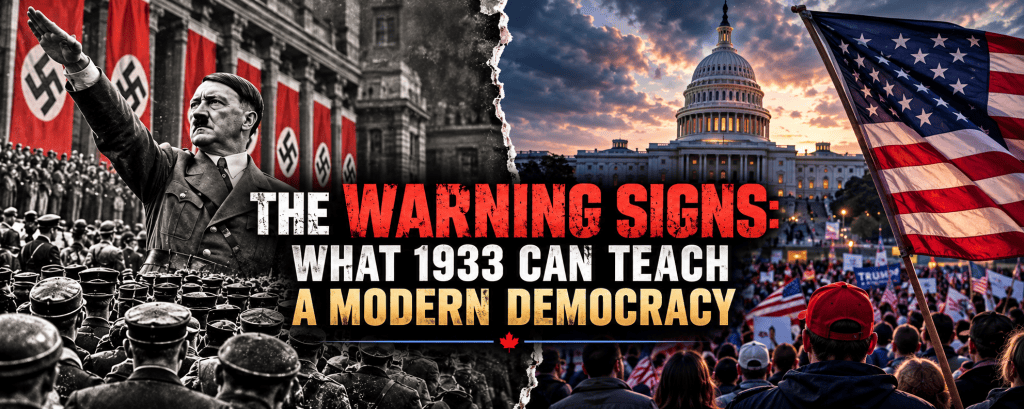
History does not have to repeat itself exactly for its warnings to matter.
This article is not saying that the United States is Nazi Germany.
It is not saying that today’s leaders are identical to Hitler, nor that today’s immigrants are facing the Holocaust.
It asks a different question:
Can some of the political and institutional changes that helped destroy democracy in 1930s Germany begin appearing in another democracy?
History tells us that democratic institutions can erode. That is why recognizing warning signs matters—while democratic institutions still have the ability to respond.
LOOK AT THE PATTERN—NOT JUST ONE POLICY
1. A NATION IS TOLD THAT IT IS UNDER THREAT
1930s Germany
The Nazis portrayed Germany as being threatened by enemies inside and outside the country. Jews, communists, political opponents and other groups were increasingly represented as threats to the German nation.
United States today
Immigration and other political issues are increasingly discussed through the language of national security, public safety, jobs, culture and national identity.
Political arguments about immigration are not themselves evidence of Nazism.
The warning sign is more basic:
What happens when an entire category of people is increasingly treated as a threat rather than as individuals?
Fear can make extraordinary government action easier to justify.
2. “US VERSUS THEM” REPLACES EQUAL CITIZENSHIP
The Nazis progressively divided German society between those considered part of the national community and those excluded from it.
A modern democracy faces a different but related question whenever political disagreement becomes a question of who is a “real” citizen, who belongs, or who should be regarded as an outsider or enemy.
Democracy depends on citizens retaining equal political standing even when their political views are radically different.
The warning sign is the erosion of that principle.
3. LARGE-SCALE DETENTION BECOMES NORMALIZED
The first Nazi concentration camps appeared shortly after Hitler became chancellor in January 1933. Dachau opened on March 22, 1933, initially holding political opponents. The early camp system subsequently expanded and became centralized under SS control.
The United States today has an entirely different legal and political system.
ICE detention is not equivalent to the Nazi concentration-camp system.
But the scale of American immigration detention is significant.
More than 65,000 people are currently held in ICE custody, according to recent immigration data. Large numbers of people are being detained for immigration violations, including people without criminal convictions.
The historical lesson is therefore not:
“Every detention facility is a concentration camp.”
It is:
Pay attention when government detention of a particular category of people becomes large-scale and increasingly normalized.
The legal safeguards surrounding that detention matter.
So does whether those safeguards remain effective.
4. DUE PROCESS COMES UNDER PRESSURE
This is where the comparison requires particular care.
Nazi Germany developed a system in which political opponents could be detained outside ordinary judicial processes. Emergency measures gave police sweeping powers to arrest political opponents without normal judicial protections.
The United States has not abolished judicial review.
American courts continue to hear challenges to executive immigration actions, and courts have blocked or restricted some administration policies.
But there are current disputes worth watching.
ICE recently stopped publicly displaying the locations of many detainees who already have final removal orders in its online detainee locator. Immigration lawyers and relatives said the change made it more difficult to locate people in detention and pursue potential legal remedies. ICE defended the change as part of its deportation priorities.
These developments do not establish that American due process has disappeared.
They do establish why access to counsel, judicial review and the ability to challenge government action deserve continued scrutiny.
5. POLITICAL OPPONENTS BECOME “ENEMIES”
In 1933 Germany, Communists, Social Democrats, trade unionists and other political opponents were among the earliest targets of Nazi repression. The regime ultimately eliminated organized political opposition altogether.
The United States remains a multiparty democracy with functioning opposition parties and competitive elections.
But there are current disputes involving political expression and government power.
The case of Georgetown scholar Badar Khan Suri is one example. The Trump administration has asked the Supreme Court to review litigation arising from his detention after a lower court found he was likely to succeed in arguing that his detention violated constitutional protections involving speech and due process. The administration disputes the lower court’s authority in the case.
There are also ongoing disputes involving access for news organizations to the White House.
These are legal and political disputes—not proof that the United States has become a dictatorship.
But they illustrate an important democratic principle.
There is a profound difference between:
“I disagree with my political opponent.”
and:
“My political opponent is an enemy of the country.”
A healthy democracy needs room for the first without turning the second into a justification for suppressing legitimate opposition.
6. WHO BELONGS?
Nazi Germany ultimately defined citizenship and belonging according to racial ideology and progressively excluded Jews and other groups from legal protection.
The United States today is nowhere near that system.
But citizenship remains an important constitutional issue.
The Trump administration’s attempts to restrict birthright citizenship have faced major challenges in federal court, including a Supreme Court ruling against the administration’s initial broad approach and a subsequent federal court ruling blocking a narrower order.
That development matters for another reason:
The courts are still acting as a check on executive power.
That is precisely the kind of institutional resistance that matters in a democracy.
7. GOVERNMENT POWER EXPANDS WHILE INSTITUTIONAL RESISTANCE IS TESTED
This is perhaps the most important distinction between 1933 Germany and the United States in 2026.
In 1933, Hitler and the Nazi Party destroyed Germany’s multiparty democracy and established a dictatorship. Political opposition was eliminated and democratic institutions were brought under Nazi control.
That has not happened in the United States.
Congress still exists.
Opposition parties still exist.
Elections still exist.
Independent media still operate.
Federalism remains.
Courts continue to issue decisions against the administration.
That difference is enormous.
And it points toward the real warning:
Protect the institutions capable of saying NO to government power.
And then watch what happens when they do.
THE MOST IMPORTANT LESSON FROM 1933
The Holocaust did not begin in 1933.
The Nazi dictatorship developed through a series of political and institutional changes.
Political opponents were targeted.
Civil liberties were curtailed.
Government institutions were brought under Nazi control.
Detention expanded.
Political opposition was eliminated.
The definition of who belonged became increasingly exclusionary.
The Holocaust came later.
That chronology matters.
Democratic collapse is not necessarily one dramatic moment.
It can be a process in which actions that once seemed unacceptable gradually become normal.
SO WHAT SHOULD WE ACTUALLY BE WATCHING?
Don’t ask only:
“Is this Nazi Germany?”
Ask better questions.
Are government powers expanding?
Is due process being preserved?
Are particular groups being portrayed as inherently dangerous?
Are people being treated differently because of who they are rather than what they have individually done?
Are political opponents being described as enemies of the nation?
Can journalists criticize those in power without government retaliation?
Can judges rule against the government independently?
Are extraordinary detention and enforcement powers becoming normalized?
Are democratic institutions still capable of saying NO?
And when they say NO:
Does the government obey?
Those questions are more useful than any political label.
THE WARNING
History does not repeat itself perfectly.
It doesn’t have to.
The circumstances of 1930s Germany and the United States in 2026 are profoundly different.
The United States has a Constitution, federal courts, federalism, opposition parties, independent journalism and a long tradition of civil liberties.
Those institutions are not meaningless.
They are the reason the comparisons above have important limits.
But institutions are only as strong as the people and systems that maintain them.
The lesson of Nazi Germany isn’t simply:
“Look what Hitler did.”
It is:
Look at what happened when people gradually accepted the idea that certain groups could have fewer rights, political opponents could become enemies, government power should not be questioned, and legal restraints could be bent in the name of the nation.
That is why the comparison deserves careful discussion.
Not because America is Nazi Germany.
Not because history must end the same way.
But because recognizing dangerous patterns early gives a democracy the opportunity to stop them before they become irreversible.
North of Polite
Canadian news, analysis and commentary without the noise.
© 2026 North of Polite. Original reporting, analysis and commentary. All rights reserved. 🍁


Leave a comment