
Is Canada Making a New Alberta Pipeline More Complicated Than It Needs to Be?
Analysis by North of Polite
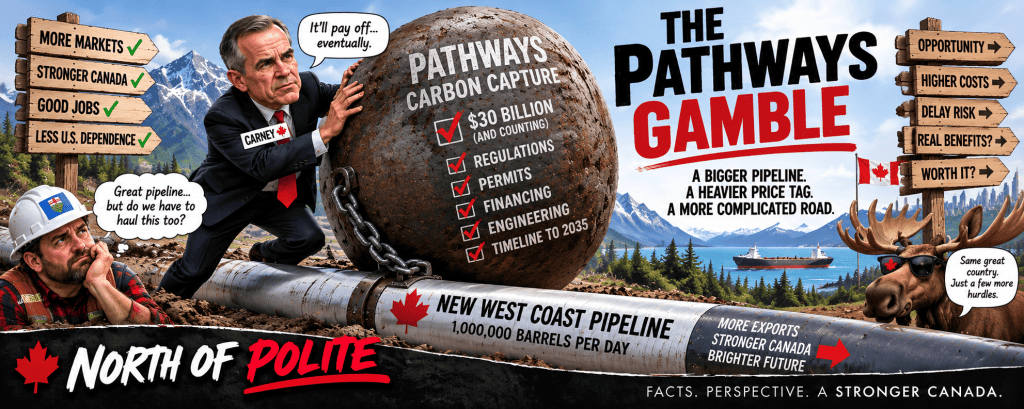
There is something unusual happening between Ottawa and Alberta.
Prime Minister Mark Carney’s government is supporting something Alberta has wanted for years: another major pipeline capable of carrying Alberta oil toward the West Coast and Asian markets.
That could be very good news for Alberta—and for Canada.
More export capacity could give Canadian producers access to more international customers and reduce our dependence on the United States as the primary buyer of Canadian oil.
But there’s a catch.
The new pipeline has been tied to an enormous carbon-capture project known as Pathways.
And that’s where Canadians should start asking questions.
WHAT IS PATHWAYS?
The basic idea isn’t particularly difficult to understand.
Oil-sands operations produce carbon dioxide. Pathways proposes capturing large quantities of those emissions, transporting the CO₂ through pipelines and permanently storing it underground.
Supporters see an enormous opportunity.
Canada could potentially increase oil production and exports while reducing the emissions associated with producing that oil.
That could help Canadian energy remain competitive in a world increasingly concerned about carbon emissions.
So there is a legitimate economic and environmental argument for Pathways.
NOW LOOK AT THE PRICE
This is where things become controversial.
Industry estimates have placed the potential cost of Pathways at up to roughly $30 billion.
Thirty billion dollars is an enormous amount of money.
And this isn’t a finished project waiting for someone to flip a switch.
There are still major financial, regulatory, engineering and permitting hurdles ahead.
The federal government’s current agreement with Alberta calls for the first phase of Pathways to be completed by 2035.
AND THAT’S WHERE THE PIPELINE QUESTION GETS INTERESTING
The proposed pipeline has a relatively straightforward economic purpose:
Get more Canadian oil to more customers.
Pathways has a different purpose:
Reduce the emissions associated with producing that oil.
Both projects may have merit.
But here’s the important part:
Ottawa and Alberta have explicitly agreed that construction of the pipeline and construction of Pathways are mutually dependent.
The agreement also describes Pathways as a prerequisite for approval, commencement and continued construction of the new pipeline.
In other words, these aren’t simply two unrelated projects happening at the same time.
Their futures have deliberately been connected.
And that deserves scrutiny.
THE ARGUMENT FOR CARNEY’S APPROACH
There is a serious case for what Ottawa and Alberta are attempting.
Canada could get another major energy export route.
Alberta could get greater ability to increase production.
Canada could become less dependent on the American market.
Carbon capture could reduce the emissions associated with Alberta’s oil.
And Canada could potentially market itself internationally as a reliable supplier of lower-emission energy.
There’s also a political compromise here.
Ottawa gets significant emissions reductions.
Alberta gets increased production and export capacity.
Industry gets greater certainty about future environmental rules.
If everything works, Canada could sell considerably more oil while reducing the emissions intensity of producing it.
That’s potentially a very powerful combination.
THE ARGUMENT AGAINST IT
The risk is that Canada takes a project with a relatively simple objective—sell more Canadian energy to the world—and makes its success dependent on another enormously expensive and technically complicated project.
Pathways could cost tens of billions of dollars.
It still faces significant financial, regulatory and engineering challenges.
And its first phase isn’t expected to be completed until 2035.
That doesn’t mean Pathways is a bad project.
It means Canadians should understand the risk involved in making one enormous project dependent on another enormous project.
If Pathways runs into serious delays, cost overruns or financing problems, what happens to the pipeline?
That’s an important question.
SO IS PATHWAYS A BRILLIANT COMPROMISE OR AN EXPENSIVE ROADBLOCK?
We don’t know yet.
And that’s probably the most responsible answer.
Carney deserves credit for recognizing that Canada needs greater energy-export capacity and more customers outside the United States.
Alberta deserves credit for pushing aggressively for greater access to international markets.
And reducing the emissions associated with Canadian oil could have genuine long-term economic value.
But Canadians are also entitled to question whether tying a badly needed export pipeline to a carbon-capture project potentially costing tens of billions of dollars creates unnecessary risk.
If Pathways works economically, technologically and environmentally, this arrangement could become a major Canadian achievement.
But if Pathways encounters serious problems, Canadians deserve to know whether the pipeline gets dragged down with it.
So here’s the question North of Polite would put to Prime Minister Carney:
If a new West Coast pipeline makes economic and strategic sense for Canada on its own merits, why should its future depend on the success of a separate multibillion-dollar carbon-capture project?
That’s not an anti-Carney question.
It’s not an anti-environment question.
And it certainly isn’t an anti-Alberta question.
It’s a question about whether Canada is designing an energy strategy that can actually get built.
Because at the end of the day, announcements don’t move oil.
Pipelines do.
North of Polite
Canada first. Facts first. If you make a claim, bring the receipts. We will too.
© 2026 North of Polite. Original reporting, analysis and commentary. All rights reserved. 🍁


Leave a comment