
Analysis by North of Polite
In our last article, we looked at the enormous cost and complexity of the proposed Pathways carbon-capture project in Alberta.
But that raises an obvious question:
Why are we doing this at all?
To answer that, we first need to understand what carbon dioxide does, why putting more of it into the atmosphere matters, and how carbon capture is supposed to help.
Fortunately, you don’t need a science degree to understand it.
FIRST: WHAT’S THE PROBLEM WITH CO₂?
Carbon dioxide—or CO₂—is naturally present in our atmosphere.
Plants need it.
Humans and animals exhale it.
The problem is quantity.
Burning coal, oil and natural gas takes carbon that was stored underground and releases it into the atmosphere as CO₂.
CO₂ is a greenhouse gas. It absorbs some of the heat Earth would otherwise radiate back into space.
Think of Earth’s atmosphere like a blanket.
We need the blanket.
Without the natural greenhouse effect, Earth would be far too cold for the world we know.
But adding more greenhouse gases effectively makes that blanket warmer.
That’s where human-caused climate change comes in.
SO WHAT DOES CARBON CAPTURE ACTUALLY DO?
Here’s the easiest way to understand it.
Imagine an industrial facility producing exhaust containing CO₂.
Normally, that CO₂ enters the atmosphere.
Carbon capture attempts to grab much of it before it gets out.
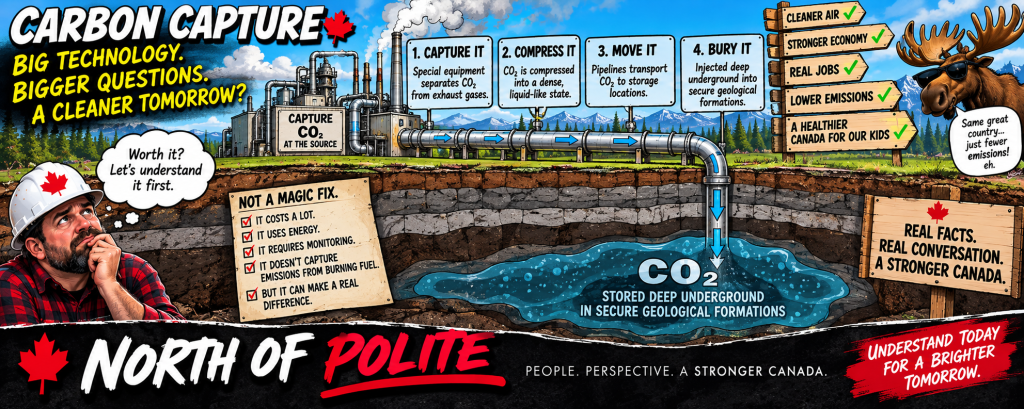
Special equipment separates CO₂ from other gases.
The captured CO₂ is then compressed until it becomes extremely dense, making it practical to transport through pipelines.
Those pipelines carry it to a suitable storage location.
Then it is injected deep underground.
So the basic process is:
CAPTURE IT → COMPRESS IT → MOVE IT → BURY IT.
That’s carbon capture and storage in four steps.
WHERE DOES THE CO₂ GO?
This part sounds strange until you understand the geology.
The CO₂ isn’t pumped into some giant underground empty cave.
It is injected deep into suitable porous rock formations.
Think of water soaking into a sponge rather than filling a balloon.
Layers of impermeable rock above the storage formation act as geological seals intended to keep the CO₂ underground.
Canada—and particularly Western Canada—has geological formations suitable for this kind of storage.
DOES IT STAY THERE?
That’s one of the most important questions.
Properly selected geological formations can trap CO₂ for extremely long periods.
But claiming there’s absolutely no risk would be misleading.
Storage sites must be carefully selected, engineered and monitored.
Wells have to be maintained.
Geological conditions have to be understood.
And governments need rules governing what happens if problems occur.
Carbon capture isn’t:
Drill a hole. Pump it down. Forget about it.
Long-term storage and monitoring are essential parts of the technology.
WHY DOES IT COST SO MUCH?
Because carbon capture isn’t simply a giant filter attached to a smokestack.
You need capture equipment.
You need energy and chemicals to separate the CO₂.
You need compressors.
You need pipelines.
You need injection wells.
You need geological studies.
You need monitoring.
And you need all of that infrastructure to operate reliably for decades.
That’s why projects such as Pathways can cost tens of billions of dollars.
SO WHAT’S THE BENEFIT?
Here’s why Alberta’s oil industry is interested.
Carbon capture could allow Canada to continue producing large quantities of oil while substantially reducing some of the emissions created during its production.
That’s important.
The world isn’t going to stop using oil tomorrow.
Planes still fly.
Trucks still move goods.
Petrochemicals are used to manufacture thousands of products.
Heavy industries still require enormous amounts of energy.
So there’s a reasonable argument:
If we’re going to produce oil, producing it with fewer emissions is better than producing it with more.
BUT CARBON CAPTURE ISN’T A MAGIC FIX
This distinction matters enormously.
Capturing CO₂ at an oil-sands facility primarily addresses emissions associated with producing the oil.
Eventually, much of that oil becomes gasoline, diesel, jet fuel or other products that are burned.
Burning those fuels produces additional CO₂.
Carbon capture equipment at an Alberta production facility doesn’t capture those later emissions from millions of vehicles, aircraft and other users.
So carbon capture can reduce emissions.
But it doesn’t make a barrel of oil carbon-free.
Whenever somebody says fossil fuels become “clean” because of carbon capture, ask:
Which emissions are actually being captured?
That’s a much better question.
SO IS CARBON CAPTURE GOOD OR BAD?
It’s a tool.
And tools should be judged by what they actually accomplish.
Carbon capture could prevent millions of tonnes of industrial CO₂ from entering the atmosphere.
It could help reduce emissions from industries where eliminating them completely is extremely difficult.
It could also help Canadian energy remain competitive as other countries introduce increasingly strict climate policies.
But it isn’t free.
It requires enormous infrastructure.
It consumes energy.
It can be extremely expensive.
Storage requires proper geological selection and long-term monitoring.
And capturing emissions during oil production doesn’t eliminate the emissions created when the resulting fuel is eventually burned.
All of those things can be true at the same time.
AND THAT BRINGS US BACK TO PATHWAYS
Now we can better understand what Alberta’s proposed multibillion-dollar Pathways project is actually trying to accomplish.
It isn’t primarily about sucking Canada’s existing CO₂ out of the atmosphere.
It’s about preventing a portion of future industrial CO₂ emissions from entering the atmosphere in the first place, then transporting that captured CO₂ and storing it underground.
That’s an important distinction.
So instead of shouting:
“Carbon capture will save us!”
or
“Carbon capture is a complete waste of money!”
Canadians should ask better questions.
How much CO₂ will actually be prevented from entering the atmosphere?
How much will each tonne cost?
Who pays?
How much energy will the system consume?
How securely will the CO₂ be stored?
Who monitors it?
And could Canada achieve the same emissions reductions more cheaply another way?
Those are questions worth billions of dollars.
Because protecting Canada’s economy matters.
Protecting Alberta’s energy industry matters.
And protecting the environment we’re leaving future generations matters too.
The difficult part is figuring out how to do all three.
That’s the conversation Canada should be having.
North of Polite
Canada first. Facts first. Canadians decide for themselves.
© 2026 North of Polite. Original reporting, analysis and commentary. All rights reserved. 🍁


Leave a comment