
Analysis by North of Polite
Claims are circulating that Prime Minister Mark Carney is moving Canada toward military cooperation with China.
There is some truth behind that claim — but without context, it creates a misleading picture of what has actually happened.
On September 4, 2026, Canadian and Chinese defence officials held the fifth Canada-China Defence Coordination Dialogue in Ottawa.
China’s Ministry of National Defense said the two sides discussed international and regional issues, expressed a willingness to strengthen practical exchanges and cooperation between their militaries, and sought greater mutual understanding and trust. Canada’s Department of National Defence has since confirmed that the meeting occurred, describing it as working-level dialogue supporting military-to-military communications.
The meeting is real.
But the history matters.
This Did Not Start With Mark Carney
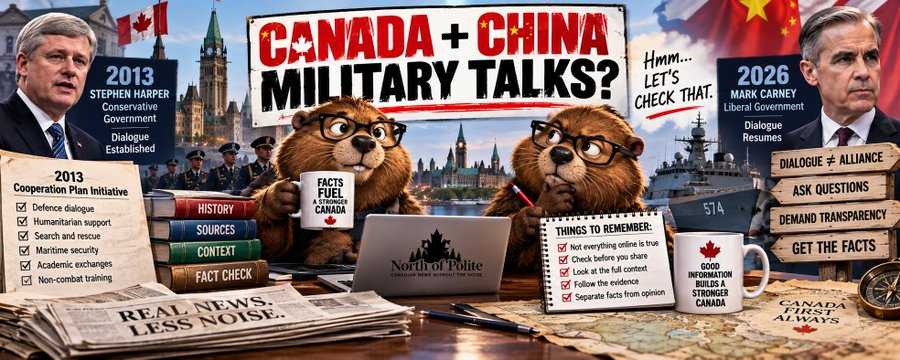
Canada’s formal Defence Coordination Dialogue with China dates back to 2013, when Stephen Harper was prime minister and the Conservative Party of Canada held a majority government.
On June 3, 2013, Conservative defence minister Peter MacKay met Chinese Defence Minister General Chang Wanquan in Beijing.
The Harper government’s own announcement said the two ministers agreed to establish a Defence Coordination Dialogue to exchange views and discuss defence engagement plans.
The announcement went further, saying the two governments intended to establish a Cooperation Plan Initiative between the Canadian Armed Forces and China’s People’s Liberation Army.
Its stated purpose was to strengthen defence and military cooperation.
Later that summer, MacKay’s successor as defence minister, Rob Nicholson, and General Chang signed the Cooperation Plan Initiative in Ottawa.
So whatever Canadians think about renewed military dialogue with China today, one fact needs to be clear:
Mark Carney did not create this framework. It originated under Stephen Harper’s Conservative government.
What Did Canada Agree To?
The 2013 Cooperation Plan Initiative was non-binding. It did not obligate Canada to conduct military activities with China.
According to Canada’s Department of National Defence, the framework supported possible activities including senior-level visits, Defence Coordination Dialogues, humanitarian assistance and disaster response, search and rescue, anti-piracy and maritime security cooperation, academic exchanges and individual or small-unit training in non-combat areas.
Four Defence Coordination Dialogues subsequently took place:
2013 — Canada
2014 — China
2016 — Canada
2018 — China
Canada’s records say its last bilateral military training with China also occurred in 2018.
The September 4 meeting is therefore the fifth dialogue and the first since April 2018.
So What Has Carney’s Government Actually Done?
It has allowed this long-dormant defence dialogue to resume.
And that deserves scrutiny.
China says both sides expressed a willingness to strengthen practical military exchanges and cooperation. Canadians are therefore entitled to ask exactly what kinds of cooperation were discussed and where Ottawa intends to draw the line.
But there is an important difference between talking to another country’s military and forming a military alliance with it.
Nothing in the publicly available account of the September 4 meeting establishes a new defence treaty, military alliance, joint combat exercise, weapons agreement, basing arrangement or intelligence-sharing agreement between Canada and China.
Those are much larger claims, and we have found no evidence supporting them.
Why Talk to China at All?
There is another side to this story that deserves to be included.
Canada’s current defence position is hardly an endorsement of China’s behaviour.
National Defence says it remains concerned about China’s Arctic ambitions, its actions around Taiwan and its militarization of the South China Sea.
At the same time, Canada says maintaining frank dialogue with China’s People’s Liberation Army can reinforce guardrails and reduce the risk of military miscalculation.
Countries do not have to be friends—or even trust one another—to have reasons to keep military communication channels open.
Sometimes the countries with the greatest disagreements have the greatest need to communicate.
The Question Ottawa Still Needs to Answer
Talking to China’s military is not the same thing as partnering with it.
But Canadians are still entitled to know where the guardrails are.
Is this simply a communication channel for discussing regional security and reducing the possibility of military incidents?
Or could Canada eventually resume training, exchanges, port visits or other practical military activities contemplated by the old 2013 framework?
At this point, we have found no public evidence that those activities have resumed.
That distinction matters.
We shouldn’t claim military cooperation exists when the evidence doesn’t establish it.
But Ottawa should also be clear with Canadians about what this renewed dialogue is intended to accomplish—and what forms of military cooperation remain off the table.
North of Polite Verdict
CLAIM: “Canada and China have resumed military-to-military talks.” — TRUE.
CLAIM: “The Carney government has reopened a defence dialogue with China.” — TRUE.
CLAIM: “Carney created Canada-China military cooperation.” — FALSE. The formal framework dates to Stephen Harper’s Conservative government in 2013.
CLAIM: “Canada is entering a military alliance with China.” — NO EVIDENCE FOUND.
China is a major military power, and Canada has serious security disagreements with Beijing. Canadians should scrutinize renewed military contact with China and demand transparency from their government.
But scrutiny requires getting the history and the facts right — even when those facts complicate the political story we might expect to find.
This relationship wasn’t invented by Carney. It began under Harper’s Conservative government, continued for several years, went largely dormant after 2018, and has now resumed at the dialogue level.
That’s where the evidence takes us today.
North of Polite
Check the claim. Read the source. Keep the context.
© 2026 North of Polite. Original reporting, analysis and commentary. All rights reserved. 🍁


Leave a comment