Analysis by North of Polite
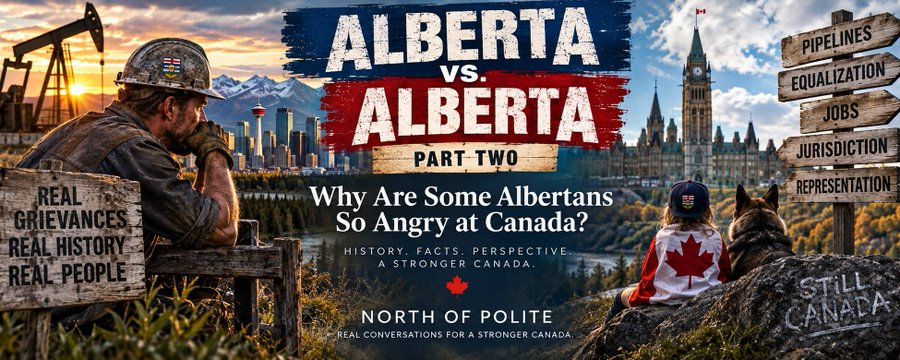
If we’re going to talk seriously about Alberta separatism, we have to start by admitting something:
The anger didn’t come from nowhere.
You don’t have to support separation to understand why some Albertans are angry with Ottawa.
And you don’t have to defend every federal decision to believe Alberta should remain Canadian.
This Argument Is Older Than Justin Trudeau
Western alienation didn’t begin with the current federal government. It didn’t even begin with Pierre Trudeau.
For generations, many Western Canadians believed national economic policies were designed primarily around the interests of Central Canada.
Alberta’s own historical records describe a longstanding sense of political and economic alienation from federal governments thousands of kilometres away.
Then came the event that still hangs over Alberta politics more than four decades later.
Three Letters: NEP
In 1980, Pierre Trudeau’s government introduced the National Energy Program.
The federal government wanted greater Canadian ownership of the petroleum industry, secure domestic energy supplies and a larger federal share of energy revenues.
Albertans saw something very different.
The NEP kept Canadian oil prices below world prices, introduced additional taxes and provided incentives that encouraged some exploration outside Alberta. Alberta viewed it as Ottawa reaching directly into the province’s most important industry.
Jobs and investment disappeared.
Families remembered.
And the NEP became one of the most powerful symbols of Western alienation.
But here’s where North of Polite’s rule applies:
Tell the whole story.
The NEP wasn’t responsible for everything that went wrong.
World oil prices collapsed. Canada entered a recession. Companies carried heavy debt while interest rates were high. Alberta’s own historical account acknowledges those factors too.
So the anger over the NEP has a genuine historical foundation.
The mythology that it single-handedly caused every economic problem Alberta suffered does not.
Then There’s Equalization
Few words produce an argument in Alberta faster.
Alberta receives zero Equalization dollars in 2026–27.
Quebec receives Equalization. Manitoba and the Atlantic provinces receive it too.
But here’s the part that often disappears from political memes:
Alberta doesn’t write Quebec an Equalization cheque.
Equalization is a federal program financed through federal government revenues.
Albertans can legitimately debate whether the formula is fair. They can argue Alberta has contributed disproportionately to federal finances over many years.
But saying “Alberta sends billions of dollars in Equalization to Quebec” isn’t an accurate description of how the program operates.
And Alberta isn’t receiving nothing from Ottawa.
For 2026–27, Alberta is scheduled to receive approximately $9.2 billion in major federal transfers, including about $7.0 billion through the Canada Health Transfer and $2.2 billion through the Canada Social Transfer.
Both facts can be true:
Alberta can contribute enormously to Canada while still receiving substantial federal funding.
What About the Pipelines?
There’s another legitimate grievance buried beneath an overly simple slogan.
Federal environmental and regulatory decisions have created serious conflict with Alberta.
But saying Ottawa simply refuses to let Alberta build pipelines isn’t the whole story either.
The biggest example is Trans Mountain.
The expansion entered service in May 2024 and increased the system’s capacity from roughly 300,000 barrels per day to 890,000.
It dramatically increased Western Canada’s access to Pacific export markets.
And there’s an awkward fact for anyone claiming Ottawa has always tried to prevent Alberta oil from reaching market:
The federal government bought Trans Mountain.
That doesn’t erase other pipeline battles.
It simply means the history is more complicated than the slogan.
So Why Are Some Albertans Angry?
Because underneath the memes and political rhetoric are real memories.
Real constitutional battles.
Real economic shocks.
Real disagreements over who should control natural resources.
And a genuine feeling among some Albertans that decisions affecting their livelihoods are too often made far away by governments they didn’t elect.
Those feelings shouldn’t be mocked.
But they shouldn’t be manipulated either.
Because there’s an enormous difference between saying:
“Canada has sometimes treated Alberta unfairly.”
and saying:
“Therefore Alberta would be better off outside Canada.”
The first is an argument we can examine against history.
The second requires an entirely different set of evidence.
And that’s where this series is going.
Because before Albertans decide whether Canada has failed Alberta, we should probably understand something else first:
There isn’t just one Alberta.
NEXT: Part Three — Two Albertas: The Divide That Existed Long Before Separatism
We’ll look at the political and cultural divisions inside Alberta itself—from north and south to rural and urban, Calgary and Edmonton—and ask whether today’s separatist debate is really Alberta versus Canada…
or another chapter in Alberta’s long argument with itself.
North of Polite
We show you the evidence. You decide what to believe.
© 2026 North of Polite. Original reporting, analysis and commentary. All rights reserved. 🍁


Leave a comment