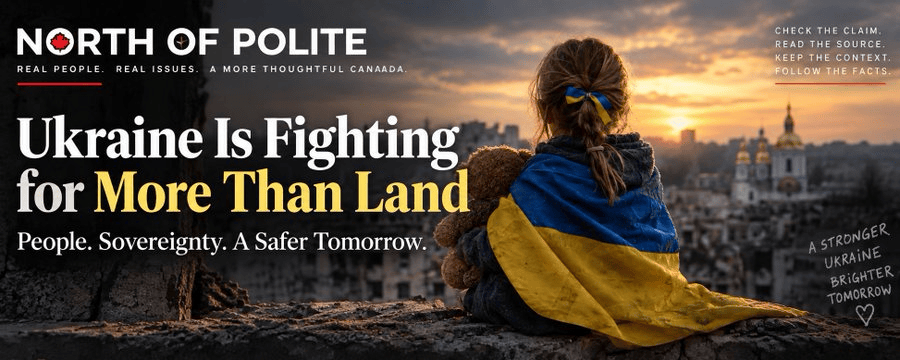
Russia’s war against Ukraine is often described as a war over territory.
It is.
But that description is no longer enough.
More than four years after Russia launched its full-scale invasion, the evidence tells a much larger story: civilians killed and displaced, prisoners tortured, children transferred from their homeland, Ukrainian identity suppressed under occupation, and an increasingly international conflict sustained by countries far beyond Russia and Ukraine.
Now, as the United States again sends representatives to negotiate with Vladimir Putin, another question hangs over everything:
Who gets to decide what peace looks like—and what Ukrainians will be required to live with when the negotiations are over?
A Note From North of Polite
I was in Ukraine during the opening period of Russia’s full-scale invasion. I saw some of what Ukrainians were experiencing firsthand.
That experience inevitably affects how I view this war.
For precisely that reason, the factual claims in this article have been checked against independent and primary sources rather than relying on my experience alone.
What Has Happened to Ukrainians?
We do not need wartime propaganda to establish that grave abuses have occurred.
International investigators have documented torture, unlawful killings, sexual violence, enforced disappearances, arbitrary detention and other serious violations committed by Russian authorities and forces.
The UN Independent International Commission of Inquiry on Ukraine has found Russian authorities’ use of torture to be widespread and systematic and has concluded that documented conduct amounted to war crimes and crimes against humanity.
The treatment of Ukrainian children is particularly disturbing.
In March 2023, the International Criminal Court issued arrest warrants for Russian President Vladimir Putin and Russia’s Commissioner for Children’s Rights, Maria Lvova-Belova. ICC judges found reasonable grounds to believe they bear responsibility for the alleged war crimes of unlawful deportation and unlawful transfer of Ukrainian children from occupied areas of Ukraine.
The legal language matters.
Putin has not been convicted by the ICC.
An arrest warrant is not a conviction.
But neither should the seriousness of the allegations behind that warrant be minimized.
This War Is About More Than Territory
The evidence from Russian-occupied Ukraine shows why describing this purely as a border dispute misses something fundamental.
International investigators and human-rights monitors have documented Russian authorities imposing Russian laws, administrative systems, citizenship and education while restricting Ukrainian language, culture, political expression and identity.
Ukrainian children in occupied areas have been exposed to Russian curricula and programs intended to integrate them into Russian political and cultural life.
Residents have faced pressure to obtain Russian passports, with access to employment, health care, social services and freedom of movement affected in some circumstances.
This is about much more than where someone draws a line on a map.
The documented occupation policies show an effort to subordinate Ukrainian political, civic and cultural life in territory Russia controls.
We cannot claim to know every ultimate intention inside Vladimir Putin’s mind.
We don’t need to.
We can examine what Russian authorities have actually done.
Ukrainians Are Still Dying
These are not merely crimes and tragedies from the opening months of 2022.
The war is killing civilians today.
In July 2026 alone, the United Nations verified at least 437 civilians killed and 2,610 injured in Ukraine. The number killed was the highest in a single month since May 2022.
Long-range missiles and drones were the leading cause of civilian casualties. The UN also warns that increasingly limited information from occupied territory makes verification difficult and that the actual number of casualties there is likely significantly higher.
Then came September 8.
Following a temporary halt in attacks on Kyiv and Moscow during the American envoys’ visit, Russia resumed attacks on the Ukrainian capital.
According to Ukrainian authorities cited by Reuters, five people were killed and nearly 30 injured. Residential buildings, a school, a clinic and other sites were damaged.
Russia said its intended targets were military and logistical facilities.
Civilian casualties alone do not automatically establish that an individual attack constitutes a war crime. International humanitarian law examines matters including the target, distinction between civilian and military objects, proportionality and precautions.
Documented atrocities are serious enough without declaring every battlefield allegation legally proven before investigation.
Russia Is Not Fighting Alone
Russia launched the full-scale invasion.
But Russia has not sustained this war entirely by itself.
North Korea has supplied enormous quantities of artillery ammunition and ballistic missiles and has gone further by deploying troops in support of Russia.
Iran has supplied direct military assistance, most notably attack drones.
Belarus allowed its territory to be used for Russia’s invasion and has provided infrastructure and other support to Moscow.
China’s role is different and should not be misrepresented.
China has not deployed combat forces comparable to North Korea’s. NATO and Western governments instead accuse Beijing of helping sustain Russia’s defence-industrial base through dual-use goods, components and industrial support.
Those distinctions matter. These countries should not simply be thrown into one category and described as though they have all done the same thing.
But together they demonstrate something important:
Russia’s ability to sustain this war has an international dimension.
Ukraine Isn’t Fighting Alone Either
Neither is Ukraine.
The United States, Canada, the United Kingdom, Germany, Poland, other European countries and partners around the world have provided weapons, ammunition, air defence, training, intelligence, humanitarian assistance and enormous financial support.
There is an important distinction between the foreign assistance received by the two sides.
Russia crossed Ukraine’s internationally recognized borders and launched the full-scale invasion. Ukraine’s partners are assisting a country defending itself against that invasion.
There are legitimate debates about Western strategy, individual weapons transfers, the cost and duration of assistance and how this war should end.
Those debates should happen.
But the underlying circumstances of the two sides receiving foreign assistance are not interchangeable.
Britain has become one of Ukraine’s most important military supporters. The UK government reports £16 billion in military support since the full-scale invasion and says more than 63,000 Ukrainian personnel have been trained in Britain.
Germany has also become a major military supporter and continues to provide critical air-defence assistance.
Germany, Britain and other European partners remain directly involved in discussions about Ukraine’s security and any eventual settlement.
And then there is Poland.
Poland Opened Its Door
Poland’s contribution cannot be measured only in tanks, aircraft or złoty.
When Ukrainians began pouring across the border in 2022, ordinary Polish citizens met them.
Families opened their homes.
Volunteers provided food, clothing and transportation.
Communities helped strangers who arrived carrying children, bags and whatever pieces of their lives they could bring with them.
Poland also became one of Ukraine’s crucial military and logistical supporters, providing weapons and ammunition, training Ukrainian personnel and serving as a gateway through which enormous quantities of assistance travelled toward Ukraine.
More than four years later, 961,170 people who fled Ukraine remained under temporary protection in Poland as of June 30, 2026.
But Poland was not alone.
Millions Opened Their Homes and Their Hearts
Across Europe and far beyond it, governments, communities and ordinary people responded to one of the largest movements of displaced people Europe has experienced in generations.
Families hosted strangers.
Volunteers collected food, clothing and medicine.
Children entered unfamiliar schools.
Communities helped people rebuild pieces of lives interrupted by war.
Countries far from Ukraine—including Canada—welcomed Ukrainians seeking safety thousands of kilometres from their homes.
As of June 30, 4.41 million people who fled Ukraine remained under temporary protection in the European Union alone. Germany hosted approximately 1.29 million, Poland 961,170 and Czechia about 391,000.
Governments provided weapons, money and diplomacy.
Ordinary people provided bedrooms, meals, rides, clothing, schools for children and somewhere safe to sleep.
Governments make foreign policy.
People decide what humanity looks like when frightened families arrive at their door.
Now Come Witkoff and Kushner
Against this background, the Trump administration has renewed its attempt at diplomacy.
President Donald Trump sent Steve Witkoff and Jared Kushner to Moscow, where they held more than three hours of talks with Vladimir Putin on September 5.
They then travelled to Kyiv and met Ukrainian President Volodymyr Zelenskyy.
There was no breakthrough.
On September 8, Zelenskyy said the American envoys had brought forward some worthwhile ideas and that Ukraine was prepared to continue working on them with the United States and European partners.
But Ukraine and Russia remain far apart.
At the centre of that disagreement is territory in eastern Ukraine.
Russia claims Ukrainian territory that its military has still not completely captured. Ukraine continues to reject demands that it surrender Ukrainian-held territory simply because Moscow claims it.
That means something extraordinary is potentially being discussed across a negotiating table:
Part of what Russia seeks through negotiation is territory its military has failed to take completely by force.
And that raises a difficult question:
Are these negotiations intended to produce a peace Ukrainians can live with—or the fastest agreement Washington and Moscow can obtain?
Those are not necessarily the same thing.
Trump, Putin and Alaska
Trump’s willingness to engage directly with senior Russian officials stretches back to his first presidency.
But the episode most relevant to Ukraine occurred on August 15, 2025, when Trump welcomed Vladimir Putin to Alaska for negotiations over the war.
Putin entered American territory while subject to the ICC arrest warrant concerning the alleged unlawful deportation and transfer of Ukrainian children.
There is an important legal qualification.
The United States is not a party to the Rome Statute.
It therefore was not operating under the same Rome Statute treaty obligation to arrest and surrender Putin that applies to ICC member states.
Trump did not violate an American ICC treaty obligation merely by allowing Putin into Alaska.
But legality does not answer the political or moral question.
A Russian president subject to an International Criminal Court arrest warrant over alleged crimes involving Ukrainian children was welcomed onto American soil for presidential diplomacy.
The summit produced no ceasefire or peace agreement.
Now Washington is engaging Putin again.
On September 8, Trump and Putin spoke by telephone. According to the Kremlin’s account, Trump expressed a desire to end the war quickly and restore broader political and economic relations between the United States and Russia afterward.
That attribution is important. We do not have an independently verified transcript establishing the Kremlin’s description of Trump’s words as fact.
None of this proves Trump intends to sacrifice Ukraine.
But it makes one question unavoidable:
What is Ukraine being asked to give up in exchange for peace?
Peace—But at What Price?
Ending this war would save lives.
That matters enormously.
Diplomacy frequently requires negotiating with adversaries. Eventually, diplomacy may be the mechanism that ends this war.
But stopping the shooting and achieving a durable, just peace are not automatically the same thing.
If Ukraine is pressured to surrender territory Russia has failed to conquer, what happens to Ukrainians living there?
What happens to their citizenship, political rights, education, language and national identity?
What security arrangement prevents another invasion after Russia has rebuilt its forces?
And what lesson does another powerful government, somewhere else in the world, take from the outcome?
For those who have watched this war through television screens, Ukraine can become maps, arrows, casualty numbers and negotiating positions.
For the people who have lived through it, it is homes, families, missing children, funerals and lives that cannot simply be redrawn on somebody else’s negotiating map.
Is Ukraine Defending Something Larger?
Ukraine is unquestionably fighting for its own survival, sovereignty and territory.
But this war may also have become a test of something larger:
Can a sovereign country choose its own government, alliances and national future—or can a more powerful neighbour eventually overturn those choices through invasion, occupation and attrition?
That question reaches far beyond Ukraine.
It reaches Poland, Germany, Britain and the rest of Europe.
It reaches Canada and the United States.
And it reaches governments elsewhere watching what the international community ultimately accepts.
This does not mean democratic countries must support every decision made by Ukraine indefinitely or without scrutiny.
It does not mean diplomacy is betrayal.
And questioning Western strategy does not make someone pro-Russian.
It means the eventual peace deserves to be judged not only by whether the guns become quiet, but also by what precedent that peace leaves behind.
If invasion, occupation and years of attrition ultimately produce internationally accepted territorial rewards, other governments will notice.
North of Polite’s Bottom Line
Russia launched the full-scale invasion of Ukraine.
International investigators have documented grave abuses by Russian authorities and forces, including conduct determined in documented cases to constitute war crimes and crimes against humanity.
The International Criminal Court has issued an arrest warrant for Vladimir Putin. He has not been convicted, and we will not pretend otherwise.
Russian occupation has involved far more than moving a border. It has affected Ukrainian government, citizenship, education, culture and fundamental rights.
Russia has received substantial foreign assistance.
Ukraine has survived in large part because other countries have helped it resist.
And millions of ordinary people responded to Ukrainians fleeing war not with weapons or speeches, but with food, clothing, transportation and places to live.
Now diplomacy has returned to centre stage.
Perhaps diplomacy will ultimately end this terrible war.
It should.
But Ukrainians—not Washington, Moscow or anyone else—will have to live with whatever that peace leaves behind.
Peace matters. But peace cannot simply mean that the shooting stops after aggression has been rewarded and the people who were invaded lose the right to determine their own future.
This war is about territory.
It is about human beings.
It is about sovereignty.
And perhaps, ultimately, it is about whether the democratic principle that people have the right to determine their country’s future can survive when a more powerful neighbour decides otherwise.
The final question is not simply where the border will be.
It is whether force gets the final word.
North of Polite — Check the claim. Read the source. Keep the context. Follow the facts.
Unapologetically Canadian. We stand for a strong, sovereign and united Canada. No party owns our loyalty. If you make a claim, bring the receipts. We will too.


Leave a comment